Lesson Eighty four Ventricular arrhythmias originating from papillary muscles in the right ventricle
2018-08-13童鸿
Patient characteristics
Patients in this study consisted of eight consecutive patients with frequent premature ventricular complexes(PVCs)or both PVCs and ventricular tachycardia(VT)who had been referred for catheter ablation and whose arrhythmia was mapped to one of the right ventricular(RV)papillary muscles (PAPs).The control group consisted of 10 consecutive patients who were referred for ablation of symptomatic idiopathic arrhythmias originating in the right ventricle.Patients with RV PAP arrhythmias were predominantly men (seven of eight),while patients in the control group were all women(10/10).Four patients in the RV PAP group and one patient in the control group had an impaired left ventricular function before the procedure.Mean right ventricular ejection fraction was 0.53%±0.08%in the PAP group and 0.57%±0.10%in the control group.MRI did not reveal evidence of right ventricular dysplasia in any of the patients.One patient in the study group had nonsustained VT provoked by ventricular burst pacing,and four patients had inducible VT with burst pacing.Isoproterenol triggered nonsustained VT in one patient and increased the PVC frequency in two patients.In the control group,three of 10 patients had nonsustained VT triggered by isoproterenol infusion.During VT,entrainment could not be demonstrated.
Twelve-lead electrocardiogram
Twelve-lead electrocardiograms(ECGs)of the PVCs and VTs were analyzed for bundle branch block morphology,axis,QRS width,presence of notching in V1to V6(Figure 1),R-wave pattern in V1(rS,QS),and the transition point from predominantly negative S-wave to predominantly positive R-wave deflection in the precordium.An early transition was defined as transition in lead V4or earlier (Figure 1,left panel),and late transition was defined as a transition in V5or V6(Figure 1,right panel).Notches were defined as deflections in the QRS complex aside from1a triphasic pattern(Figure 1).
Pleomorphic PVCs were present in three of the eight RV PAP patients and in three of 10 patients in the control group.A total of 15 VAs were mapped to the RV PAPs.All RV PAP arrhythmias had an rS or QS pattern in lead V1and displayed a left bundle branch block morphology.The mean QRS width during ventricular ectopy was greater in the PAP group(163±21 ms)than in the control group(141±22 ms).In the PAP group,10 PVC morphologies had an inferior axis,and five had a superior axis.In the control group,all arrhythmias had an inferior axis.Notching in the precordial leads was present in 11 of 15 PVC morphologies in the RV PAP group and in five of 13 PVC morphologies in the control group.Late precordial transition (>V4)was present in patients with posterior or anterior RV PAP arrhythmias.This corresponds to the more apical insertion of both anterior and posterior papillary muscles. Early precordial transition(≤V4)and an inferior axis occurred more often in arrhythmias originating in the septal RV PAP owing to2the more basal insertion of the septal papillary muscle.
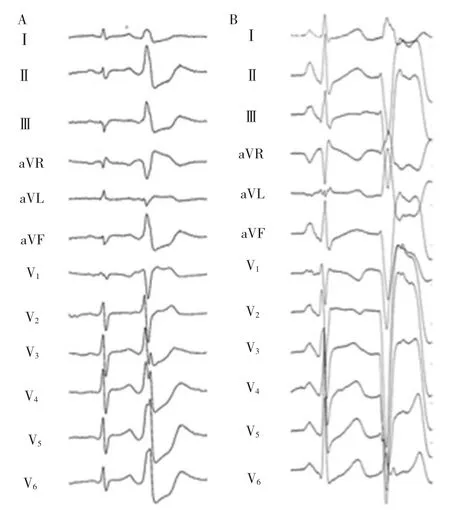
Figure1 A:A 12-lead ECG of PVCs originating in a septal papillary muscle.Note the inferior axis,the early transition in lead V3,and the presence of notching.B:A 12-lead ECG of frequent PVCs originating in a posterior PAP.Note the superior axis and the late precordial transition in V5.
Mapping and Ablation(Figures 2 and 3)
Severalmultipolar electrode catheters were introduced into the right ventricle,right atrium,and His position.Programmed right ventricular stimulation was performed using up to four extrastimuli to assess for inducible VT.Programmed stimulation was repeated during infusion of isoproterenol at 2-20 μg/min.An electroanatomical mapping system(CARTO)was used to guide mapping.Activation mapping was performed during ventricular ectopy or VT.In the setting of infrequent ventricular ectopy,pace mapping was used to identify the site of origin.
Radiofrequency energy wasdelivered via a 4-mm-tip catheter or a 3.5-mm-tip irrigated-tip catheter at sites with the earliest endocardial activation during the VA and/or at matching pace-mapping sites.Radiofrequency energy was delivered in a temperaturecontrolled mode with a target temperature of 55℃at a power of≤50 W.With the irrigated-tip catheter,radiofrequency energy was applied at a power of 30-35 W and a maximal temperature of 45℃.Programmed ventricular stimulation with and without isoproterenol infusion was repeated at the end of the procedure.

Figure 2 A:Site of origin of a PVC originating in a posterior papillary muscle.A Purkinje potential is present during sinus rhythm(arrow).The endocardial activation time was-20 ms at the successful ablation site.B:Site of origin of a papillary muscle PVC without a recorded Purkinje potential.
The earliest endocardial activation time during VT orPVCswas23±8msbeforetheQRScomplexintheRV PAP patients and 28±4 ms in the control group.At the site of origin,there were matching pace maps compared with the targeted arrhythmia in the PAP group(a pace-mapmatchofatleast11/12leadswasfoundineight ofeightpatients)andinthenon-PAPgroup(apace-map matchofatleast11/12 leadswasfound in 10/10 patients).The site of origin of the arrhythmia was mapped to the right posterior papillary muscle (n=3),the anterior papillary muscle(n=4),or the septal muscle(n=8).A Purkinje potential at the effective ablation site was identified in two of eight patients in the RV PAP group andinnoneofthecontrolpatients.Themeanamplitudeof the ventricular electrogram at the site of origin of the arrhythmia during sinus rhythm was 2.1±1.4 mV in the RV PAPgroup and 2.9±2.4 mV in the control group.The mean power achieved was similar in the two groups,30.5±8.4 W and 30.4±5.8 W in the PAP and RVOT patients,respectively.The mean temperatures achieved during ablation were 35.5±7.3℃and 35.3±1.6℃in the PAP and RVOT groups and did not differ significantly.The mean impedance was higher in the PAP group(100.9±11.5 ohms)than in the control group (86.6±9.3ohms).Themeanablationtimewas8.9±2.3minutesin patients with single morphology papillary muscle ectopy and 16.9±9.1minutes in patients with two or more right papillary PVC/VT morphologies.The procedure time was longer in the PAP group as compared with in the control group(277±49vs.203±67minutes,respectively).
Real-time imaging
Intracardiac echocardiography was used during the procedures to identify the papillary muscles and to confirm catheter contact with the papillary muscle.Using intracardiac ultrasound the distinction of the site of origin was made between the septal PAP(insertion on the septum)and the anterior or posterior PAP(inserting in the RV free wall or apex).
Right-sided papillary muscle and arrhythmias
Prior studies described VAs originating in thepapillary muscles of the LV in patients with and without prior myocardial infarction.This study demonstrates that VAs also can arise in a RV PAP.Intracardiac echocardiography helped to identify the site of origin of arrhythmias originating from the right ventricle.Similar to arrhythmias originating from left-sided papillary muscles,adequate contact of the ablation catheter with the papillary muscle is important to assure a successful ablation.Structural abnormalities are often observed in patients with left-sided PAP arrhythmias.Scarring was occasionally observed even in the absence of prior myocardial infarction.

Figure 3 Schema of the right ventricle and the origin of PAP-related arrhythmias.
None of the patients in this series showed evidence of delayed enhancement on the preprocedural MRI.However,for the nulling of the MR signal,the signal from the healthy LV myocardium was used and right-sided abnormalities might have been missed owing to lower inversion times.The presence of a lower ejection fraction in half of the PAP patients,despite a similar baseline PVC burden in the control group,is intriguing butmighthave occurred by chance.Consistent with prior reports in patients with reduced ejection fraction and a high burden of PVCs,the LV ejection fraction improved after ablation in all patients with a reduced LV ejection fraction in this study.
Mechanism
RV PAP arrhythmias were not inducible by programmed atrial or ventricular stimulation.Sustained VT,if inducible,was provoked by isoproterenol or burst pacing,suggesting that the underlying mechanism is triggered activity.This is consistent with prior reports in patients with left-sided papillary muscle arrhythmias without prior infarction.Furthermore,VT could not be entrained or terminated by overdrive pacing,also supportingautomaticityinstead ofreentryasthe mechanism.Two of the eight patients in our study had a Purkinje potential at the successful site of ablation at the base of a papillary muscle,suggesting that the Purkinje fiber system might be involved in the arrhythmogenic substrate similar to left-sided papillary muscle arrhythmias.Failure to identify a Purkinje potential in the majority of the patients does not prove the absence of involvement of the Purkinje fiber system but may reflect the difficulty in achieving good contact with the arrhythmogenic papillary muscle.
词 汇
provoke v.对...挑衅,激起,诱导
isoproterenol n.异丙肾上腺素
ectopy n.异位
insertion n.插入,插入物,嵌饰
multipolar adj.多极的
extrastimuli n.期外刺激
impedance n.阻抗
distinction n.区分,荣誉,不同点,差别
scar n.&v.疤痕,疤,斑疤,痕,岩礁,创伤;结疤
null n.&v.零,零位;使...无效
inversion n.反向,倒转物,倒装
intrigue n.&v.阴谋,情节,私通;耍阴谋,吸引,使...困惑,私通
burden n.要旨,重负,载重吨,重担,低声部,负担
automaticity n.自动性
arrhythmogenic adj.致心律失常的
注 释
1.aside from指“除…之外,偏离,暂置不论”,常置于句首,如Aside from their scavenger function,macrophages also possess destabilizing and thrombogenic properties。除了清除功能外,巨噬细胞也有引发不稳定和促进血栓形成特性。
2.owing to指“由于……”,医学文献中常用,特别强调因果关系或内在联系,可置于句首、句中或句尾,如Owing to the different release kinetics of cTnI and cTnT,the magnitude of rise or fall in the level of these proteins has to be established for every cTn assay individually。由于cTnI和cTnT的不同释放动力学,每个cTn试剂盒都必须确立这些蛋白浓度升高或下降的量值。
参考译文
第84课 右心室乳头肌起源室性心律失常
患者特征
研究对象(PAP组)系因频发室性期前收缩(PVC)或PVC合并室性心动过速而来行射频导管消融手术(下称消融),同时标测到心律失常起源于右心室乳头肌(PAP)的8例连续患者。对照组为因右心室起源特发性心律失常来行消融的连续10例症状性患者。右心室PAP心律失常患者多为男性(7/8),而对照组全为女性(10/10)。术前右心室PAP组中4例和对照组中1例存在左心室功能障碍。PAP组平均射血分数(0.53±0.08)%,对照组为(0.57±0.10)%。所有患者 MRI均无右心室发育不良迹象。研究组心室猝发起搏诱发非持续性室性心动过速(VT)1例,猝发起搏诱发可诱发性VT 4例。异丙肾上腺素促发非持续性VT 1例,增加PVC频率2例。对照组10例中的3例滴注异丙肾上腺素促发非持续性VT。VT时不能拖带。
12导联心电图
对PVC和VT的12导联心电图的束支传导阻滞图形,心电轴,QRS 宽度,V1~V6导联的切迹(图 1),V1的 R 波形态(Rs,QS)以及胸导联从负向S波为主转为正向R波为主的移行点进行分析。