健康干预对糖尿病合并脑卒中患者自我管理能力的影响
2018-01-18徐群美
徐群美
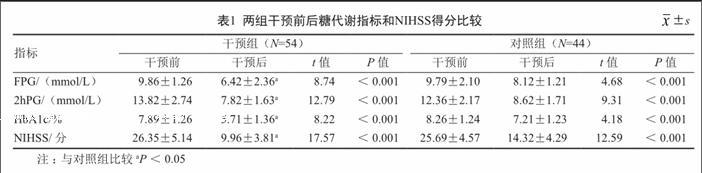
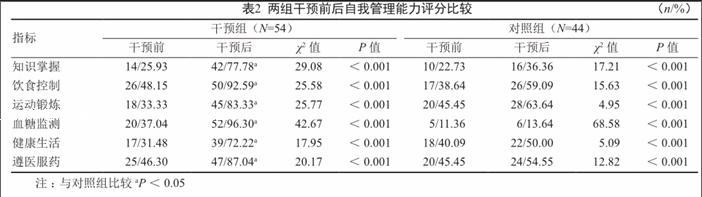
摘 要 目的:观察健康教育和行为干预对糖尿病合并脑卒中患者自我管理能力的影响。方法:收集2016年5月至2017年5月在本中心接受治疗的98例糖尿病合并脑卒中患者临床资料,分为对照组44例,平均年龄(64.11±4.96)岁;干预组54例,平均年龄(62.13±2.34)岁。对照组行常规干预,干预组行健康教育和行为干预,比较两组间的糖代谢指标及自我管理能力。结果:干预组空腹血糖、餐后2 h血糖、糖化血红蛋白、NIHSS得分以及自我管理能力评分改善均比对照组明显(P<0.05)。结论:健康教育和行为干预能提高糖尿病并脑卒中患者的自我管理能力。
关键词 健康教育;行为干预;糖尿病合并脑卒中;自我管理能力
中图分类号:R587.1 文献标志码:A 文章编号:1006-1533(2017)24-0060-03
Influence of health intervention on self-management ability in patients with diabetes mellitus complicated with stroke
XU Qunmei
(Pengpu Community Health Service Center of Jingan District, Shanghai 200435, China)
ABSTRACT Objective: To observe the influence of health education and behavior intervention on self-management ability of diabetic patients with stroke. Methods: The clinical data of 98 patients with diabetes mellitus complicated with stroke treated in our center from May 2016 to May 2017 were collected and divided into a control group with 44 cases, with an average age (64.11±4.96) years and an intervention group with 54 cases, with an average age (62.13±2.34) years. The control group received routine intervention and the intervention group was given health education and behavior intervention. The indexes of glucose metabolism and self-management ability between the two groups were compared. Results: The fasting blood glucose, postprandial 2 h blood glucose, glycosylated hemoglobin, NIHSS score and self-management ability score of the intervention group were significantly better than those of the control group(P<0.05). Conclusion: Health education and behavior intervention can improve the self-management ability of patients with diabetes mellitus complicated with stroke.
KEY WORDS health education; behavior intervention; diabetes complicated with stroke; self-management ability
糖尿病合并腦卒中患者病情复杂,故临床需加强糖尿病的防治,提高患者自我保健及管理能力,以控制血糖稳定[1]。本文旨在探索健康教育和行为干预对糖尿病合并脑卒中患者的自我管理能力的影响。
1 资料与方法
1.1 一般资料
收集2016年5月至2017年5月在本中心接受治疗的98例糖尿病合并脑卒中患者临床资料,分为干预组(54例)和对照组(44例),干预组中男性28例,女性26例,年龄52~72岁,平均年龄(62.13±2.34)岁,糖尿病病程3~10年,平均病程(5.36±0.47)年;对照组中男性24例,女性20例,年龄55~76岁,平均年龄(64.11±4.96)岁,糖尿病病程4~11年,平均病程(6.14±0.32)年;两组基础资料的差异无统计学意义(P>0.05)。
1.2 方法
对照组行常规干预,内容包括定期监测血糖水平,指导患者用药,合理安排饮食,嘱患者适当运动。干预组行健康教育,并辅以行为改变指导,内容包括(1)心理疏导:耐心疏导患者心理,客观介绍糖尿病疾病知识及防治方法,纠正患者认知,劝导患者保持愉快心情,积极面对疾病。(……
