基于线粒体DNA COⅠ基因鉴别畜禽肉中鸡源性成分
2017-11-16唐修君樊艳凤葛庆联贾晓旭张静刘茵茵张小燕王珏高玉时
唐修君+樊艳凤+葛庆联+贾晓旭+张静+刘茵茵+张小燕+王珏+高玉时
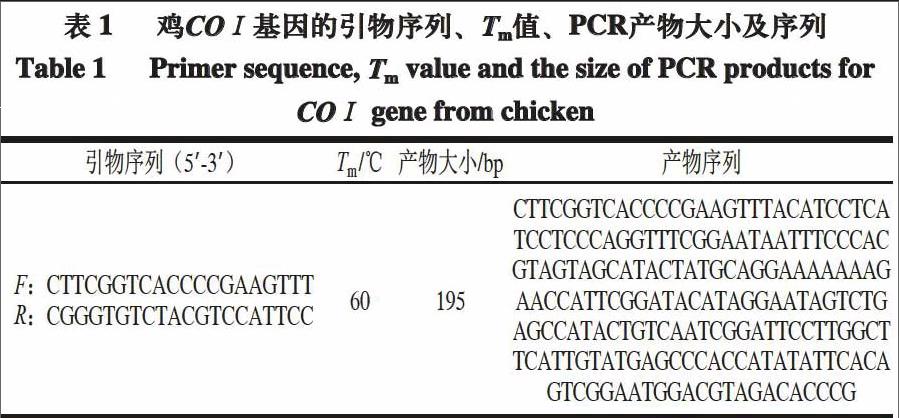
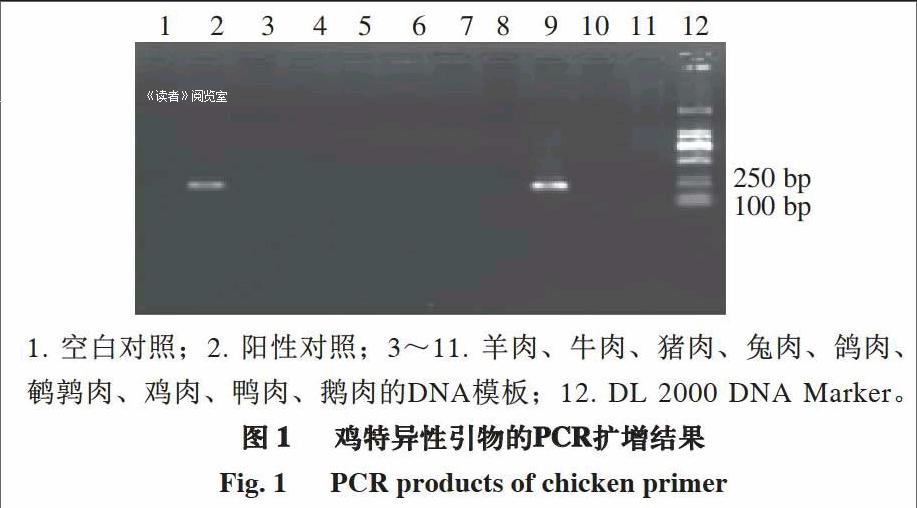

摘 要:为建立畜禽肉中鸡源性成分的快速检测方法,以线粒体DNA细胞色素C氧化酶亚基Ⅰ(COⅠ)基因序列为靶点,比较羊、牛、猪、兔、鸽、鹌鹑、鸡、鸭、鹅9 种动物COⅠ基因的差异位点,设计筛选鸡特异性引物,进行常规聚合酶链式反应(polymerase chain reaction,PCR)和荧光定量PCR检测。结果表明:所设计的引物仅对鸡肉DNA模板有扩增条带和典型扩增曲线,且循环阈(cycle threshold,Ct)值为21.78,对其他动物DNA模板无扩增。方法特异性较强,灵敏度较高,达pg级,可以用于畜禽肉与肉制品中鸡源性成分的快速、有效、準确检测。
关键词:鸡源性成分;线粒体DNA;COⅠ基因;荧光定量PCR
Identification of Chicken Origin Ingredients in Livestock and Poultry Meat Based on Mitochondrial DNA COI Gene
TANG Xiujun, FAN Yanfeng, GE Qinglian, JIA Xiaoxu, ZHANF Jing, LIU Yinyin, ZHANG Xiaoyan, WANG Jue, GAO Yushi*
(Institute of Poultry, Chinese Academy of Agricultural Sciences, Yangzhou 225125, China)
Abstract: In this study, a quick method to identify ingredients of chicken origin in livestock and poultry meat was developed by polymerase chain reaction (PCR) and fluorescence quantitative PCR using mitochondrial DNA cytochrome C coxidase subunit Ⅰ (CO Ⅰ) gene as target gene. The mitochondrial DNA CO Ⅰ genes from chicken, duck, goose, pig, cattle, sheep, rabbit, pigeon and quail revealed distinct loci. Based on this, a set of chicken-specific primers was designed. The results showed that the designed primers could only amplify template DNA from chicken with a cycle threshold (Ct) value of 21.78. The PCR assay had a high specificity and sensitivity (at pg level) and it could be used to detect ingredients of chicken origin in livestock and poultry meat quickly and accurately.
Key words: chicken origin ingredients; mitochondrial DNA; cytochrome C coxidase subunit I (CO I) gene; fluorescence quantitative PCR
DOI:10.7506/rlyj1001-8123-201708009
中图分类号:TS207.3 文献标志码:A 文章编号:1001-8123(2017)08-0044-05
作为人类重要的营养来源,肉类与人们的生活和健康密切相关,然而在利益驱动下肉制品掺杂、掺假事件时有发生,“挂鹅头卖鸭肉”、非法使用添加剂牛肉膏等食品安全事件不断出现,严重侵害了消费者的权益。肉类来源鉴别的传统方法是依靠感官评价和肉类形态学手段,但这些已远不能满足监管部门对肉制品掺杂、掺假现象的监控,因此加强肉类产品中动物源性成分的检测技术研究意义重大。
随着分子生物学技术的不断发展,以DNA为基础的聚合酶链式反应(polymerase chain reaction,PCR)技术以其独特的优势被越来越多地应用于畜禽肉源性成分的鉴别,并已逐步成为肉类产品中动物源性成分鉴定的核心方法[1-4]。近年来,实时荧光定量PCR技术凭借其特异性良好、自动化程度高、检测周期短以及扩增目的片段较小等优势在动物源性成分鉴别中成为研究热点,极大地提高了动物源性成分定性检测的效率和灵敏度[5-6]。……
