肾移植患者心理整合情况的临床调查
2017-05-31周琴飞张亚林
周琴飞+张亚林

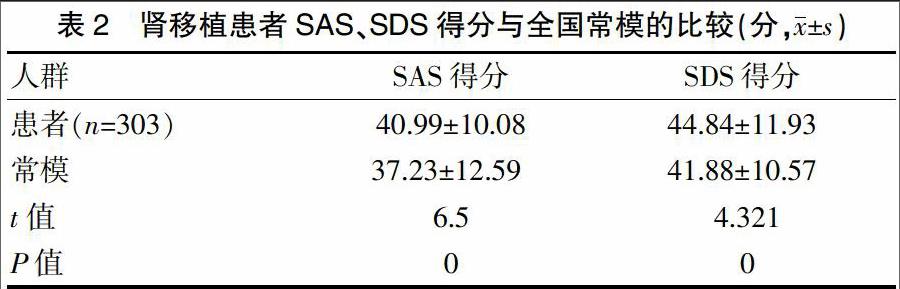

[摘要]目的 通過调查肾移植术后患者焦虑、抑郁等心理状态及心理整合情况,分析肾移植术后患者的心理体验。方法 纳入2012年5~9月在中南大学三所附属医院就诊的303例肾移植术后患者,采用定式问卷,包括基本情况表、焦虑自评量表(SAS)、抑郁自评量表(SDS)和心理整合情况表,调查肾移植患者的心理整合情况现状及与心理状态的相关性。结果 肾移植患者的SAS得分为(40.99±10.08)分,SDS得分为(44.84±11.93)分,均高于常模[(37.23±12.59)、(41.88±10.57)分](P=0.000);绝大部分(84.2%)肾移植患者认为移植的肾脏已成为自己身体的一部分,而仍有患者不确定(11.5%),甚至有些患者(21.8%)认为移植的肾脏是体内异物。将心理整合情况进行因子分析,提取出两个因子——器官整合及与供者关系。相关性分析显示,器官整合、与供者关系均与SAS、SDS得分显著相关(P<0.05)。结论 大多数肾移植患者的心理整合情况良好,但仍有一部分患者心理整合过程持续存在异常,临床上应早期鉴别心理整合出现问题的患者,及时介入干预,以改善患者的心理状态,提高其生存质量。
[关键词]肾移植;心理整合;焦虑;抑郁
[中图分类号] R318.16 [文献标识码] A [文章编号] 1674-4721(2016)12(a)-0007-04
Clinical investigation of psychological integration in patients with kidney transplantation
ZHOU Qin-fei1 ZHANG Ya-lin2
1.Department of General Medicine,Zhejiang Cancer Hospital,Hangzhou 310022,China;2.Department of Mental Health,the Second Hospital of Xiangya in Central South University of Hunan Province,Changsha 410011,China
[Abstract]Objective To investigate the anxiety and depression of psychological state and so on and psychological integration status of patients after kidney transplantation,and analyze the psychological experience of patients after kidney transplantation.Methods 303 cases after kidney transplantation treated by three affiliated hospitals of Central South University from May to September 2012 were included.Formulary questionnaire including basic information table,self-rating anxiety scale (SAS),self-rating depression scale (SDS) and psychological integration scale were used to investigate the psychological integration of patients after kidney transplantation and the correlation between psychological integration and psychological state.Results SAS score of patients with kidney transplantation was (40.99±10.08) points,SDS score was (44.84±11.93) points,and SAS and SDS score were higher than those of the norm [(37.23±12.59) points,(41.88±10.57) points] (P=0.000).The vast majority (84.2%) of patients with kidney transplant believed that the transplanted kidney had become a part of the body,but still a small part of the patients (11.5%) were not sure even some patients (21.8%) thought that the kidney transplanted were still a foreign body.Factor analysis of psychological integration was conducted and two factors extracted—organ integration and the relationship with donor.Correlation analysis showed that organ integration and the relationship with donor were significantly correlated with SAS and SDS score (P<0.05).Conclusion Most of patients with kidney transplant have good psychological integration,but there is still a part of patients with persistent abnormal psychological integration process,early identification of psychological integration problems of patients and timely intervention can improve the psychological status and quality of life of patients with kidney transplantation.
[Key words]Kidney transplantation;Psychological integration;Anxiety;Depression
终末期肾病指各种慢性肾脏疾病的终末阶段,而肾移植已经成为终末期肾病治疗的最佳选择。国外众多研究发现移植患者对自身疾病及移植器官的感知可能影响患者的躯体康复[1-3],因此,对于肾移植患者而言,除了术后生理功能的恢复外,对新器官的认知及心理体验也同样重要[2,4]。
心理整合概念早在1971年由Muslin[5]提出,定义为移植的器官被机体接纳、同化成为自身一部分的过程,同时提出了渐进性内化假说:初始阶段为异体阶段,患者将移植器官认为是陌生的“异物”,出现“自我”排斥;第二阶段为部分一体化阶段,患者对新器官的关注度降低,移植器官为过渡对象,此时既是“异物”,也是“自我的一部分”;……