高原低氧环境气虚小鼠肾、骨和脑组织反应性变化的分子机制研究
2016-01-11安方玉骆亚莉刘永琦李应东刘雪松史旭锋高卓越
安方玉 骆亚莉 刘永琦 李应东 刘雪松 史旭锋 高卓越
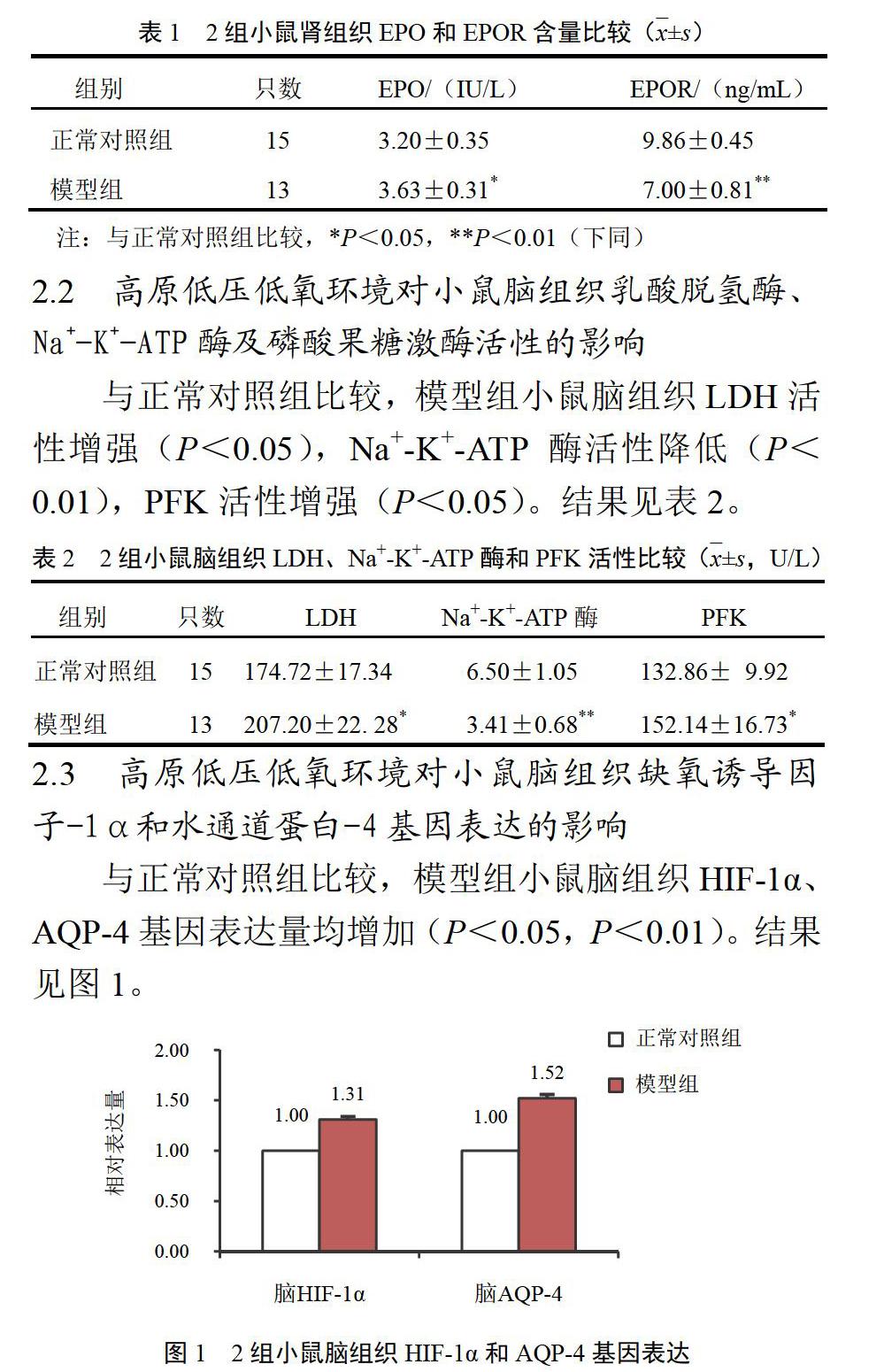
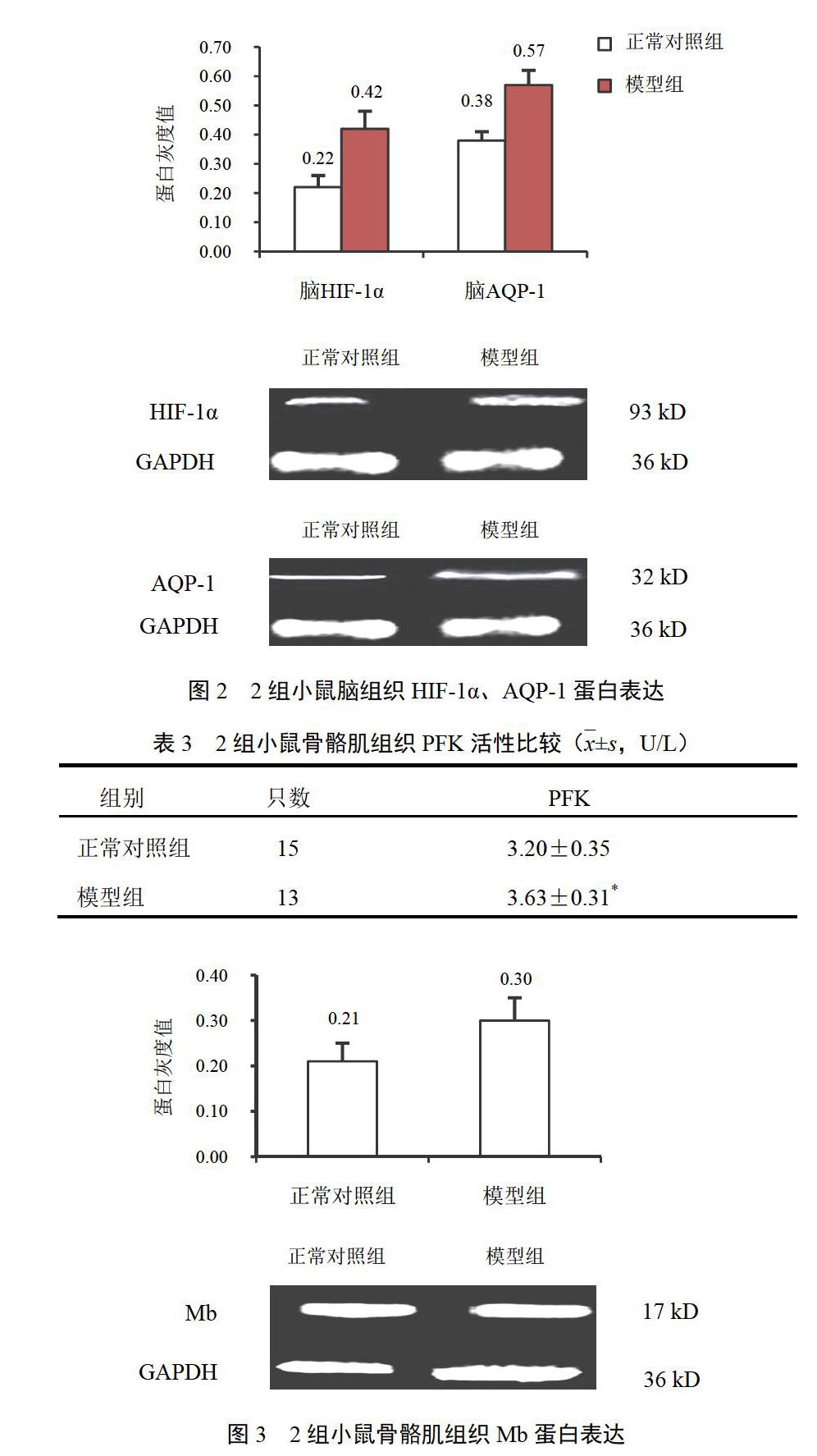
摘要:目的 观察高原低压低氧环境中小鼠肾、骨、脑组织的适应性反应分子机制,探讨肾与脑髓的阴阳上下升降互济的统一性。方法 将SPF级小鼠采用随机数字表法分为正常对照组、模型组。模型组小鼠于低氧舱中模拟高海拔环境进行低氧暴露,连续21 d。第22日出舱称重后眼球采血处死小鼠。比色分析法检测各组小鼠脑组织乳酸脱氢酶(LDH)及Na+-K+-ATP酶活性。ELISA检测各组小鼠脑、骨骼肌组织磷酸果糖激酶(PFK)活性及肾组织促红细胞生成素(EPO)及其受体(EPOR)的含量。RT-PCR检测各组小鼠脑组织缺氧诱导因子-1α(HIF-1α)和水通道蛋白(AQP)-4 mRNA表达,Western blot检测脑组织HIF-1α、AQP-1及骨骼肌组织肌红蛋白(Mb)蛋白表达。结果 与正常对照组比较,模型组小鼠肾组织EPO含量升高,脑组织LDH、PFK活性增强(P<0.05)、HIF-1α和AQP-4的mRNA和蛋白表达水平升高(P<0.05,P<0.01);模型组小鼠骨骼肌组织PFK活性增强和Mb蛋白表达水平升高(P<0.05),脑组织Na+-K+-ATP酶活性和肾组织EPOR含量降低(P<0.05,P<0.01)。结论 高原低压低氧环境小鼠肾、骨和脑组织均发生了阴阳上下升降互济的适应性反应。
关键词:高原低氧;分子机制;肾;骨;脑;小鼠
DOI:10.3969/j.issn.1005-5304.2016.01.014
中图分类号:R228 文献标识码:A 文章编号:1005-5304(2016)01-0060-05
Study on Molecular Mechanism of Reactive Changes in Kidney, Skeleton and Brain of Mice Models in High Altitude Hypoxia Environment AN Fang-yu1, LUO Ya-li1, LIU Yong-qi1,2, LI Ying-dong1,2, LIU Xue-song1, SHI Xu-feng3, GAO Zhuo-yue1,2 (1. Provincial-Level Key Laboratory for Molecular Medicine of Major Diseases and Study on Prevention and Treatment of Traditional Chinese Medicine, Gansu University of Chinese Medicine, Lanzhou 730000, China; 2. Key Laboratory of Dunhuang Medicine and Transformation of Ministry of Education and Gansu Province, Lanzhou 730000, China; 3. Clinical College of Gansu University of Chinese Medicine, Lanzhou 730000, China)
Abstract: Objective To observe the molecular mechanism of adaptive response of the kidney and skeleton and brain issues in the high altitude hypoxia; To discuss the unity of yin and yang oscillation relationship of kidney and brain marrow. Methods SPF KM mice were randomly divided into control group and model group according to random number table method. Mice in the model group were exposed to high altitude hypoxia cabin for successive 21 d. On the 22nd day, mice got out of the cabin and their body weight was measured, and then they were put to death through eyeball blood sampling. The activities of lactic LDH and Na+-K+-ATPase in brain tissue were detected by spectrophotometric colorimetry. The PFK activities of brain and skeletal muscle were detected by ELISA. Meanwhile the contents of EPO and EPOR in the kidney were measured by ELISA. The mRNA expressions of HIF-1α and AQP-4 in brain were assessed by RT-PCR. At the same time, the protein expressions of HIF-1α and AQP-1 in brain and the protein expression of Mb in skeletal muscle were detected by Western blot. Results Compared with the normal group, the LDH and PFK in brain tissue and the content of EPO in kidney tissue were all raised in the model
group(P<0.05). Meanwhile the mRNA expressions of HIF-1α and AQP-4 and the protein expressions of HIF-1α and AQP-1 in brain were all increased in the mice from the model group; the activities of PFK and the protein expression of Mb in skeletal muscle were also raised in the model group. But the activity of Na+-K+-ATPase in brain tissue and the content of EPOR in kidney tissue both decreased in the model group (P<0.05, P<0.01). Conclusion Adaptive response and the unity of yin and yang oscillation relationship between kidney, skeleton and brain tissue happen in high altitude hypoxia.
Key words: high altitude hypoxia; molecular mechanism; kidney; skeleton; brain; mice
高原地区低压、低氧、低温、强辐射等因素对人体生理和免疫系统均有明显的影响,其中,低氧是主要影响因素[1]。中医认为高原清气不足(缺氧)、燥寒二气为主(干燥多风、寒冷低温)。高原低氧多可诱发机体出现气虚、寒凝、血瘀等证,成为高原反应及高原病发生发展的重要机制。中医认为肾主骨生髓,通于脑。肾属五脏,位于下焦,藏精、主骨生髓;脑属奇恒之腑,位置最高,为诸阳之会,主认识。一属阴,一属阳,上下升降互济,肾精肾水上滋脑髓,脑固摄升提肾气,相互作用,互生互长,肾、骨、脑的升降互济对维持机体平衡健康发挥关键作用[2]。……
