轻型颅脑外伤患者的焦虑情绪分析及其心理干预
2015-08-06杨晓莉
杨晓莉
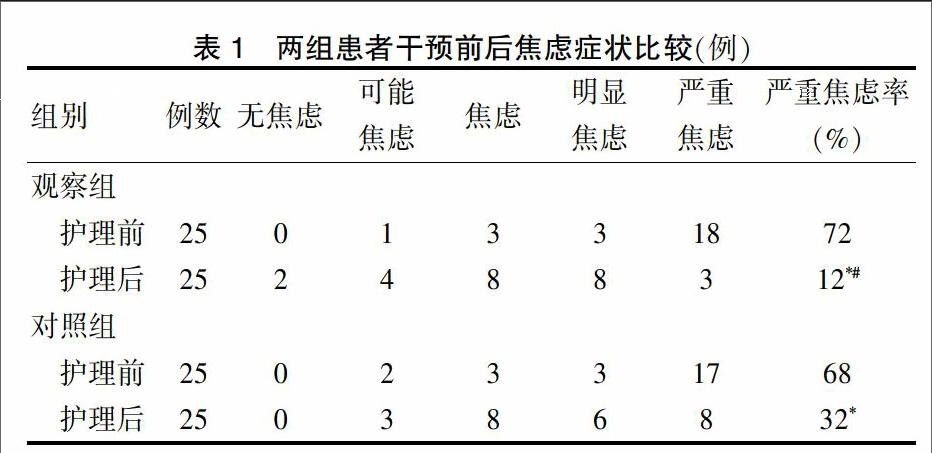
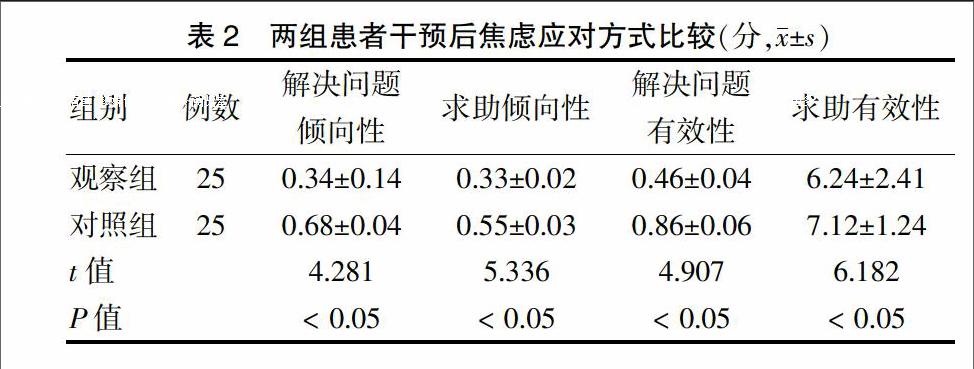
[摘要] 目的 分析轻型颅脑外伤患者的焦虑症状,并给予相应的心理干预措施,评价干预效果。 方法 选取2011年1月~2014年1月绍兴市中心医院收治的50例轻型颅脑外伤后焦虑患者,将其随机分为观察组及对照组,每组各25例,对照组仅采用常规护理,观察组在此基础上予以心理干预。护理干预前后采用汉密顿焦虑量表(HAMA)评价患者的焦虑状态,采用应对方式问卷评价患者的应对能力。 结果 护理干预后,两组患者严重焦虑率均较护理前明显下降(P < 0.05),但观察组的严重焦虑率(12%)明显低于对照组(32%),差异有统计学意义(P < 0.05)。观察组患者解决问题倾向性[(0.34±0.14)分]、求助倾向性[(0.33±0.02)分]、解决问题有效性[(0.46±0.04)分]、求助有效性[(6.24±2.41)分]均明显优于对照组[(0.68±0.04)、(0.55±0.03)、(0.86±0.06)、(7.12±1.24)分],组间比较差异有统计学意义(P < 0.05)。 结论 合适的心理干预可有效缓解轻型颅脑外伤患者的焦虑情绪,从而提高其应对能力,值得临床推广应用。
[关键词] 轻型颅脑外伤;焦虑;心理干预
[中图分类号] R473.74 [文献标识码] A [文章编号] 1673-7210(2015)06(b)-0128-04
Anxiety analysis and psychological intervention of patients with mild traumatic brain injury
YANG Xiaoli
Shaoxing Central Hospital, Zhejiang Province, Shaoxing 312030, China
[Abstract] Objective To analyze mild traumatic brain injury patients' anxiety, and give corresponding psychological interventions, evaluate the efficacy of the intervention. Methods From January 2011 to January 2014, in Shaoxing Central Hospital, 50 patients with anxiety after mild traumatic brain injury were selected and randomly divided into observation group and control group, with 25 cases in each group. Patients of the control group only received routine nursing care, and patients of the observation group received psychological intervention on the basis of the routine nursing care. After nursing intervention, anxiety of patients in two groups were assessed by Hamilton anxiety scale (HAMA), coping capacity of patients were evaluated by the coping styles questionnaire. Results After nursing intervention, the severe anxiety rate of two groups were markedly reduced compared with before the intervention (P < 0.05), and this of the observation group (12%) was lower than that of the control group (32%), the difference was statistically significant (P < 0.05). The inclination of solving the problem, helping orientation and solving problem efficiency, helping effectiveness in observation group [(0.34±0.14), (0.33±0.02), (0.46±0.04), (6.24±2.41) scores] were significantly better than those of the control group [(0.68±0.04), (0.55±0.03), (0.86±0.06), (7.12±1.24) scores], the differences were statistically significant (P < 0.05). Conclusion Proper psychological intervention can obviously relieve anxiety symptoms of mild traumatic brain injury patients, so as to improve the response capacity, which is worth of clinical promotion.
[Key words] Mild traumatic brain injury; Anxiety; Psychological intervention
颅脑损伤是目前神经外科十分常见的疾病,随着目前颅脑伤患者的日益增多,给患者的家庭以及整个社会都带来了巨大的负担,而颅脑外伤及其预后已受到了精神病学、神经外科学以及心理学等多个学科的共同关注[1-2]。颅脑损伤后患者主要表现为意识障碍(嗜睡、浅昏迷、昏迷、深度昏迷)、头痛呕吐、瞳孔散大、血压下降等,恢复缓慢、病程较长,因此很多患者在治疗过程中会产生严重的经济以及心理负担,对于病情较重者,在治疗过程中会出现焦虑和恐惧心理,这些不良的心理变化将影响到病情康复,有研究指出[3],心理干预在颅脑外伤的患者心理康复中起到了越来越重要的作用,本研究就将在常规治疗的基础上,对轻型颅脑外伤患者采取心理干预,并取得了较好的治疗效果,现将结果报道如下:
1资料与方法
1.1 一般资料