基于悬吊运动系统的躯干控制性训练联合有氧训练在痉挛型脑瘫患儿中的应用观察
2024-06-21肖静
肖静
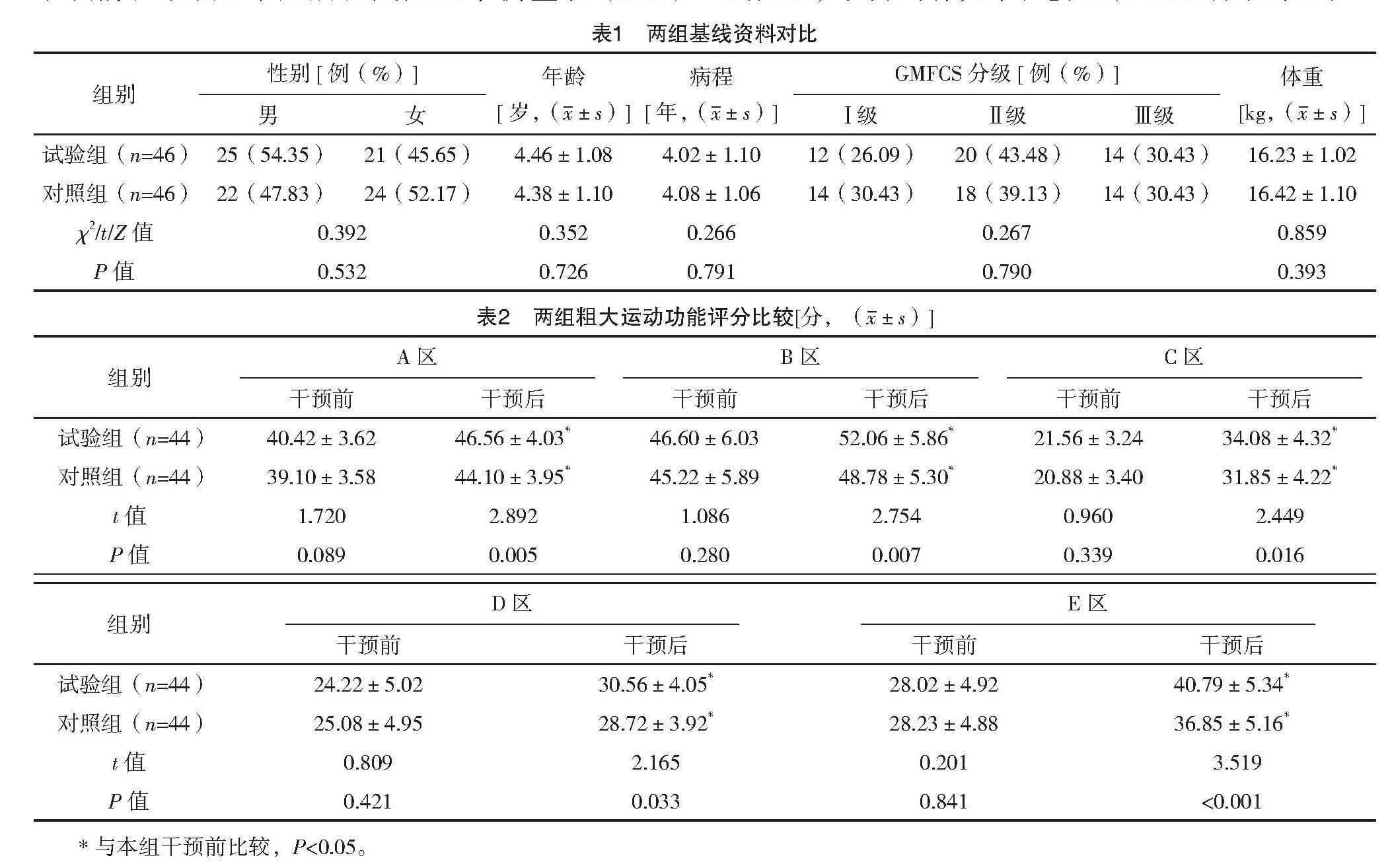
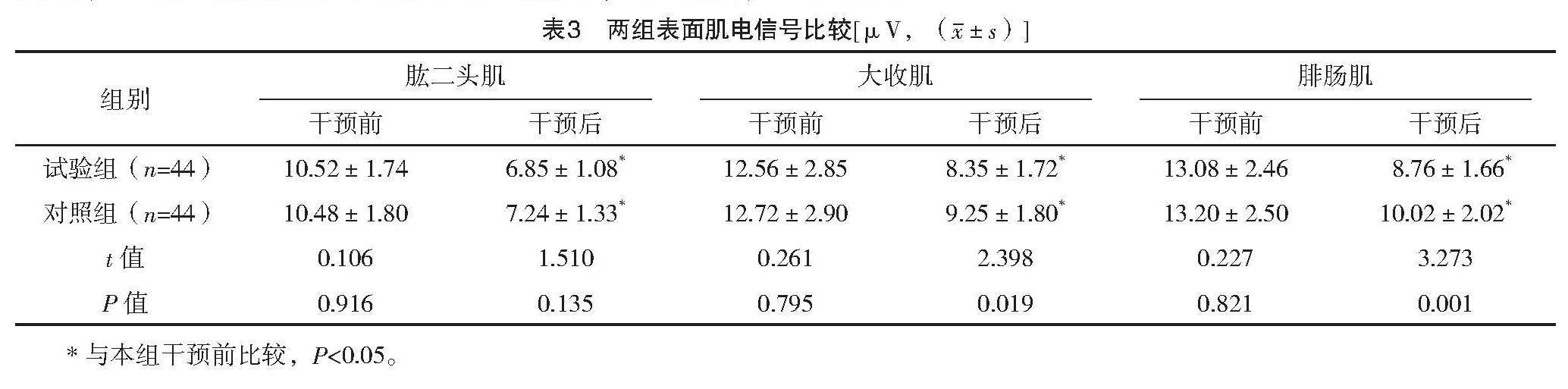

【摘要】 目的:探讨基于悬吊运动系统的躯干控制性训练联合有氧训练在痉挛型脑瘫患儿中的应用效果。方法:选取新余市妇幼保健院2020年6月—2022年6月收治的痉挛型脑瘫患儿92例,按照随机数字表法将患儿分为试验组与对照组,各46例。干预期间试验组和对照组各脱落2例患儿,最终两组各有44例患儿进入本次研究。给予对照组患儿有氧训练干预,试验组在对照组基础上采用基于悬吊运动系统的躯干控制性训练,两组均干预6个月。比较两组干预前后粗大运动功能[粗大运动功能测试(CMFM-88)评分]、平衡功能[儿童平衡量表(PBS)评分],通过测量表面肌电信号方均根值(RMS)评价肌张力。结果:干预后,两组CMFM-88中A区、B区、C区、D区、E区评分均升高,且试验组均高于对照组,差异均有统计学意义(P<0.05)。干预后,两组肱二头肌、大收肌与腓肠肌RMS均降低,且试验组均低于对照组,差异均有统计学意义(P<0.05)。干预后,两组PBS评分均升高,且试验组高于对照组,差异均有统计学意义(P<0.05)。结论:基于悬吊运动系统的躯干控制性训练联合有氧训练可降低痉挛型脑瘫患儿肌张力,改善运动功能和平衡功能。
【关键词】 痉挛型脑瘫 悬吊运动 躯干控制 有氧训练 运动功能 平衡功能
Observation on the Application of Trunk Control Training Based on Suspension Motion System Combined with Aerobic Training in Children with Spasticity Cerebral Palsy/XIAO Jing. //Medical Innovation of China, 2024, 21(13): 0-078
[Abstract] Objective: To explore the application effect of trunk control training based on suspension motion system combined with aerobic training in children with spasticity cerebral palsy. Method: A total of 92 children with spasticity cerebral palsy admitted to Maternity & Child Care Center of Xinyu from June 2020 to June 2022 were selected and divided into experimental group and control group according to random number table method, with 46 cases in each group. Two children were excluded from each of the experimental group and control group during the intervention period, resulting in 44 children in each of the two groups entering this study. Children in the control group were given aerobic training intervention, and the experimental group was given trunk control training based on suspension motion system on the basis of the control group. Both groups were given intervention for 6 months. Gross motor function [gross motor function measure-88 (CMFM-88) score] and balance function [pediatric balance scale (PBS) score] were compared between the two groups before and after intervention, and the muscle tone was evaluated by surface electromyographic signal root-mean-square value (RMS). Result: After the intervention, the scores of area A, B, C, D and E of CMFM-88 in the two groups all increased, and those in the experimental group were higher than those in the control group, the differences were statistically significant (P<0.05). After intervention, the RMS of the biceps brachii, adductor magnus, and gastrocnemius muscles decreased in both groups, and those in the experimental group were lower than those in the control group, the differences were statistically significant (P<0.05). After intervention, PBS scores of both groups were increased, and that in the experimental group was higher than that in the control group, the differences were statistically significant (P<0.05). Conclusion: Trunk control training based on suspension motion system combined with aerobic training can reduce muscle tone and improve motor function and balance function in children with spasticity cerebral palsy.
[Key words] Spasticity cerebral palsy Suspension motion Trunk control Aerobic training Motor function Balance function
First-author's address: Department of Children's Neurological Rehabilitation, Maternity & Child Care Center of Xinyu, Xinyu 338000, China
doi:10.3969/j.issn.1674-4985.2024.13.017
痉挛型脑瘫是脑性瘫痪的常见类型,占所有脑瘫的60%~70%,该类脑瘫以肌张力升高、牵张反射亢进为主要特征,可诱发运动功能障碍、姿势异常、平衡功能降低等症状,严重影响患儿的日常生活活动能力[1]。研究表明,运动康复对改善痉挛型脑瘫患儿运动功能、纠正肌张力异常有着重要作用[2]。目前,临床上针对痉挛型脑瘫患儿康复的方法较多,如作业疗法、感觉统合训练等,虽然能在一定程度上改善患儿运动功能,但无法充分调动患儿的积极性和主动性,导致干预效果欠佳[3]。悬吊运动是近年来新兴的一种力量训练,可促进人体在不稳定状态下进行主动训练,从而达到康复治疗的目的[4]。……