静脉溶栓联合双重抗血小板治疗AIS患者的效果及对神经功能和TEG参数的影响
2024-06-21廖成俊贺佳吴颖
廖成俊 贺佳 吴颖

*基金项目:深圳市龙岗区经济与科技发展专项资金医疗卫生科技计划项目(LGWJ202188)
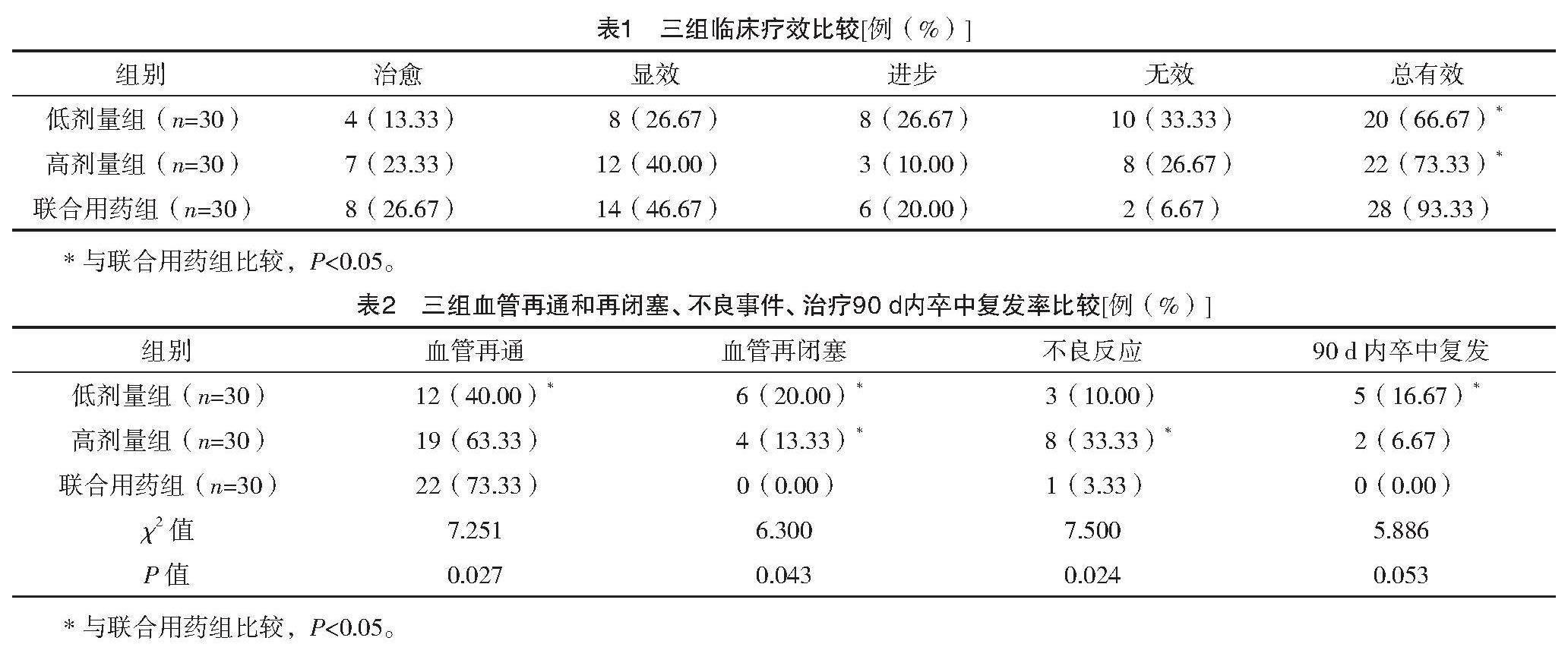
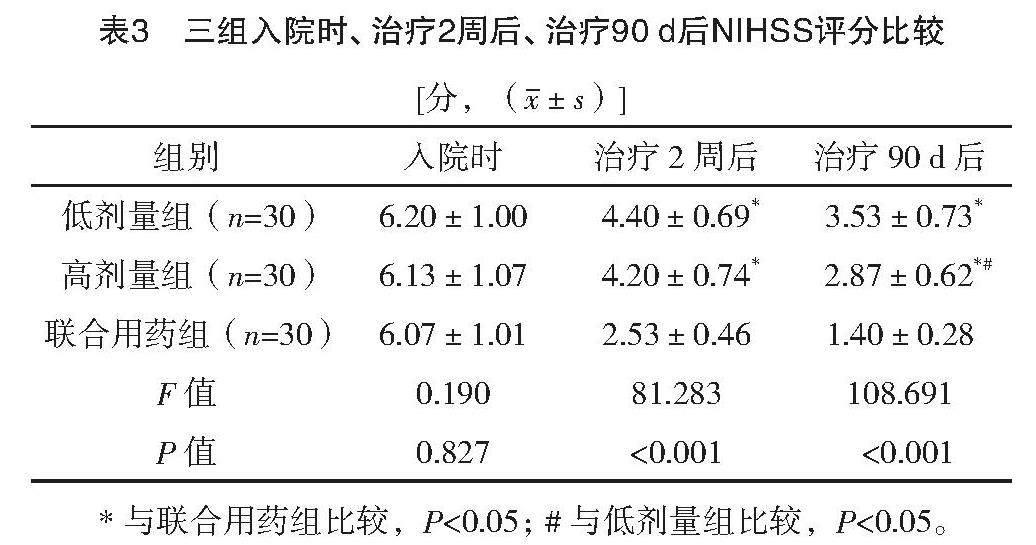
【摘要】 目的:观察急性缺血性脑卒中(acute ischemic stroke,AIS)患者静脉溶栓后采用联合双重抗血小板治疗的效果、安全性及对血栓弹力图(thromboelastogram,TEG)的影响。方法:本研究选取2022年2月—2023年5月深圳市龙岗区第三人民医院收治的90例AIS患者,全部进行静脉溶栓治疗,按入院数字编号随机分为三组:低剂量组(阿司匹林100 mg)、高剂量组(阿司匹林300 mg)、联合用药组(阿司匹林100 mg+氯吡格雷75 mg),每组30例。通过观察三组患者临床效果、血管再通和再闭塞发生率、治疗期间不良反应、远期复发率、美国国立卫生研究院卒中量表(NIHSS)评分及TEG参数变化。结果:联合用药组临床总有效率高于低剂量组和高剂量组(P<0.05)。联合用药组AIS急性期(即发病7 d内)血管再通率明显高于低剂量组,差异有统计学意义(P<0.05);联合用药组AIS急性期(即发病7 d内)血管再闭塞率明显低于低剂量组、高剂量组,差异均有统计学意义(P<0.05);联合用药组住院期间不良反应发生率明显低于高剂量组,差异有统计学意义(P<0.05);联合用药组治疗90 d内卒中复发率明显低于低剂量组,差异有统计学意义(P<0.05)。三组患者治疗2周后NIHSS评分比较差异有统计学意义(P<0.05),且联合用药组显著低于低剂量组和高剂量组,差异均有统计学意义(P<0.05);三组患者治疗90 d后NIHSS评分比较差异有统计学意义(P<0.05),且联合用药组显著低于低剂量组和高剂量组,差异均有统计学意义(P<0.05),高剂量组显著低于低剂量组,差异有统计学意义(P<0.05)。治疗后高剂量组K值比低剂量组长(P<0.05),MA值比低剂量组低(P<0.05);联合用药组R值、K值均比高剂量组、低剂量组长,凝血综合指数(CI)比高剂量组、低剂量组高(P<0.001),α角、MA值均比高剂量组、低剂量组低(P<0.05)。结论:静脉溶栓治疗后联合双重抗血小板治疗AIS患者能提高临床效果,降低复发率,减少治疗风险;抗血小板聚集治疗影响TEG参数,联合双重抗血小板治疗可能通过调节TEG参数发挥作用。
【关键词】 急性缺血性脑卒中 静脉溶栓 双重抗血小板 神经功能 血栓弹力图
Effect of Intravenous Thrombolysis Combined with Dual Antiplatelet Therapy on AIS Patients and Its Influence on Nerve Function and TEG Parameters/LIAO Chengjun, HE Jia, WU Ying. //Medical Innovation of China, 2024, 21(13): 0-065
[Abstract] Objective: To observe the efficacy, safety and effect of combined antiplatelet therapy on thromboelastography (TEG) after intravenous thrombolysis in patients with acute ischemic stroke (AIS). Method: In this study, 90 patients with AIS admitted to Shenzhen Longgang District Third People's Hospital from February 2022 to May 2023 were selected, according to the different application of antiplatelet drugs after intravenous thrombolysis, they were randomly divided into three groups: low-dose group (Aspirin 100 mg), high-dose group (Aspirin 300 mg), combined drug group (Aspirin 100 mg+ Clopidogrel 75 mg), 30 cases in each group. The clinical effect, incidence of vascular recanalization and re-occlusion, adverse reactions during treatment, long-term recurrence rate, NIHSS score and TEG parameters were observed in three groups. Result: The total clinical effective rate of the combined drug group was higher than that of the low-dose group and high-dose group (P<0.05). The vascular recanalization rate in the combined drug group was significantly higher than that in the low-dose group in the acute phase of acute ischemic stroke (within 7 days of onset), the difference was statistically significant (P<0.05); the rate of vascular re occlusion in the combined drug group was significantly lower than that in the low-dose group and the high-dose group in the acute phase of acute ischemic stroke ( within 7 days of onset), the differences were statistically significant (P<0.05); the incidence of adverse reactions during hospitalization in the combined drug group was significantly lower than that in the high-dose group, the difference was statistically significant (P<0.05); the recurrence rate of stroke within 90 days in the combined drug group was significantly lower than that in the low-dose group (P<0.05). There were significant differences in NIHSS scores among the three groups after 2 weeks of treatment (P<0.05), and the combined drug group was significantly lower than the low-dose group and the high-dose group, the differences were statistically significant (P<0.05); there were significant differences in NIHSS scores among the three groups after 90 days of treatment (P<0.05), and the combined drug group was significantly lower than that of the low-dose group and the high-dose group (P<0.05), and the high-dose group was significantly lower than that of the low-dose group (P<0.05). After treatment, the K value of high-dose group was longer than that of low-dose group (P<0.05), and the MA value of high-dose group was lower than that of low-dose group (P<0.05); the R value and K value in the combination group were longer than those in the high-dose group and the low-dose group, CI was higher than that in the high-dose group and the low-dose group (P<0.001), α angle and MA value were lower than those in the high-dose group and the low-dose group (P<0.05). Conclusion: Combined with dual antiplatelet therapy after intravenous thrombolysis can improve the clinical efficacy, reduce the recurrence rate and reduce the treatment risk in AIS patients. Antiplatelet aggregation therapy affects TEG parameters, and combined antiplatelet therapy may play a role by regulating TEG parameters.
[Key words] Acute ischemic stroke Intravenous thrombolysis Dual antiplatelet Neurological function Thromboelastogram
First-author's address: Department of Neurology, Shenzhen Longgang District Third People's Hospital, Shenzhen 518115, China
doi:10.3969/j.issn.1674-4985.2024.13.014
中国近20年来急性缺血性脑卒中(acute ischemic stroke,AIS)发病率呈逐年上升趋势[1-2],每年因卒中死亡的人数已超过肿瘤和心血管疾病,成为因病致死的主要原因之一,并且在卒中患者中约有80%的患者是由于AIS死亡。因此,探索一种高效、安全的治疗方式对改善AIS患者症状及预后具有重要的社会意义。现以AIS患者为研究对象观察静脉溶栓后联合双重抗血小板治疗的效果和安全性,以及AIS采用不同抗血小板治疗方法后血栓弹力图(thromboelastogram,TEG)变化情况。现报道如下。
1 资料与方法
1.1 一般资料
选择2022年2月—2023年5月在深圳市龙岗区第三人民医院神经内科住院的90例AIS患者。(1)纳入标准:①症状、体征及辅助检查均符合文献[3]《中国急性缺血性脑卒中诊疗指南2018》相关要求;……