丁苯酞氯化钠注射液、尤瑞克林联合静脉溶栓对急性脑梗死患者血管内皮功能及出血性转化的影响
2024-06-21章洪斌郝楼李坤
章洪斌 郝楼 李坤
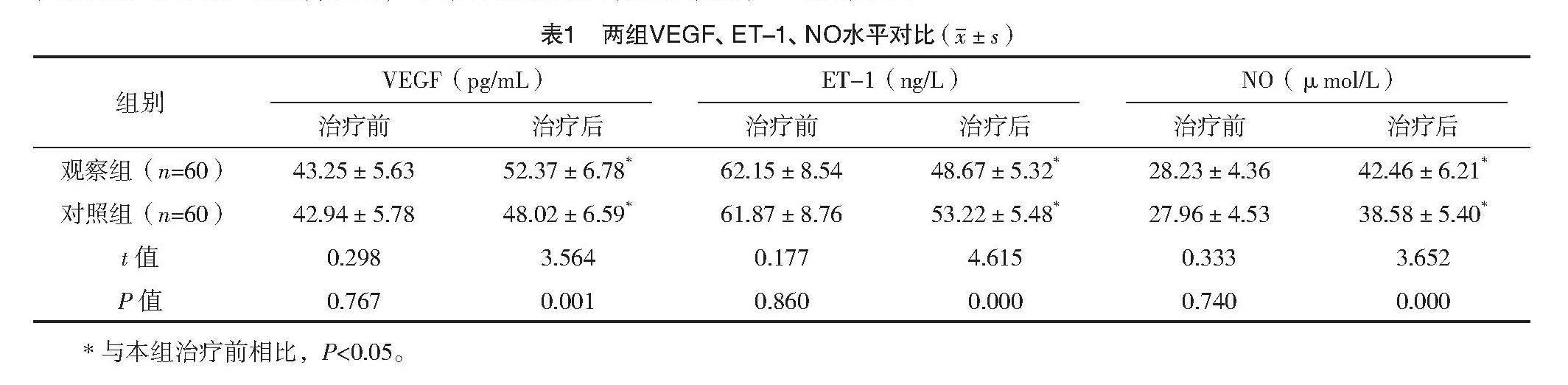
【摘要】 目的:探究丁苯酞氯化钠注射液、尤瑞克林联合静脉溶栓对急性脑梗死(ACI)患者血管内皮及出血性转化(HT)的影响。方法:选取2020年10月—2023年5月南昌市人民医院诊治的120例ACI患者,用随机数字表法分为对照组及观察组,各60例。对照组施行静脉溶栓与常规治疗,观察组在对照组治疗基础上,另施行丁苯酞氯化钠注射液、尤瑞克林治疗。评价对比两组血管内皮功能、神经功能缺损程度、血液流变学指标及HT发生率。结果:治疗2周后,两组血管内皮生长因子(VEGF)、一氧化氮(NO)水平均上升,内皮素-1(ET-1)均下降,与对照组[(48.02±6.59)pg/mL、(38.58±5.40)μmol/L、
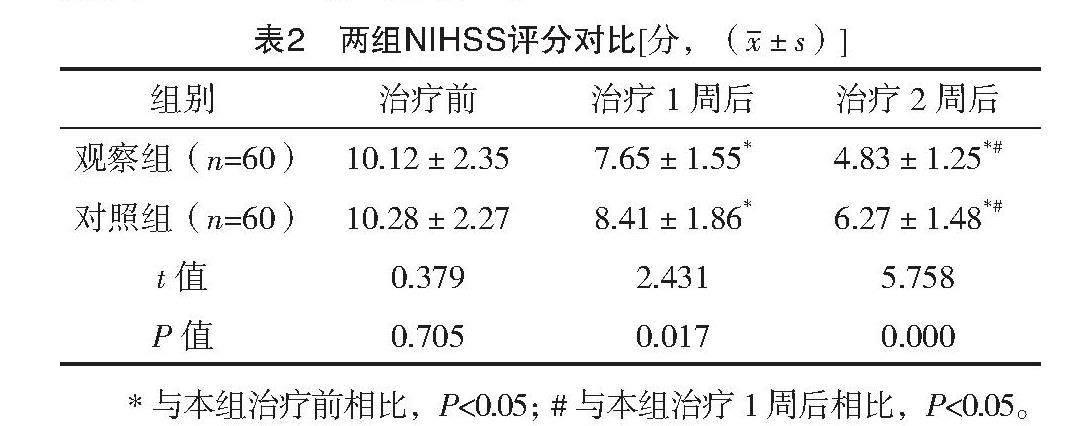
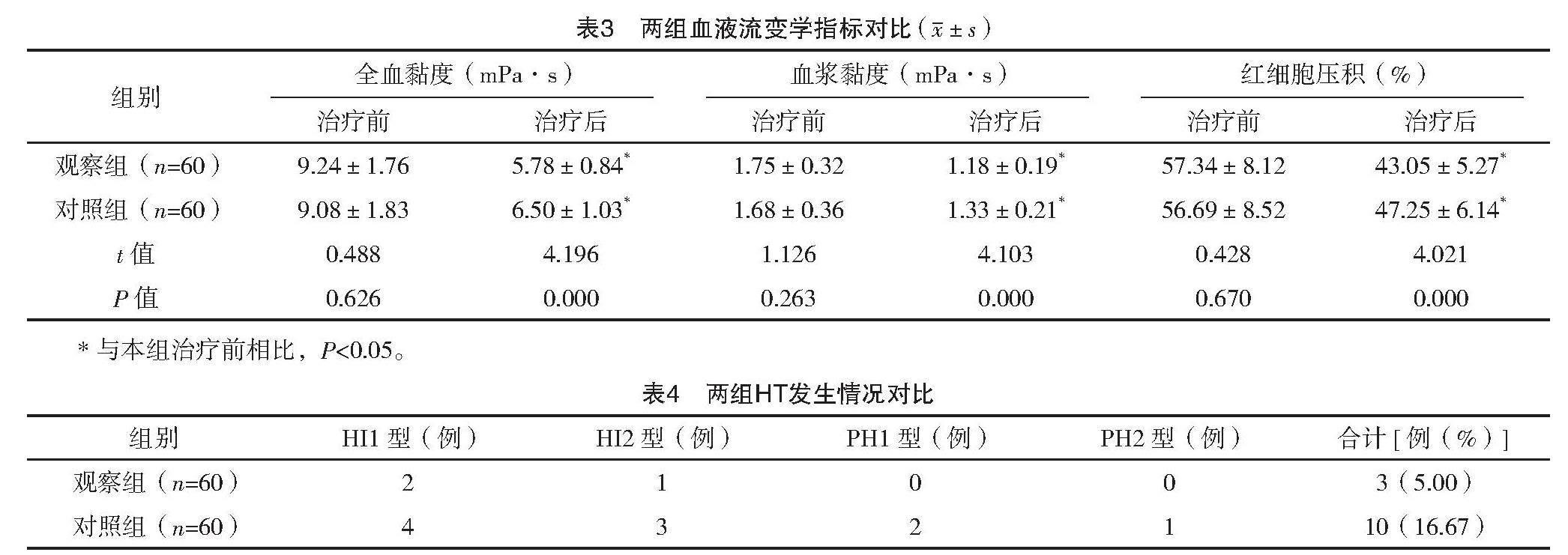
(53.22±5.48)ng/L]比较,观察组VEGF、NO[(52.37±6.78)pg/mL、(42.46±6.21)μmol/L]水平均更高,ET-1[(48.67±5.32)ng/L]水平更低,差异均有统计学意义(P<0.05);治疗1、2周后,两组美国国立卫生研究院卒中量表(NIHSS)评分均下降,且观察组[(7.65±1.55)分、(4.83±1.25)分]较对照组[(8.41±1.86)分、(6.27±1.48)分]均显著更低,差异均有统计学意义(P<0.05);治疗2周后,两组全血黏度、血浆黏度、红细胞压积均下降,且观察组[(5.78±0.84)mPa·s、(1.18±0.19)mPa·s、(43.05±5.27)%]较对照组[(6.50±1.03)mPa·s、(1.33±0.21)mPa·s、(47.25±6.14)%]均显著更低,差异均有统计学意义(P<0.05);观察组、对照组HT发生率分别为5.00%、16.67%,两组HT发生率比较,差异有统计学意义(P<0.05)。结论:丁苯酞氯化钠注射液、尤瑞克林联合静脉溶栓治疗ACI,可改善患者血管内皮功能,降低神经功能损伤和HT发生风险。
【关键词】 丁苯酞氯化钠注射液 尤瑞克林 静脉溶栓 急性脑梗死
Effects of Butylphthalide and Sodium Chloride Injection and Urinary Kallidinogenase Combined with Intravenous Thrombolysis on Vascular Endothelial Function and Hemorrhagic Transformation in Patients with Acute Cerebral Infarction/ZHANG Hongbin, HAO Lou, LI Kun. //Medical Innovation of China, 2024, 21(13): 0-042
[Abstract] Objective: To investigate the effect of Butylphthalide and Sodium Chloride Injection and Urinary Kallidinogenase combined with intravenous thrombolysis on vascular endothelial function and hemorrhagic transformation (HT) in patients with acute cerebral infarction (ACI). Method: A total of 120 patients with ACI diagnosed and treated in Nanchang People's Hospital from October 2020 to May 2023 were selected and divided into control group and observation group by random number table method, with 60 cases in each group. The control group was treated with intravenous thrombolysis and conventional treatment, the observation group was treated with Butylphthalide and Sodium Chloride Injection and Urinary Kallidinogenase on the basis of the control group. Vascular endothelial function, nerve function defect, hemorheology indexes and incidence of HT were evaluated and compared between the two groups. Result: After 2 weeks of treatment, the levels of vascular endothelial growth factor (VEGF) and nitric oxide (NO) increased and endothelin-1 (ET-1) decreased in both groups, compared with the control group [(48.02±6.59) pg/mL, (38.58±5.40) μmol/L, (53.22±5.48) ng/L], VEGF, NO levels [(52.37±6.78) pg/mL, (42.46±6.21) μmol/L] in the observation group were higher, and ET-1 levels [(48.67±5.32) ng/L] was lower, the differences were statistically significant (P<0.05). After 1 and 2 weeks of treatment, the national institutes of health stroke scale (NIHSS) scores decreased in both groups, and those in the observation group [(7.65±1.55) scores, (4.83±1.25) scores] were significantly lower than those in the control group [(8.41±1.86) scores, (6.27±1.48) scores], the differences were statistically significant (P<0.05). After 2 weeks of treatment, whole blood viscosity, plasma viscosity and hematocrit decreased in both groups, and those in the observation group [(5.78±0.84) mPa·s, (1.18±0.19) mPa·s, (43.05±5.27) %] were significantly lower than those in the control group [(6.50±1.03) mPa·s, (1.33±0.21) mPa·s, (47.25±6.14) %], the differences were statistically significant (P<0.05). The incidence of HT in observation group and control group was 5.00% and 16.67%, respectively, there was statistical significance in the incidence of HT between the two groups (P<0.05). Conclusion: Butylphthalide and Sodium Chloride Injection and Urinary Kallidinogenase combined with intravenous thrombolysis can improve the vascular endothelial function of patients with ACI and reduce the risk of neurological damage and HT.
[Key words] Butylphthalide and Sodium Chloride Injection Urinary Kallidinogenase Intravenous thrombolysis Acute cerebral infarction
First-author's address: Department of Neurology, Nanchang People's Hospital, Nanchang 330000, China
doi:10.3969/j.issn.1674-4985.2024.13.009
急性脑梗死(ACI)是由于脑血管突发性阻塞导致脑部血液供应不足的严重病症,可能导致大脑部分功能永久性损伤甚至死亡[1]。ACI患者通常会出现神经功能缺失、言语障碍、视力障碍、平衡失调、头晕、恶心及呕吐等症状。对于早期就诊的患者,可以采用溶栓药物来溶解血栓,恢复脑血流。静脉溶栓指的是通过静脉导管或穿刺注射溶栓药物促进血栓溶解,恢复脑血流以减轻梗死区域脑组织损伤,是临床治疗ACI有效、首选的方法,通常使用的溶栓药物为重组组织型纤溶酶原激活物(rt-PA)和尿激酶[2]。然而,静脉溶栓治疗后,患者容易发生出血性转化(HT)、溶栓后再栓塞等并发症,其中HT是最常见的并发症,发生率为10%~43%[3]。丁苯酞氯化钠注射液是一种常用于治疗ACI的国家Ⅰ类脑保护剂药物,可改善血液循环与神经功能缺损。……