不同体位对妇科肿瘤调强放射治疗剂量学和急性放射性肠炎的影响
2021-12-30严华梅 李政欢 王冬辉 黄晓清 王弯 陈露茜 董洁 徐向英
严华梅 李政欢 王冬辉 黄晓清 王弯 陈露茜 董洁 徐向英
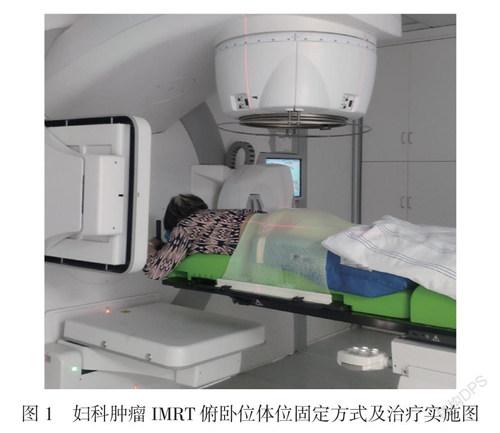
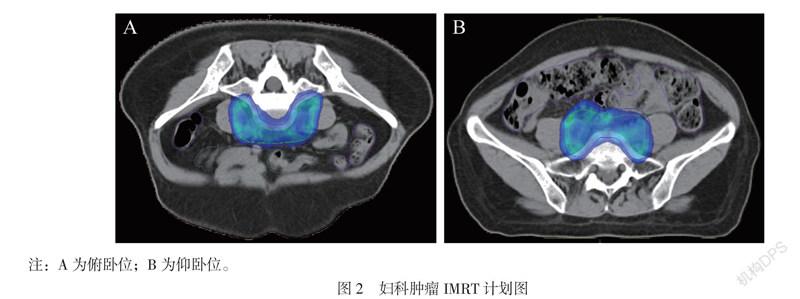
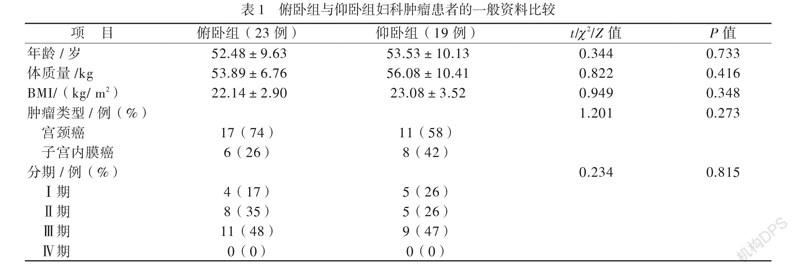
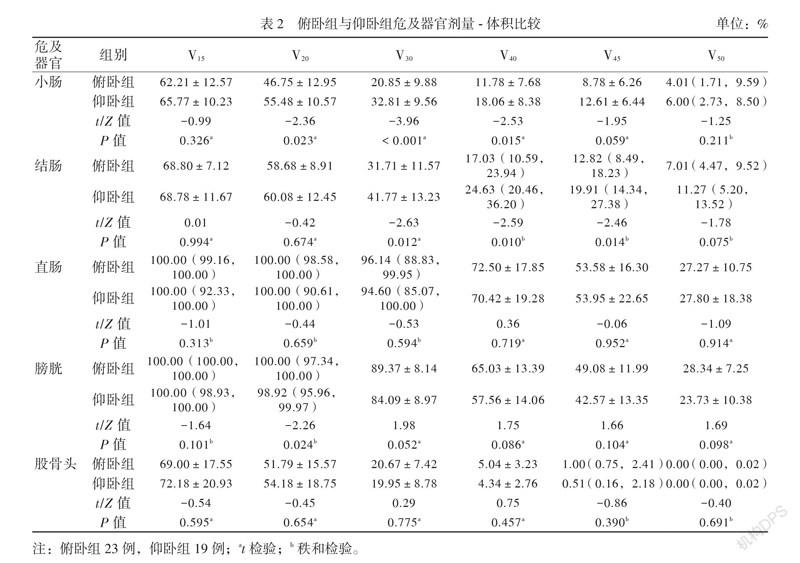
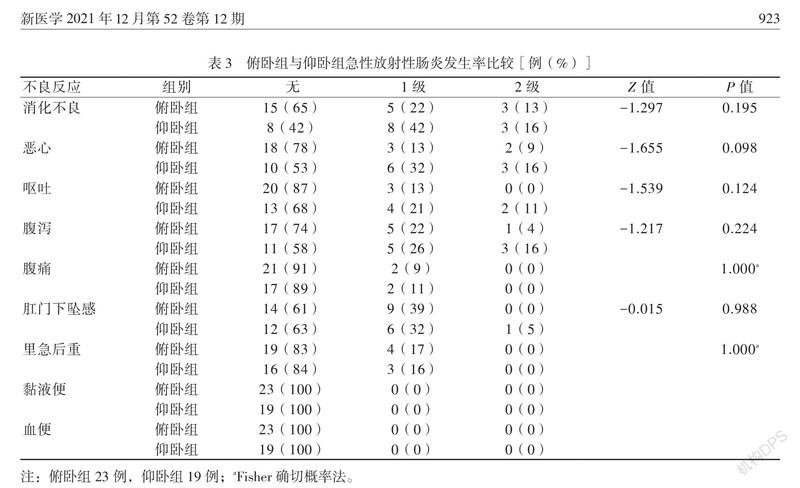
【摘要】目的 探討妇科肿瘤调强放射治疗(IMRT)采用俯卧位或仰卧位对危及器官剂量学及放射治疗不良反应的影响,优化IMRT体位固定方式。方法 选择42例宫颈癌及子宫内膜癌IMRT患者,按体位固定方式分为俯卧组23例与仰卧组19例。在相同条件下勾画靶区和危及器官并进行治疗计划优化,比较2组患者危及器官剂量-体积关系,分析2组患者急性放射性肠炎的发生情况。结果 俯卧组小肠接受15~50 Gy照射剂量的体积均小于仰卧组,其中2组接受20、30、40 Gy剂量的体积比较差异均有统计学意义(P均< 0.05)。俯卧组患者结肠接受30、40、45 Gy剂量的体积比较差异均有统计学意义(P均< 0.05)。俯卧组膀胱接受15~50 Gy照射剂量的体积比仰卧组稍升高,但仅接受20 Gy照射剂量的体积在组间比较差异有统计学意义(P < 0.05)。2组患者直肠及股骨头的剂量-体积关系比较差异无统计学意义(P > 0.05)。俯卧组患者消化不良、恶心、呕吐、腹痛和腹泻等急性放射性肠炎的发生率低于仰卧组,但组间比较差异无统计学意义(P均> 0.05)。结论 妇科肿瘤IMRT采用俯卧位可降低小肠及结肠接受照射剂量。
【关键词】妇科肿瘤;调强放射治疗;体位;剂量学;急性放射性肠炎
Effect of prone and supine positions on dosimetry and acute radiation enteritis in intensity-modulated radiotherapy for gynecologic cancer Yan Huamei, Li Zhenghuan, Wang Donghui, Huang Xiaoqing, Wang Wan, Chen Luxi, Dong Jie, Xu Xiangying. Department of Radiation Oncology, the Third Affiliated Hospital of Sun Yat-sen University, Guangzhou 510630, China
Corresponding author, Xu Xiangying, E-mail: lifz1977@163.com
【Abstact】Objective To evaluate the effect of prone and supine positions on organs at risk and the incidence of acute radiation enteritis in intensity-modulated radiotherapy for gynecologic cancer and optimize the body position. Methods 42 patients with cervical cancer or endometrial cancer undergoing intensity-modulated radiotherapy were recruited and randomly divided into the prone (n = 23) and supine position groups (n = 19). The clinical tumor volume and organs at risk were delineated under the same conditions, and the treatment plan was optimized. The dose-volume relationship of organs at risk was compared between two groups. The incidence of acute radiation enteritis was analyzed between two groups. Results Compared with the supine position group, the small intestine volume irradiated by 15-50 Gy was decreased in the prone position, and statistically significant differences were observed in the volume of 20, 30 and 40 Gy between two groups (all P < 0.05). The colon volume receiving 30, 40 and 45 Gy irradiation in the prone position was lower than that in the supine position (all P < 0.05). The bladder volume receiving 15-50 Gy irradiation in the prone position was slightly higher compared with that in the supine position, but the statistical significance only in in the volume of 20 Gy between two groups (P < 0.05). No statistical significance was found in the dose-volume relationship of the rectum and femoral head between two groups (P > 0.05). The incidence of indigestion, nausea, vomiting, abdominal pain, diarrhea and acute radiation enteritis in the prone group was significantly lower than that in the supine position, but there was no statistical significance in the dose-volume relationship between two groups (all P > 0.05). Conclusion Intensity-modulated radiotherapy in the prone position for gynecologic cancer can significantly reduce the dose of small intestine and colon.
【Key words】Gynecologic cancer; Intensity-modulated radiotherapy; Position; Dosimetry;
Acute radiation enteritis
宫颈癌、子宫内膜癌是常见的妇科恶性肿瘤,调强放射治疗(IMRT)是妇科恶性肿瘤主要治疗方式,各期宫颈癌均可采用放射治疗,大部分子宫内膜癌需接受放射治疗[1-2]。放射性肠炎是盆腔放射治疗常见的不良反应,并且是影响患者生活质量的主要原因[3]。……