探讨优质护理在小儿急性肾炎护理中的应用
2021-12-13任林
任林

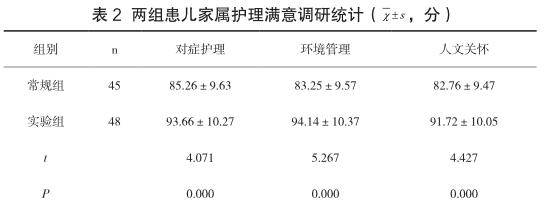
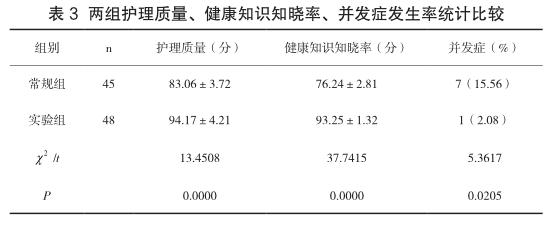
【摘 要】目的:探讨优质护理于小儿急性肾炎急性期护理效果。方法: 选取2017年6月至2020年6月儿科住院部收治93例小兒急性肾炎患儿为探查对象,采用随机数字分组方式,常规组共计45例,行基础护理,实验组共计48例,行优质护理,组间进行临床症状转归、患儿家属护理满意度、护理质量、健康知识知晓率、并发症发生情况的比较。结果:实验组患儿高血压、蛋白尿、水肿发生率低于常规组(P<0.05);实验组患儿家属于对症护理、环境管理、人文关怀等维度满意评分高于常规组(P<0.05);相比于常规组,实验组的护理质量评分、健康知识知晓率更高,并发症发生率更低,具备统计学差异(P<0.05)。结论:小儿急性肾炎急性期开展优质护理,可缓解临床症状,提高患儿护理满意度与疾病认知水平,提升生活质量,减少并发症。
【关键词】优质护理;小儿急性肾炎急性期;护理效果
【Abstract】Objective: To explore the effect of high quality nursing in the acute stage of pediatric acute nephritis. Methods: From June 2017 to June 2020, 93 cases of pediatric acute nephritis in the inpatient department of pediatrics were selected as the objects of investigation. The method of random number group was adopted. A total of 45 cases in the conventional group were given basic nursing care, while 48 cases in the experimental group were given quality nursing care.The outcomes of clinical symptoms, care satisfaction of the childrens family members, the quality of care, the awareness rate of health knowledge, and the occurrence of complications were compared between the groups. RESULTS: The incidence of hypertension, proteinuria and edema in the experimental group was lower than that in the conventional group (P<0.05). The satisfaction scores of symptomatic nursing, environmental management and humanistic care in the experimental group were higher than those in the conventional group (P<0.05);Compared with the control group, the experimental group had a higher nursing quality score, a higher awareness rate of health knowledge, and a lower incidence of complications, with statistical differences (P<0.05).. Conclusion: Carrying out high-quality nursing care in the acute stage of acute nephritis in children can relieve clinical symptoms, improve nursing satisfaction and disease awareness of children, improve the quality of life, and reduce complications.
【Key?Words】Quality nursing; Acute stage of acute nephritis in children; Nursing effect
小儿急性肾炎主要是指急性链球菌感染后诱发的免疫复合物于肾小球内出现弥漫性、增生性、渗出性炎性病变,以高血压、水肿、尿少为主要症状,对临床治疗时机要求较高,若没有给予医疗干预,易诱发慢性肾炎,危害小儿生命安全。据流行病学研究数据显示,小儿急性肾炎预后效果不佳,于急性发作期护理依赖性较大,完善临床护理模式具有重要课题探讨价值[1]。现研究笔者为提高我院临床护理开展质量,特引入优质护理对策,旨在为小儿急性肾炎急性发作治疗增效,选取2017年6月至2020年6月儿科住院部收治93例小儿急性肾炎急性期患儿为探查对象,开展如下报道。
1 资料与方法
1.1 一般资料
选取2017年6月至2020年6月儿科住院部收治93例小儿急性肾炎急性期患儿为探查对象,研究项目征求伦理委员会批准,采用随机数字分组方式,常规组45例,男23例,女22例,年龄1岁~13岁,平均年龄(5.63±0.71)岁;实验组48例,男25例,女23例,年龄1岁~13岁,平均年龄(5.59±0.69)岁;统计分析两组小儿急性肾炎急性期患儿入组资料,差异均衡具有比对价值(P>0.05)。纳……