优质护理干预用于小儿支气管肺炎护理对肺功能的价值探究
2021-11-10移京京
移京京
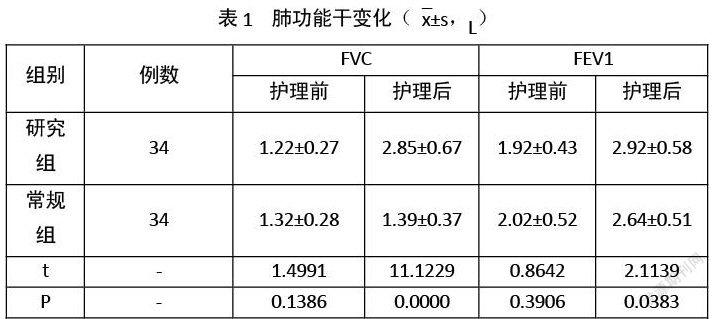
摘要:目的:探讨对小儿支气管肺炎患儿实施优质护理干预的效果。方法:研究对象截取的时间区间在2019年6月-2020年6月期间,以我院收治的68例小儿支气管肺炎患儿为调查对象,根据护理方案的不同,将其分成常规组(34)和研究组(34),分析护理效果。结果:护理后,研究组FEV1、FVC指标更优于常规组,p<0.05。结论:将优质护理放入到小儿支气管肺炎患儿的护理中效果显著,能够有效改善患儿的肺功能,值得推广。
关键词:优质护理;小儿支气管肺炎;肺功能
[Abstract] Objective: To explore the effect of high quality nursing intervention on children with bronchial pneumonia. Methods: the time interval of the research object was from June 2019 to June 2020. 68 cases of children with bronchopneumonia in our hospital were selected as the research object. According to the different nursing schemes, they were divided into the conventional group (34) and the research group (34), and the nursing effect was analyzed. Results: after nursing, the indexes of FEV1 and FVC in the study group were better than those in the routine group, P < 0.05. Conclusion: the effect of high quality nursing in the nursing of children with bronchial pneumonia is significant, which can effectively improve the lung function of children, and is worthy of promotion.
Key words: high quality nursing; Bronchopneumonia in children; Pulmonary function
小儿支气管肺炎的发病缓慢,典型症状为发热、咳嗽、浑身无力等,严重的会影响患儿心、脑、肾等重要器官受到病菌影响。因此,对小儿支气管肺炎采取有效的护理措施极为重要[1]。基于此,本文旨在对小儿支气管肺炎的护理中实施优质护理干预后的影响展开调查,现有如下调查数据。
1.一般资料和方法
1.1一般资料
研究对象截取的时间区间在2019年6月-2020年6月期间,以我院收治的68例小儿支气管肺炎患儿为调查对象,根据护理方案的不同,将其分成常规组(34)和研究组(34)。其中常规组男女人数分别为20人和14人,平均年龄(4.51±0.55)岁;研究组男女人数分别为22人和12人,平均年龄(4.7±0.3)岁。
1.2护理方法
1.21常规组:
该组患儿的护理重点集中在对患儿的治疗上,根据医嘱为患儿提供相应的对症治疗,并对患儿家属进行相关用药指导等。
1.22研究组:该组患儿采用优质护理,具体:(1)病情监测。患儿入会员后,对患儿各项指标进行监测,如果患儿出现烦躁、呼吸急促的情况,应马上汇报医生,进行及时抢救,以确保患儿生命健康。……
