三叶青黄酮调控STAT3信号通路对膀胱癌细胞增殖、凋亡的影响及作用机制研究
2021-11-03吴琦
吴琦

[关键词] 三叶青黄酮;STAT3信号通路;膀胱癌;细胞增殖;细胞凋亡
[中图分类号] R735.7 [文献标识码] A [文章编号] 1673-9701(2021)17-0025-04
Effect and mechanism research of cloverleaf flavonoids regulated STAT3 signaling pathway on proliferation and apoptosis of bladder cancer cells
WU Qi
Department of Urinary Surgery, the People's Hospital of Lishui City in Zhejiang Province, Lishui 323000, China
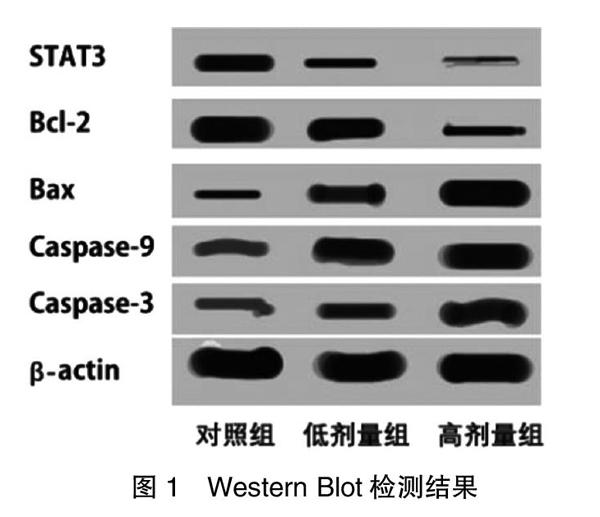
[Abstract] Objective To analyze the effect and mechanism of cloverleaf flavonoids regulated STAT3 signaling pathway on the proliferation and apoptosis of bladder cancer cells. Methods Bladder cancer T24 cells were divided into the control group,the low-dose group and the high-dose group,and treated with the blank medium,50 μg/mL cloverleaf flavonoids and 100 μg/mL cloverleaf flavonoids, respectively. Flow cytometry was used to detect the cell apoptosis, and MTT method was used to detect the apoptosis inhibition rates of T24 cells. The levels of Caspase-3, Caspase-9, Bax, Bcl-2, STAT3 and β-actin were detected by Western blot. Results The inhibitory rate of cell proliferation of bladder cancer cells in the high-dose group was significantly higher than that in the low-dose group, and the difference was statistically significant (P<0.05). The apoptosis rates of bladder cancer cells in the control group, the low-dose group and the high-dose group were significantly different, and the apoptosis rate in the high-dose group was the highest, and the differences were statistically significant(P<0.05). The expression levels of Caspase-3, Caspase-9, Bax, Bcl-2 and STAT3 were significantly different among all groups, and the expression levels of Caspase-3, Caspase-9 and Bax were the highest in the high-dose group, while the levels of Bcl-2 and STAT3 were the lowest, and the differences were statistically significant (P<0.05). Conclusion Cloverleaf flavonoids regulate STAT3 signaling pathway to inhibit proliferation and promote apoptosis of bladder cancer cells.
[Key words] Cloverleaf flavonoids; STAT3 signaling pathway; Bladder cancer; Cell proliferation; Cell apoptosis
膀胱癌是現阶段临床中较为常见的尿路上皮系统恶性肿瘤,一般情况下患者术后极易复发,且多种药物治疗效果和预防方案均不理想,并具有一定的毒副作用[1]。三叶青(Lespedeza buergeri miq)具有祛风化痰、清热解毒、活血止痛功效,临床中多用于对肺炎、小儿高热惊厥等症状进行治疗,且现也多用于对各类肿瘤进行治疗[2]。有学者采用三叶青对肿瘤患者进行治疗,可有效延缓患者生命,抑制肿瘤生长,改善患者生命征象等[3]。虽然三叶青是临床常用药,但其药理相关研究还有待进一步分析和完善[4]。大量研究结果显示,生物类黄酮多具有明确的抗肿瘤效果,因而对三叶青的成分进行鉴定和分析具有十分重要的意义[5]。前期对三叶青成分分离和鉴定分析发现三叶青富含黄酮[6],为进一步探讨三叶青在膀胱癌中的应用效果,本研究利用三叶青黄酮对膀胱癌细胞进行干预,分析三叶青黄酮调控STAT3信号通路对膀胱癌细胞增殖、凋亡的影响及作用机制,现报道如下。
1 材料与方法
1.1 三叶青黄酮制备
取1000 g三叶青块根,利用碱性稀醇提取法提取三叶青黄酮7.6 g,后利用聚酰胺层析后分别利用不同浓度(10%、30%、50%、70%、95%)乙醇洗脱,真空干燥后称重,分别标记HT10、HT30、HT50、HT70、HT95并合并样品分别取2 mg,使用200 μLDMSO溶解,震荡全部溶解后,加入1640培养基(800 μL)中,调整浓缩液浓度为20 mg/mL,置于4℃冰箱中保存。
1.2 细胞培养及分组
本研究所用人膀……