认知行为干预对糖尿病视网膜病变患者生活质量、负性情绪的影响
2021-09-16徐灯铃俞颂平
徐灯铃 俞颂平

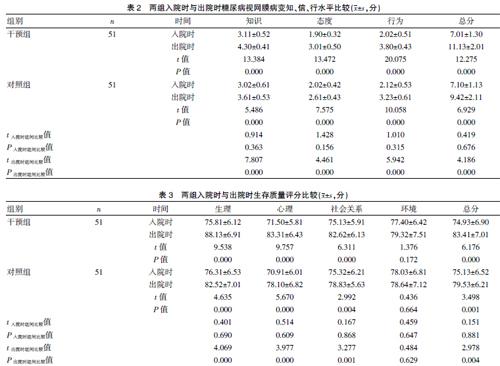

[摘要] 目的 探讨认知行为干预对糖尿病视网膜病变患者生活质量、负性情绪的影响。 方法 选择2019年8月至2020年6月在我院诊断治疗的糖尿病视网膜病变患者102例为研究对象,随机分为干预组与对照组,每组各51例。对照组采用常规健康教育,干预组采用认知行为干预。比较入院时与出院时两组糖尿病视网膜病变知、信、行水平,比较入院时与出院时两组生存质量、SAS、SDS评分。 结果 出院时两组糖尿病视网膜病变知识、態度、行为以及总分均显著高于入院时,差异有统计学意义(P<0.05);出院时,干预组糖尿病视网膜病变知识、态度、行为以及总分均显著高于对照组,差异有统计学意义(P<0.05)。出院时两组生存质量的生理、心理、社会关系以及总分均显著高于入院时,差异有统计学意义(P<0.05);出院时干预组生存质量的生理、心理、社会关系以及总分均显著高于对照组,差异有统计学意义(P<0.05)。出院时两组SAS、SDS评分较入院时显著下降,且干预组显著低于对照组,差异有统计学意义(P<0.05)。 结论 认知行为干预可显著纠正糖尿病视网膜病变患者的不良认知,进而改变行为模式,提高生活质量,缓解负性情绪。
[关键词] 认知行为干预;糖尿病视网膜病变;生活质量;负性情绪
[中图分类号] R714.256 [文献标识码] B [文章编号] 1673-9701(2021)15-0065-04
Impacts of cognitive behavioral intervention on the quality of life and negative emotion of patients with diabetic retinopathy
XU Dengling YU Songping
Department of Ophthalmology, Lishui Municipal Central Hospital in Zhejiang Province, Lishui 323000, China
[Abstract] Objective To investigate the impacts of cognitive behavioral intervention on the quality of life (QoL) and negative emotion of patients with diabetic retinopathy. Methods A total of 102 patients with diabetic retinopathy diagnosed and treated in our hospital from August 2019 to June 2020 were selected as the research objects and randomly divided into the intervention group (n=51) and the control group (n=51). The control group was treated with conventional health education, while the intervention group was treated with cognitive behavioral intervention. The comparison of cognitive, attitude and behavior of diabetic retinopathy between the two groups on admission and discharge, and the comparison of QoL, SAS and SDS scores between the two groups on admission and discharge. Results The cognitive, attitude, behavior and total score of diabetic retinopathies in the two groups on discharge were significantly higher than those on admission, with statistically significant differences(P<0.05). When discharged from hospital, the knowledge, attitude, behavior and total score of diabetic retinopathies in the intervention group were significantly higher than those in the control group, with statistically significant differences(P<0.05). The physiology, psychology, social relation and total score of the QoL between the two groups on discharge were significantly higher than those on admission, with statistically significant differences(P<0.05). The physiology, psychology, social relation and total scores of the QoL in the intervention group were significantly higher than those in the control group on discharge, with statistically significant differences(P<0.05). The scores of SAS, SDS in the two groups on discharge were significantly decreased, and those in the intervention group were obviously lower than those in the control group, with statistically significant differences(P<0.05). Conclusion Cognitive behavioral intervention can significantly correct the bad cognition of diabetic retinopathy patients, and then change their behavior patterns, improve their QoL and relieve their negative emotions.
[Key words] Cognitive behavioral intervention; Diabetic retinopathy; Quality of life; Negative emotion
糖尿病视网膜病变(Diabetic retinopathy,DR)是糖尿病高度特异性的微血管并发症。长期慢性高血糖产生氧化应激、炎症反应等可导致视网膜毛细血管发生病变,进而导致DR的发生。DR是成人新发失明最常见的病因,严重影响患者的生活质量,导致患者产生焦虑、抑郁情绪。认知行为干预是一种心理-社会干预疗法,通过纠正患者错误认知,调节患者的情绪,缓解负性情绪[1-2]。既往研究显示,认知行为疗法可改善1型糖尿病患者抑郁、焦虑等情绪,提高患者生活质量[3]。本研究对糖尿病视网膜病变患者进行认知行为干预,旨在探讨其对患者负性情绪及生活质量的影响,以期为临床提供参考,现报道如下。
1 资料与方法
1.1 一般资料
选择2019年8月至2020年6月在我院诊断治疗的糖尿病视网膜病变患者102例为研究对象。……