复杂系统视角下教育-科技-社会协同发展的关系研究
2021-07-11赵志华李茹
赵志华 李茹
【摘 要】在知识经济时代,教育、科技和社会的发展是区域经济发展的主要动力因素,明晰三者之间的协同发展关系是制定区域经济发展政策措施的基础。论文建立教育-科技-社会发展复杂系统协同度模型,以浙江等7个省份为例进行实证研究。通过发现三系统协同度的一般规律,为区域发展研究与地方政府政策制定提供理论依据。
【Abstract】In the era of knowledge economy, the development of education, science and technology and society is the main driving force of regional economic development. It is the basis of formulating regional economic development policies and measures to clarify the coordinated development relationship among the three. This paper establishes a coordination degree model of the complex system of education-science and technology-society development, and makes an empirical study of seven provinces including Zhejiang. By finding the general law of the coordination degree of three systems, this paper provides a theoretical basis for regional development research and local government policy-making.
【关键词】区域发展;协同度;面板数据;复杂系统
【Keywords】regional development; coordination degree; panel data; complex system
【中圖分类号】F124;G322 【文献标志码】A 【文章编号】1673-1069(2021)05-0128-02
1 引言
“十四五”时期,为推进区域高质量发展,如何促进各经济要素间产生“1+1>2”的协同效应成为人们关注的焦点。本文将教育、科技和社会的发展关系放在复合系统的框架下展开研究,分别建立3个子系统的有序度和协同度模型,以浙江等7个省份为研究对象进行实证分析,为各省和地区政府关于区域经济发展的决策提供参考。
2 研究理论及方法概述
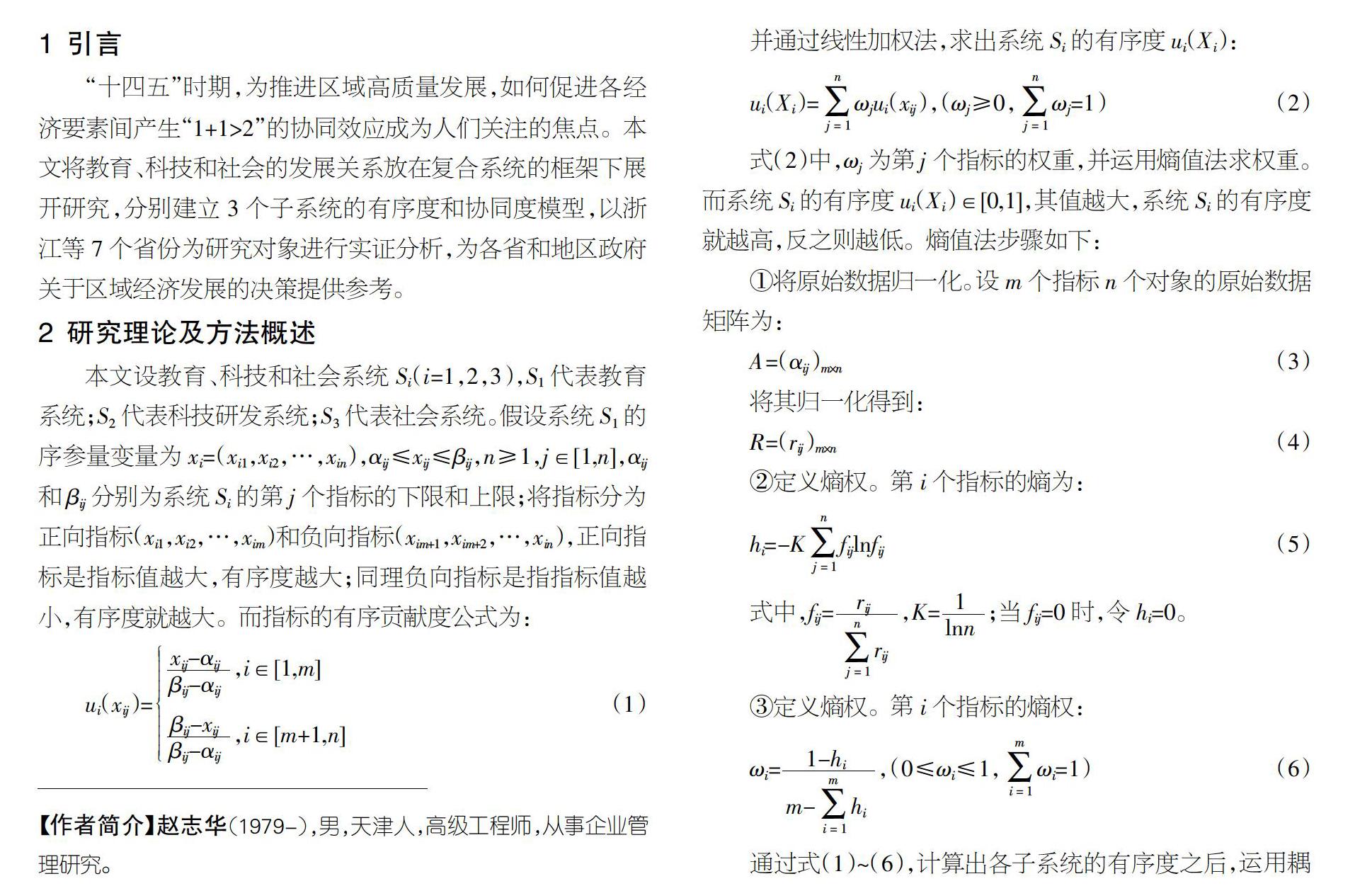
本文设教育、科技和社会系统Si(i=1,2,3),S1代表教育系统;S2代表科技研发系统;S3代表社会系统。假设系统S1的序参量变量为xi=(xi1,xi2,…,xin),?琢ij≤xij≤?茁ij,n≥1,j∈[1,n],?琢ij和?茁ij分别为系统Si的第j个指标的下限和上限;将指标分为正向指标(xi1,xi2,…,xim)和负向指标(xim+1,xim+2,…,xin),正向指标是指标值越大,有序度越大;同理负向指标是指指标值越小,有序度就越大。而指标的有序贡献度公式为:
并通过线性加权法,求出系统Si的有序度ui(Xi):
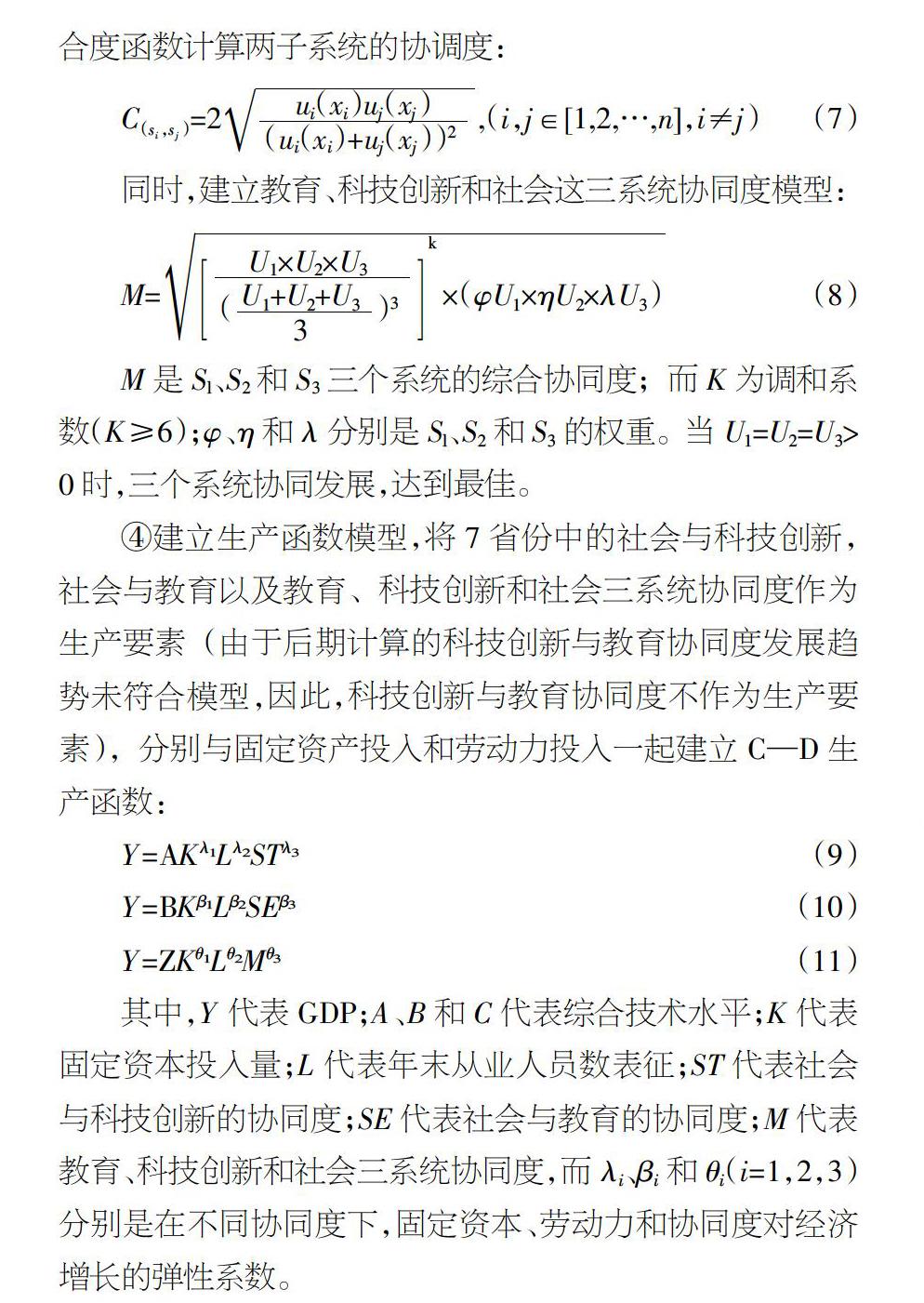
式(2)中,ωj为第j个指标的权重,并运用熵值法求权重。而系统Si的有序度ui(Xi)∈[0,1],其值越大,系统Si的有序度就越高,反之则越低。熵值法步骤如下: