莫高窟第196窟壁画可溶盐分析及相关问题研究
2021-06-15张亚旭于宗仁王丽琴崔强水碧纹孙胜利
张亚旭 于宗仁 王丽琴 崔强 水碧纹 孙胜利
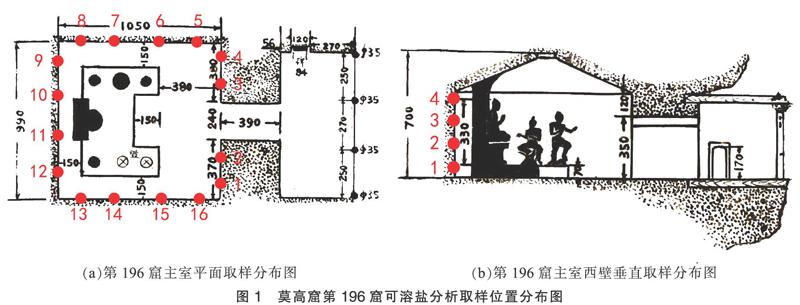
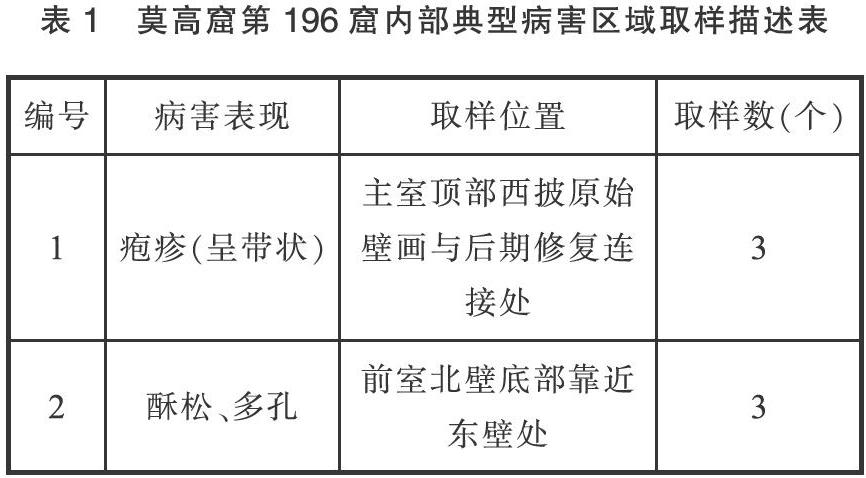

内容摘要:酥碱与疱疹是莫高窟壁画可溶盐破坏的两种外在表现形式。本研究为明确莫高窟顶层洞窟第196窟内部可溶盐种类及分布状况,采用离子色谱分析仪、扫描电镜能谱、X射线衍射分析仪等,对取自第196窟的多个样品进行检测分析。结果表明,主室内部以西壁可溶盐含量最高,南北壁次之,东壁最少,造成壁画破坏的可溶盐以NaCl为主,部分区域存在少量Na2SO4。环境相对湿度监测结果显示,降雨时洞窟内部相对湿度最高可达73%,超过莫高窟环境湿度监测预警值。洞窟内部产生带状疱疹的原因是早期修复时混合石灰砂浆不当用水所致。前室北壁底部区域酥松现象主要由可溶盐Na2SO4溶解结晶破坏所致,而较高区域的酥松以动物筑洞产生的机械破坏为主导。该研究成果对丰富莫高窟可溶盐种类及分布信息具有重要作用,同时为第196窟壁画保护修复提供参考。
关键词:莫高窟;第196窟;酥碱;疱疹;离子色谱
中图分类号:K854.3 文献标识码:A 文章编号:1000-4106(2021)01-0148-08
Abstract:Salt efflorescence and blistering are two kinds of deterioration in Mogao cave murals caused by soluble salts. This study analyzes the types and distribution of soluble salts in Mogao cave 196 by analyzing samples using ion chromatography(IC), scanning electron microscopy with energy dispersive spectrometry(SEM-EDS), and X-ray diffraction(XRD). The results show that there is a high concentration of soluble salt in the west wall, a moderate concentration in the north and south walls, and a low level of salt in the east wall. The majority of the deterioration suffered by murals results from NaCl while a small amount of Na2SO4 can be detected in some areas as well. The results of humidity monitoring detection show that the relative moisture level inside the cave increases to 73% during the rainy season, which is above the warning value for the environmental humidity of the Mogao caves. The blistering in the caves is caused by improper mixing of water with lime mortar during early restoration work. The phenomena of degeneration visible at the bottom of the north wall in the front chamber was mainly caused by soluble salt Na2SO4, while the damage in the upper areas was mostly caused by animals or insects digging holes. This research aims to provide a better understanding of the types and distribution of soluble salts in the Mogao caves in order to provide the basis of information necessary for conservation and restoration of the murals in cave 196.
Keywords:Mogao Grottoes; cave 196; salt efflorescence; blistering; Ion Chromatography
1 引 言
可溶鹽引起的酥碱、疱疹与盐霜是威胁莫高窟壁画长久保存的重要因素,酥碱甚至被称为壁画的“癌症”[1]。为解决可溶盐对敦煌壁画造成的破坏,最大限度延长文物本体寿命。近年来敦煌研究院联合国内多家单位针对莫高窟壁画盐害从水盐来源[2-4]、可溶盐破坏机理[5-7]、脱盐材料研发[8,9]等方面开展相关研究。但以上工作的基础是对造成壁画破坏的可溶盐种类及含量信息进行有效获取。……
