周围神经阻滞麻醉对子宫颈癌患者炎症因子及免疫功能影响
2021-05-10刘忠涛
刘忠涛
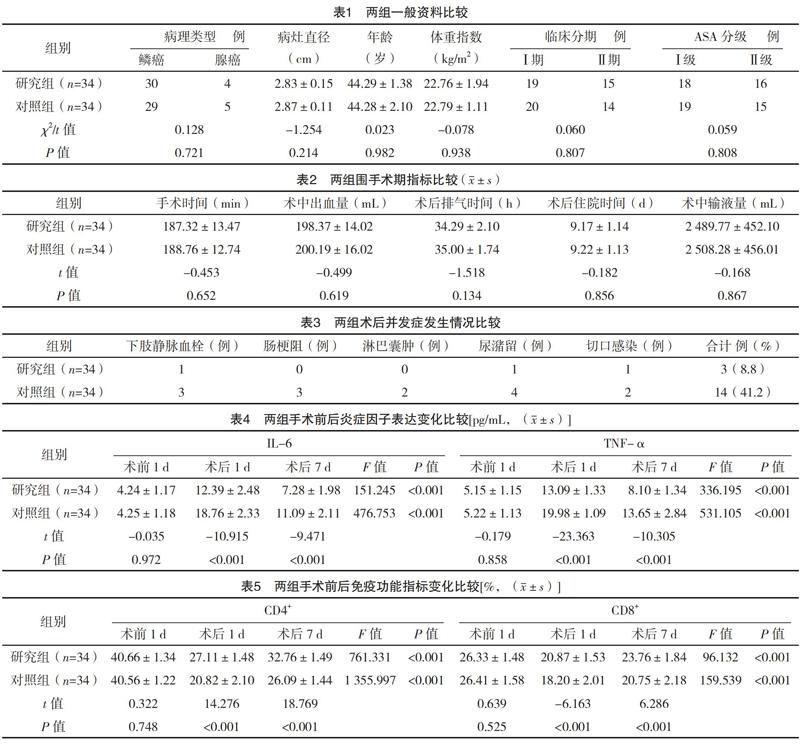
【摘要】 目的:探討周围神经阻滞麻醉对子宫颈癌患者炎症因子及免疫功能的影响。方法:选择2017年5月-2018年12月在本院进行子宫颈癌根治手术的患者68例作为研究对象。根据随机数字表法将患者分为研究组与对照组,各34例。对照组给予单纯全身麻醉,研究组在对照组麻醉的基础上给予周围神经阻滞麻醉,比较两组麻醉效果、炎症因子及免疫功能变化情况。结果:两组均顺利完成手术。两组手术时间、术中出血量、术后排气时间、术后住院时间、术中输液量比较,差异均无统计学意义(P>0.05)。研究组术后7 d的下肢静脉血栓、肠梗阻、淋巴囊肿、尿潴留、切口感染等并发症发生率为8.8%,显著低于对照组的41.2%(P<0.05)。术后1、7 d,两组的血清IL-6与TNF-α水平均高于术前1 d,研究组均低于对照组,差异均有统计学意义(P<0.05)。术后1、7 d,两组的CD4+、CD8+T淋巴细胞比例均低于术前1 d,研究组均高于对照组,差异均有统计学意义(P<0.05)。结论:周围神经阻滞麻醉在子宫颈癌手术患者中的应用并不影响手术效果,且能抑制炎症因子的释放,促进改善患者的免疫功能,减少术后并发症的发生。
【关键词】 周围神经阻滞麻醉 子宫颈癌 炎症因子 免疫功能 并发症
[Abstract] Objective: To investigate the effects of peripheral nerve block anesthesia on inflammatory factors and immune function in patients with cervical cancer. Method: A total of 68 patients with cervical cancer undergoing radical surgery in our hospital from May 2017 to December 2018 were selected as the research subjects. According to random number table method, the patients were divided into study group and control group, 34 cases in each group. The control group was given simple general anesthesia, and the study group was given peripheral nerve block anesthesia on the basis of the control group anesthesia. The changes of anesthesia effect, inflammatory factors and immune function were compared in the two groups. Result: The operation were completed successfully in both groups, and there were no significant differences in operative time, intraoperative blood loss, postoperative exhaust time, postoperative hospital stay and intraoperative fluid infusion volume between the two groups (P>0.05). 7 d after operation, the incidence of lower limb venous thrombosis, intestinal obstruction, lymphatic cyst, urinary retention, incision infection and other complications in the study group was 8.8%, significantly lower than 41.2% in the control group (P<0.05). 1 and 7 d after surgery, serum IL-6 and TNF-α levels in both groups were higher than those on day 1 before surgery, while those in the study group were lower than those in the control group, the differences were statistically significant (P<0.05). 1 and 7 d after surgery, the percentages of CD4+ and CD8+ T lymphocytes in both groups were lower than those in the 1 d before surgery, while those in the study group were higher than those in the control group, the differences were statistically significant (P<0.05). Conclusion: The application of peripheral nerve block anesthesia in patients undergoing cervical cancer surgery does not affect the surgical effect, and can inhibit the release of inflammatory factors, promote the improvement of the immune function of patients, and reduce the incidence of postoperative complications.
[Key words] Peripheral nerve block anesthesia Cervical cancer Inflammatory factors Immune function Complications
First-authors address: The Central Hospital of Jiamusi City, Jiamusi 154002, China
doi:10.3969/j.issn.1674-4985.2021.08.001
子宫颈癌是临床上最常见的妇科恶性肿瘤,当前该病的发病群体逐渐年轻化,严重威胁着女性健康。子宫颈癌的主要治疗方法包括放疗、化疗、手术等,其中手术为早期子宫颈癌的主要治疗方法[1-2]。
手术虽然为患者提供了治愈机会,也可能将肿瘤完全切除,但是手术与麻醉的创伤比较大,可导致患者出现生理、心理应激反应,影响患者的免疫功能[2-4]。免疫系统与子宫颈癌的发生、复发、发展、转移密切相关,手术与麻醉能引起机体围术期免疫抑制,有利于肿瘤细胞逃避免疫监视,导致肿瘤术后发生转移[5-7]。手术与麻醉对组织的损伤也可刺激机体释放各种炎症因子,主要为白介素6(IL-6)、肿瘤坏死因子α(TNF-α)等,可加重患者的應激反应,并直接或间接地影响患者免疫功能[8-9]。全身……