比较安罗替尼联合华蟾素或顺铂对非小细胞肺癌并恶性胸腔积液的临床治疗情况
2021-05-06米虽才吴玲艳陈志明罗建文
米虽才 吴玲艳 陈志明 罗建文
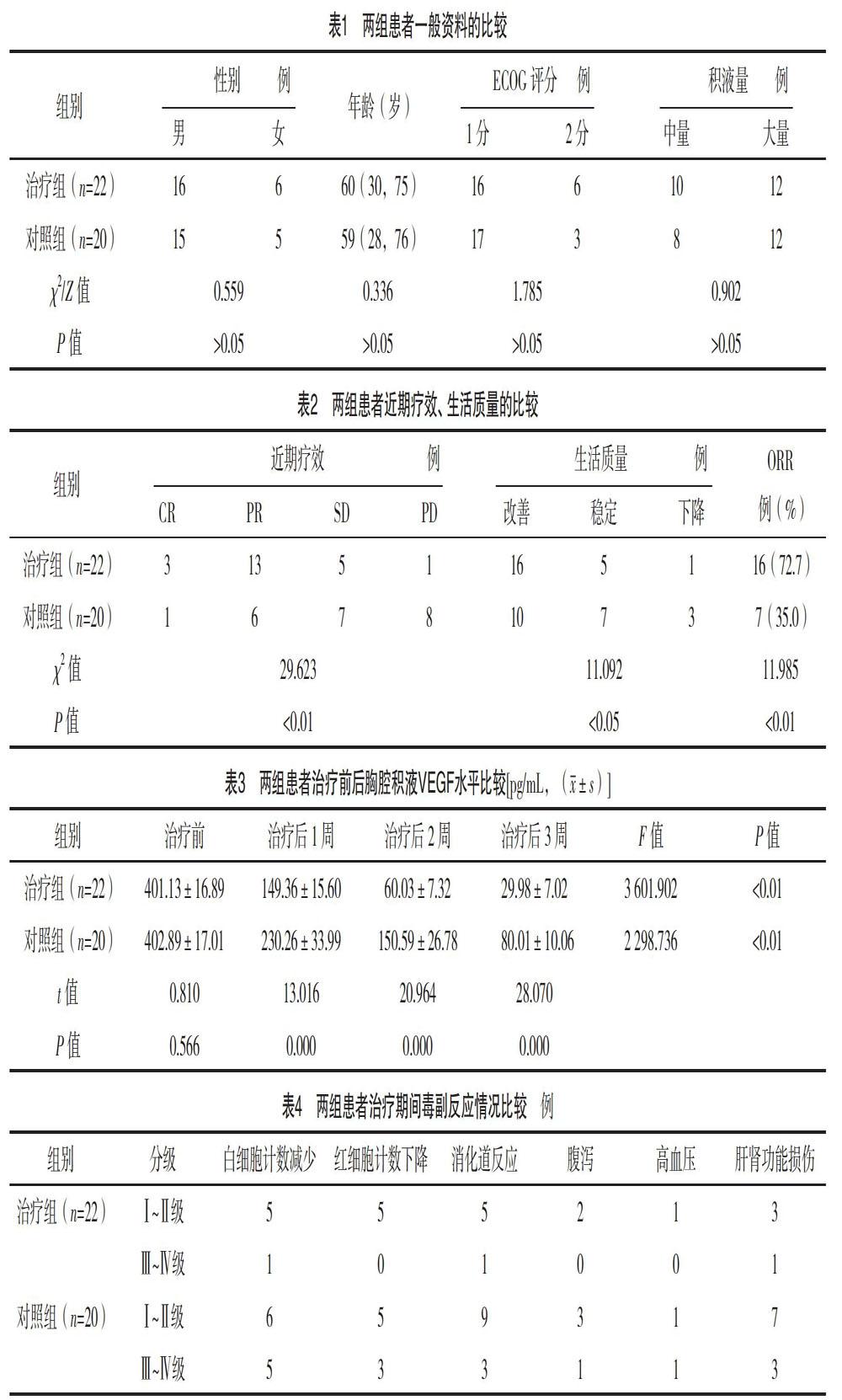
【摘要】 目的:观察安罗替尼联合华蟾素或顺铂注射液胸腔灌注治疗NSCLC并恶性胸腔积液的疗效及安全性。方法:将2018年6月-2020年2月收治的42例多方案治疗后NSCLC伴胸腔积液患者,随机分为治疗组22例及对照组20例。两组患者均行胸穿置管引流胸腔积液,予安罗替尼胶囊口服治疗,治疗组联合华蟾素,对照组联合顺铂,比较两组患者的近期疗效、生活质量,治疗1、2、3周后VEGF水平及毒副反应情况。结果:治疗组客观缓解率为72.7%,高于对照组35.0%(P<0.01);无进展生存时间为89 d,亦长于对照组49 d(P<0.05)。治疗后1、2、3周后,治疗组患者胸腔积液VEGF水平明显较对照组更为降低(P<0.05)。治疗组患者出现骨髓抑制、胃肠道毒副反应、肝肾功能损害等发生率均低于对照组(P<0.05)。两组无咯血、血栓形成等不良事件发生。结论:安罗替尼联合华蟾素治疗NSCLC恶性胸腔积液的疗效显著,且优于联合顺铂,可有效降低VEGF水平,安全性较好。
【关键词】 安罗替尼 华蟾素 非小细胞肺癌 胸腔积液
[Abstract] Objective: To observe the efficacy and safety of Anlotinib combined with Huachansu or Cisplatin Pleural Infusion in the treatment of malignant pleural effusion in patients with non-small cell lung cancer (NSCLC). Method: From June 2018 to February 2020, 42 patients with NSCLC with pleural effusion after multi-line therapy were randomly divided into two groups, the treatment group was given Anlotinib combined with Huachansu, the control group was given Anglotinib combined with Cisplatin. The therapeutic efficacy and side effects of the two groups were evaluated respectively, and the VEGF levels of the patients after 1 week, 2 weeks and 3 weeks of treatment were compared. Result: The effective rate of the treatment group was 72.7%, which was higher than that of the control group with 35.0% (P<0.01). The PFS of the treatment group was 89 days, which was also higher than that of the control group with 49 days (P<0.05). The VEGF level of pleural effusion in the treatment group was significantly lower than that in the control group at 1 week, 2 weeks and 3 weeks after treatment (P<0.05). The incidence leukopenia, nausea and vomiting, liver and kidney function damage were also lower than those in the control group (P<0.05). No adverse events such as hemoptysis and thrombosis occurred in the two groups. Conclusion: Amlotinib combined with Huachansu is effective in the treatment of malignant pleural effusion in NSCLC, and it is superior to Cisplatin in the treatment of malignant pleural effusion, it can effectively reduce the level of VEGF and is safe.
[Key words] Alotinib Huachansu Non-small cell lung cancer Pleural effusion
惡性胸腔积液是最常见的恶性肿瘤并发症之一,中晚期非小细胞肺癌(NSCLC)常常合并恶性胸腔积液,恶性的胸腔积液形成是直接导致晚期NSCLC不良预后的重要危险因素[1]。安罗替尼是一种新型的抗恶性肿瘤治疗药物,在抗肿瘤血管生成和抑制肿瘤生长方面的临床效果显著,具有较好的特异性及安全性[2]。2018年5月8日被cFDA批准用于肺癌的三线及以上治疗,且被中国临床肿瘤学会(Chinese society of clinical oncology,CSCO)纳入指南使用[3]。笔者通过随机分组的研究,对比了安罗替尼联合使用华蟾素与其联合使用顺铂胸腔内灌注治疗NSCLC恶性胸腔积液的临床治疗的疗效及临床相关的毒副反应情况,现报道如下。
1 资料与方法
1.1 一般资料 选取2018年6月-2020年2月在本科收治的42例多线方案多次治疗后的局部晚期或转移性NSCLC伴恶性胸腔积液患者,男31例,女11例。以数字表法将患者随机分为治疗组22例,对照组20例。(1)纳入标准:①患者年龄18~70周岁。……