全面化护理对提高青光眼患者睡眠质量的影响分析
2020-10-21沈秀
沈秀

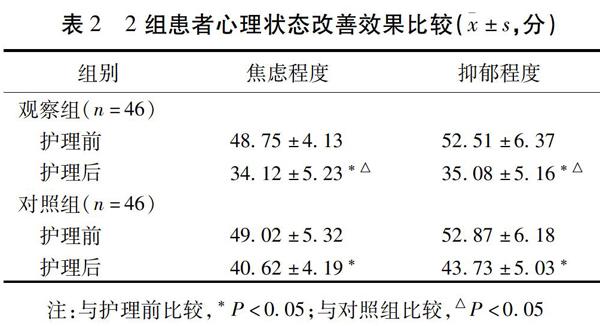
摘要 目的:探讨全面化护理对提高青光眼患者睡眠质量的影响。方法:选取2017年2月至2019年2月福建省厦门大学附属第一医院眼科收治的青光眼患者92例作为研究对象,按照随机数字表法分为对照组和观察组,每组46例。对照组和观察组分别行常规护理、全面化护理,评价2组睡眠质量及心理状态变化。结果:护理后,观察组睡眠质量评分明显降低,且显著低于对照组,差异有统计学意义(P<0.05);护理后,观察组患者心理状态焦虑及抑郁评分明显改善,且评分显著低于对照组,差异有统计学意义(P<0.05)。结论:针对青光眼患者开展全面化护理干预利于进一步改善其心理状态,提高睡眠质量,保持充足休息,利于预后,值得推广。
关键词 全面化护理;青光眼;睡眠质量
Effect of Comprehensive Nursing on Improving Sleep Quality of Glaucoma Patients
SHEN Xiu
(Department of Ophthalmology,First Affiliated Hospital of Xiamen University,Xiamen 361000,China)
Abstract Objective:To explore the effect of comprehensive nursing on improving sleep quality of glaucoma patients.Methods:A total of 92 patients with glaucoma in our hospital from February 2017 to February 2019 were randomly divided into control group and observation group,with 46 cases in each group.The control group was given routine nursing,while the observation group was given comprehensive nursing respectively.The sleep quality and psychological state of the two groups were evaluated.Results:After nursing,the sleep quality score of the observation group was significantly lower than that of the control group(P<0.05).After nursing,the anxiety and depression score of the observation group was significantly improved,and the score was significantly lower than that of the control group(P<0.05).Conclusion:Comprehensive nursing intervention for glaucoma patients is helpful to further improve their mental state,improve sleep quality,maintain adequate rest and prognosis,which is worthy of promotion.
Keywords Comprehensive nursing; Glaucoma; Sleep quality
中圖分类号:R775;R338.63文献标识码:Adoi:10.3969/j.issn.2095-7130.2020.01.068
青光眼属于常见的眼科疾病,具有致盲性,发病后会引起眼胀、眼痛、畏光、流泪、头痛及视力锐减等特征,严重危害患者生命质量[1]。当前治疗该疾病以降低眼压,减少眼组织损害为主,但患者视力受到影响,并伴随诸多症状,对其身心均造成较大影响,尤其影响其睡眠状态,无法获得充足的休息时间,导致长期处于疲劳状态,降低生命质量[2]。通过展开全面化护理工作,可考虑到患者的心理因素及症状表现,通过开展护理服务调节心理状态,减轻症状,利于全身放松,改善睡眠状态,提高睡眠质量。为此,本次研究对全面化护理对提高青光眼患者睡眠质量的影响进行了探讨,现将结果报道如下。
1 资料与方法
1.1 一般资料 选取2017年2月至2019年2月福建省厦门大学附属第一医院眼科收治的青光眼患者92例作为研究对象,按照随机数字表法分为对照组和观察组,每组46例。对照组中男25例,女21例;年龄45~72岁,平均年龄(56.95±4.03)岁;病程4 d~12 d,平均病程(7.08±0.64)d。……