关于社区慢性非传染性疾病健康教育的效果分析
2020-09-02曹庆玲
曹庆玲
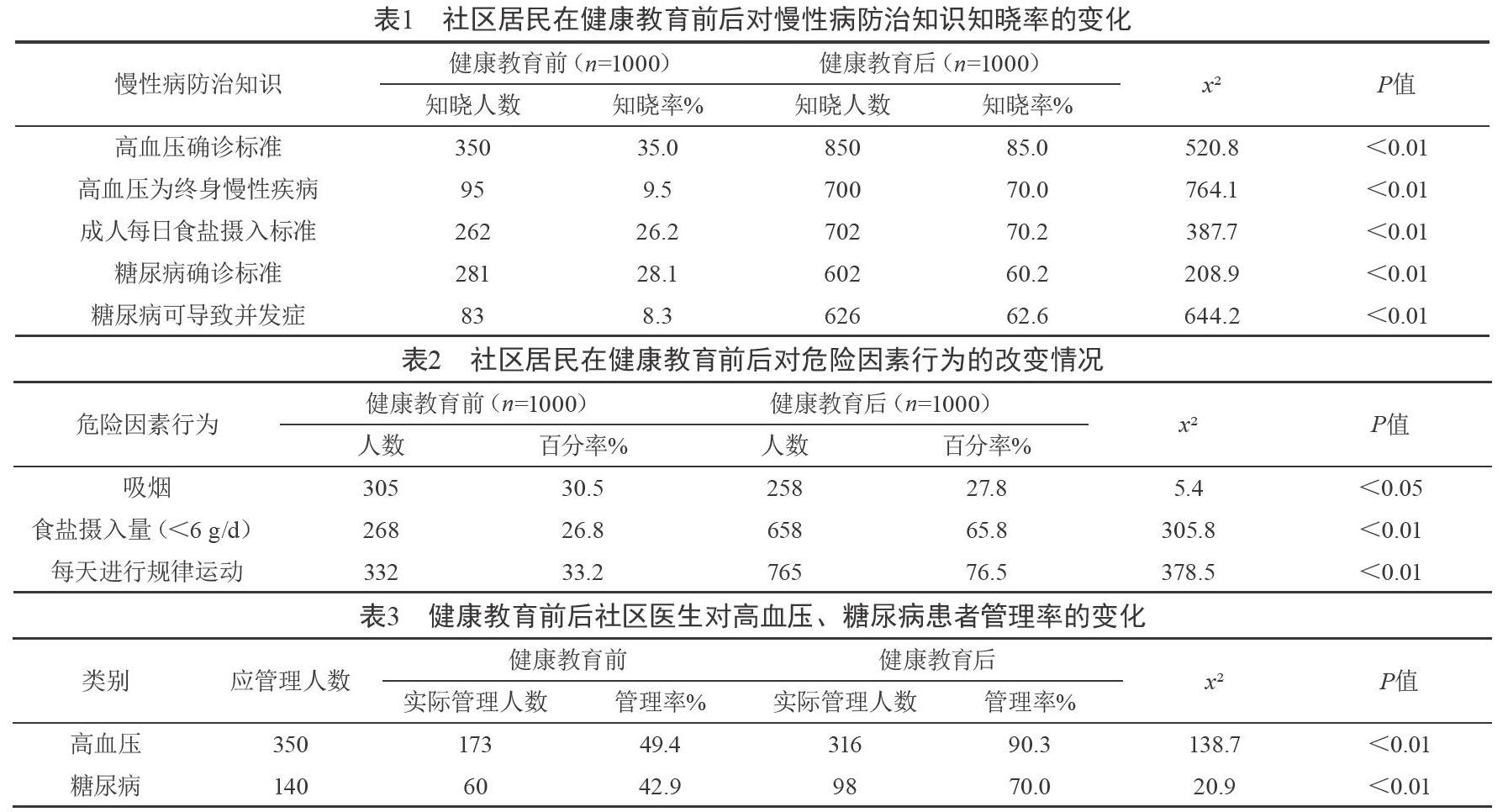
【摘要】目的 健康教育对社区慢性非传染性疾病居民健康的影响。方法 本文通过对王安社区1000名居民健康教育前后对慢性非传染性疾病防治知识的知晓率,健康教育前后对危险因素行为的改变情况,健康教育前后社区责任医生对高血压、糖尿病患者管理率的变化三个方面进行比较研究。结果 健康教育后,居民对高血压的确诊标准、高血压为终身慢性疾病、成人每日食盐摄入标准、糖尿病确诊标准、糖尿病可导致并发症的知晓率有了很大提高(均P<0.01),健康行为有了很大改变,吸烟人数明显减少(P<0.05),减少食盐摄入量人数和每天规律运动的人数明显增加(均P<0.01),社区责任医生对高血压和糖尿病患者的管理率有明显提高(均P<0.01)。结论 以健康教育为主要形式的行为危险因素干预在社区居民防治慢性非传染性疾病中发挥了重要作用。
【关键词】慢性非传染性疾病;健康教育;干预性研究
【中图分类号】R193 【文献标识码】A 【文章编号】ISSN.2095.6681.2020.21..02
【Abstract】Objective The impact of health education on the health of community residents with chronic noncommunicable diseases.Methods This paper conducts a comparative study through three aspects.Firstly,awareness rate of chronic noncommunicable diseases prevention and treatment before and after health education for 1000 residents in Wangan community.Secondly,changes in risk factor behavior before and after health education.Finally,changes in the management rate of hypertension and diabetes patients by community responsibility doctors before and after health education.Results After health education,the awareness rate of residents has been greatly improved about diagnostic criteria for hypertension in residents,hypertension is a lifelong chronic disease,daily salt intake for adults,diagnostic criteria for diabetes and diabetes can lead to complications(all P<0.01).Through health education,people's health behavior has changed a lot,there has been a marked decrease in smoking(P<0.05),the number of people who reduced their salt intake and exercised regularly each day increased significantly(all P<0.01),the management rate of hypertension and diabetes patients by community responsibility doctors has been significantly improved(all P<0.01).Conclusion Behavioral risk factor intervention plays an important role in community prevention and treatment of chronic noncommunicable diseases,especially take health education as the main form.
【Key words】Chronic non communicable diseases;Health education;Intervention research
为探究健康教育在慢性病防治中的作用与效果,王安社区进行了有组织有计划的健康教育和促进活动,收到了明显效果,现将结果报道如下。
1 材料和方法
1.1 调查对象
2018年1月~2020年1月,采用分层抽样方法抽取35岁以上社区居民1000名,其中男性476名,女性524名,65岁以上156名,基本符合辖区人口比例。高血压患者350名,糖尿病患者140名,冠心病患者150名,肿瘤患者5名。健康教育前后(一般间隔1~3个月)采用问卷形式和电话咨询两种方式调查被调查人员对高血压、糖尿病、肿瘤、冠心病等慢性病的防治知识的掌握情况,行为方式的改变情况。健康教育前后的数据输入电脑做统计处理。
1.2 健康教育的实施
1.2.1 健康教育的内容
以慢性非传染性疾病防治為主,对患者宣教的内容包括用药、行为、心理等,例如饮食方面,要告知高血压糖尿病……
