床旁即时超声测定肾阻力指数指导急性肾损伤CRRT启动时机的研究
2020-08-13邓文龙陈丽珍李俊岭
邓文龙 陈丽珍 李俊岭

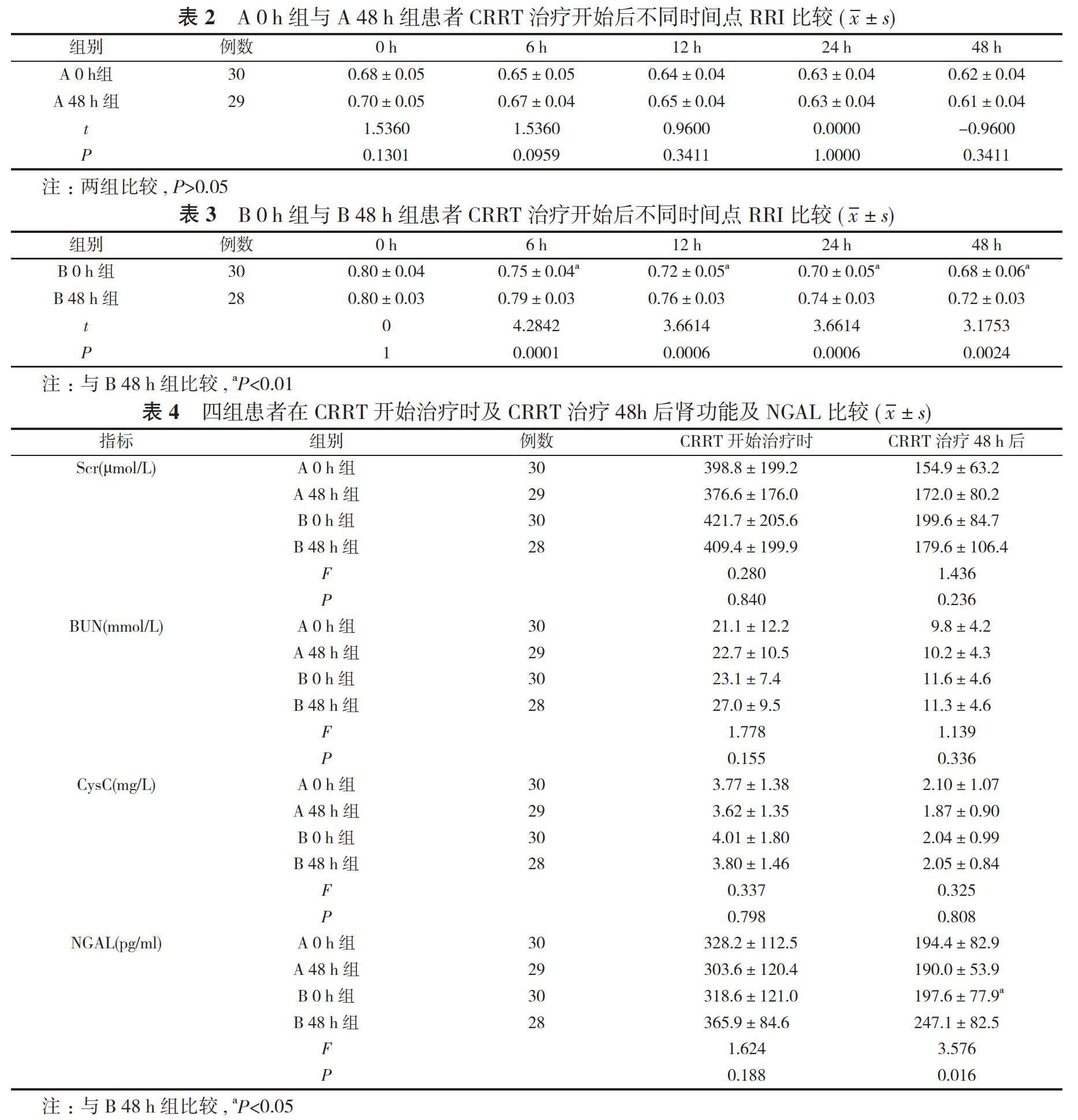

【摘要】 目的 研究床旁即时超声测定肾阻力指数(RRI)指導急性肾损伤(AKI)患者连续性肾脏替代疗法(CRRT)的启动时机。方法 117例AKI并行CRRT治疗的患者, 根据患者入重症加强护理病房(ICU)时(0)测定的RRI值, 以RRI值0.74为临界值, 分为A组(RRI≤0.74)和B组(RRI>0.74);再根据入院时RRI及CRRT启动时间分为A 0 h组(RRI≤0.74+早期CRRT治疗组, 30例)、A 48 h组(RRI≤0.74+48 h后CRRT治疗组, 29例)、B 0 h组(RRI>0.74+早期CRRT治疗组, 30例)及B 48 h组(RRI>0.74+48 h后CRRT治疗组, 28例)。比较四组患者不同时间点的RRI及血肌酐(Scr)、血尿素氮(BUN)、血胱抑素C(CysC)、血浆中性粒细胞明胶酶相关脂质运载蛋白(NGAL)水平及其预后情况。结果 B 0 h组患者CRRT治疗开始后6、12、24、48 h的RRI分别为(0.75±0.04)、(0.72±0.05)、(0.70±0.05)、(0.68±0.06), 均低于B 48 h组的(0.79±0.03)、(0.76±0.03)、(0.74±0.03)、(0.72±0.03), 差异有统计学意义(P<0.01)。四组患者的NGAL水平比较差异有统计学意义(P<0.05);在进一步的多重比较中, B 0 h组患者的NGAL显著低于B 48 h组, 差异有统计学意义(P<0.05)。A 0 h组、A 48 h组、B 0 h组及B 48 h组患者在观察期内分别死亡14例(46.67%)、16例(55.17%)、16例(53.33%)及21例(75.00%)。四组患者生存时间比较差异有统计学意义(P<0.05)。在进一步的成对比较中, A 0 h组、A 48 h组、B 0 h组患者生存时间均显著优于B 48 h组, 差异有统计学意义(P<0.05)。结论 测定RRI能早期发现肾脏血流动力学的改变, 并能用于指导AKI患者何时启动CRRT支持治疗, 当RRI>0.74时, 尽早启动CRRT可更好地改善患者的预后。
【关键词】 床旁即时超声;肾阻力指数;急性肾损伤;连续性肾脏替代疗法;中性粒细胞明胶酶相关脂质运载蛋白
DOI:10.14163/j.cnki.11-5547/r.2020.20.001
【Abstract】 Objective To study the timing of continuous renal replacement therapy (CRRT) in acute kidney injury (AKI) under the guidance of renal resistive index (RRI) by point-of-care ultrasound. Methods A total of 117 AKI patients undergoing CRRT were divided into group A (RRI≤0.74) and group B (RRI>0.74) based on the RRI value measured when the patient entered the intensive care unit (ICU) (0), with the RRI value 0.74 as the critical value. According to the RRI on admission and CRRT timing, they were divided into A 0 h group (RRI≤0.74+early CRRT treatment group, 30 cases), A 48 h group (RRI≤0.74+48 h CRRT treatment group, 29 cases), B 0 h group (RRI> 0.74+early CRRT treatment group, 30 cases) and B 48 h group (RRI>0.74+48 h after CRRT treatment group, 28 cases). The levels of RRI and blood creatinine (Scr), blood urea nitrogen (BUN), blood cystatin C (Cys C), plasma neutrophil gelatinase-associated lipocalin (NGAL) levels at different time points of the four groups were compared. Results 6, 12, 24 and 48 h after CRRT, RRI of B 0 h group were (0.75±0.04), (0.72±0.05), (0.70±0.05) and (0.68±0.06), which were all lower than those of B 48 h group (0.79±0.03), (0.76±0.03), (0.74±0.03) and (0.72±0.03), and the difference was statistically significant (P<0.01). There was statistically significant difference in NGAL level in four groups (P<0.05). In further multiple comparisons, NGAL of B 0 h group was significantly lower than that of B 48 h group, and the difference was statistically significant (P<0.05). During the observation period, 14 patients (46.67%), 16 patients (55.17%), 16 patients (53.33%) and 21 patients (75.00%) died in A 0 h group, A 48 h group, B 0 h group and B 48 h group respectively. There was no statistically significant difference in survival time among the four groups (P<0.05). In further paired comparisons, the survival time of A 0 h group, A 48 h group and B 0 h group was significantly better than that of B 48 h group, and the difference was statistically significant (P<0.05). Conclusion RRI can detect the changes of renal hemodynamics in early stage and guide the initiation of CRRT in patients with AKI. When RRI>0.74, early initiation of CRRT can improve the prognosis of patients.
【Key words】 Point-of-care ultrasound; Renal resistive index; Acute kidney injury; Continuous renal replacement therapy; Neutrophil gelatinase associated lipocalin
急性肾损伤(acute kidney injury, AKI)是由于重症患者多存在高龄、糖尿病、慢性心肺疾病等基础, 在感染、创伤、休克等因素的打击下出现的新发的急性肾脏疾病[1]。AKI的发病率为1%~20%, 其中ICU内的发病率高于一般人群, 其病死率高达50%~60%, 是ICU重症患者的重要死亡原因。连续性肾脏替代疗法(continuous renal replacement therapy, CRRT)是AKI极为重要的治疗措施, 其通过调节患者容量状态、纠正酸碱失衡及电解质紊乱、改善氮质血症等, 进而可能改善患者预后。但是, 目前临床上对于何时开始CRRT意见不一。近年来床旁即时超声技术被国外发达国家和地区作为重症患者血流动力学监测和器官灌注评估的常规工具广泛应用。研究表明, AKI患者肾血流灌注减少可能远早于血清Scr水平升高及尿量减少等临床表现的出现[2], 早期发现肾脏血流动力学的改变将有助于AKI的早期诊断, 也为CRRT治疗时机的选择提供了另外一条钥匙。本课题应用床……
