基于知信行模式的健康教育干预在精神分裂症康复期患者中的应用效果
2020-04-16邹海云肖慧莉张映莲
邹海云 肖慧莉 张映莲


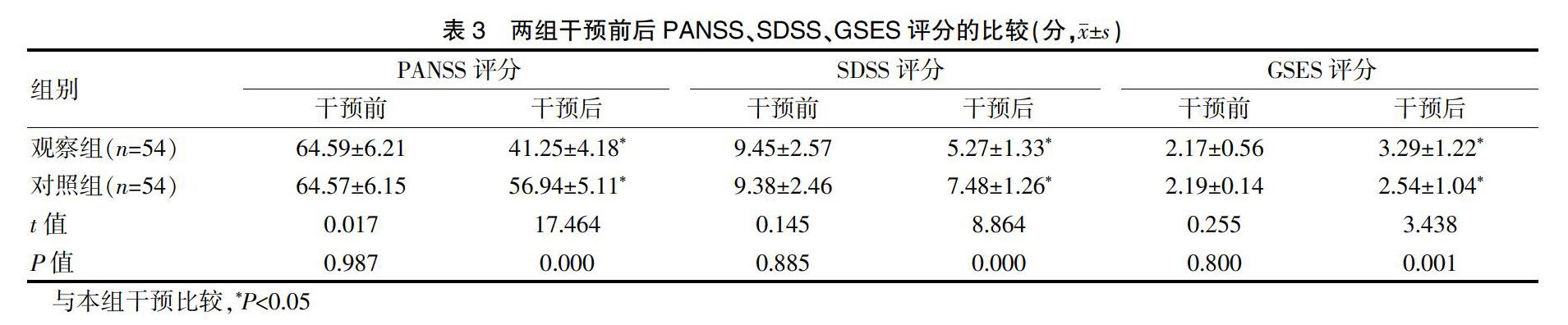
[摘要]目的 探討基于知信行(KAP)模式的健康教育干预在精神分裂症康复期患者中的应用效果。方法 选取2018年9月~2019年2月在我院康复护理的108例精神分裂症患者,采用信封法随机分为观察组和对照组,每组各54例。对照组给予常规健康教育,观察组在此基础上给予KAP模式的健康教育干预,比较干预前后两组康复状态。结果 观察组干预后服药、体能训练、营养饮食、社会活动、康复训练及生活习惯的依从率高于对照组(P<0.05);干预后两组心理社会、动力精力症状、症状和副作用评分低于干预前,且观察组干预后以上评分均低于对照组,差异有统计学意义(P<0.05);干预后两组症状评分(PANSS)、社会功能(SDSS)评分均低于干预前,自我效能评分(GSES)评分高于干预前,且观察组干预后SDSS、PANSS评分低于对照组,GSES评分高于对照组,差异有统计学意义(P<0.05)。结论 KAP模式的健康教育干预在精神分裂症康复期患者中应用较佳,可显著改善患者生活质量、临床症状及遵医行为,进一步提高社会功能及自我效能,预后好,值得临床推广应用。
[关键词]知信行模式;健康教育;精神分裂症康复期;预后
[中图分类号] R473.74 [文献标识码] A [文章编号] 1674-4721(2020)3(a)-0246-04
Application effect of health education intervention based on knowledge, attitude, practice model in patients with schizophrenia in rehabilitation period
ZOU Hai-yun XIAO Hui-li ZHANG Ying-lian
Department of Psychiatry, the Third People′s Hospital of Ji′an City, Jiangxi Province, Ji′an 343000, China
[Abstract] Objective To investigate the application effect of health education intervention based on knowledge, attitude, practice (KAP) model in patients with schizophrenia in rehabilitation period. Methods A total of 108 patients with schizophrenia who underwent rehabilitation nursing in our hospital from September 2018 to February 2019 were enrolled in the study. They were randomly divided into observation group and control group by envelope method, 54 cases in each group. The control group was given routine health education. On this basis, the observation group was given health education intervention based on KAP model. The rehabilitation status was compared between the two groups before and after intervention. Results The compliance rates of medication, physical training, nutritional diet, social activities, rehabilitation training and living habits of the observation group after intervention were higher than those of the control group (P<0.05). The scores of psycho-social factor, dynamic energy symptoms, symptoms and side effects of both groups after intervention were lower than before intervention. Besides, the above scores of the observation group after intervention were lower than those of the control group (P<0.05). After intervention, scores of positive and negative syndrome scale (PANSS) and social disability screening schedule (SDSS) of both groups were lower than those of before intervention, while scores of general self efficacy scale (GSES) were high than that of before intervention, SDSS and PANSS scores of the observation group after intervention were lower than those of the control group, while the GSES score was higher than the control group (P<0.05). Conclusion The application of health education intervention based on KAP model is relatively better in patients with schizophrenia during rehabilitation period. It can significantly improve quality of life, clinical symptoms and compliance behavior of patients, further improve social function and self-efficacy, with good prognosis. It is worthy of clinical promotion and application.
[Key words] Knowledge, attitude, practice model; Health education; Schizophrenia during rehabilitation period; Prognosis
精神病分裂患者异常的思维可能会影响其意志行为及情感,甚至出现危害社会的行为,患者常缺乏社会及家庭的关爱,产生自卑感,影响服药依从性[1]。精神病分裂患者病程较长,治疗依从性差,导致出现反复住院的情况,影响其社会及生活技能,维持治疗并提供家庭生活支持对患者恢复十分重要。常规药物治疗仅能控制患者的临床症状,对患者生活能力及社会能力无显著影响[2]。传统的健康教育为传授讲学,患者及家属自学依从性差,无法满足临床护理需求[3]。知信行(KAP)模式构建健康教育干预是一种新型护理模式,通过健康教育、产生信念、形成行为三种方式改变患者行为,其干预效果已得到临床认可,但在精神分裂患者中研究较少[4]。本研究将KAP模式的健康教育干预应用在精神分裂康复期患者,现报道如下。
1资料与方法