护理干预对急诊重症肺炎并感染性休克患者的影响
2020-04-05刘莉
刘莉

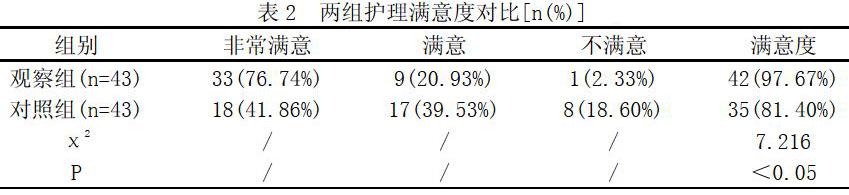
【摘 要】目的:对护理干预措施在急诊重症肺炎合并感染性休克患者中应用的效果进行观察。方法:纳入2017年2月-2019年2月急诊收治的重症肺炎合并感染性休克患者86例为研究对象并随机分为2组,对照组(n=43)仅应用常规护理干预,观察组(n=43)应用综合护理干预,对护理效果进行组间对比。结果:观察组重症监护室停留时间、机械通气时间及住院时间均短于对照组,P<0.05;观察组护理满意度97.67%,明显高于对照组的81.40%,P<0.05。结论:综合护理干预在急诊重症肺炎合并感染性休克患者护理中应用,对患者症状缓解及康复速度的提升有促进作用,患者对护理服务满意度较高,值得推广。
【关键词】急诊;重症肺炎;感染性休克;综合护理干预
【中图分类号】R473 【文献标识码】A 【文章编号】1672-3783(2020)02-0219-01
【Abstract】Objective: The effect of nursing interventions in patients with severe pneumonia complicated with septic shock was observed. Methods:86 patients with severe pneumonia complicated with septic shock admitted to the emergency department from February February to February 2019 were enrolled in the study and randomly divided into 2 groups. The control group (n=43) only used routine nursing intervention, observation group (n= 43) Apply comprehensive nursing intervention to compare the effects of care between groups.Results:In the intensive care unit, the observation group was lower than the control group, P<0.05. In terms of nursing satisfaction, the observation group was 97.67%, which was higher than 81.40% of the control group, P<0.05. Conclusion: Comprehensive nursing intervention is used in the nursing of patients with severe pneumonia complicated with septic shock, which can promote the symptom relief and the improvement of rehabilitation speed. Patients have higher satisfaction with nursing service and it is worth promoting.
【Keywords】 emergency department; severe pneumonia; septic shock; comprehensive nursing intervention
內科急症中,重症肺炎比较常见,死亡率较高。对于重症肺炎患者而言,因病情程度的不同,患者症状表现也不同,其中合并感染性休克症状在重症肺炎患者中比较严重,病情变化较快,需透析等特殊治疗,且治疗时间较长,给予患者身体、心理等方面带来极大的痛苦,且患者长期卧床期间,因缺乏运动,经常出现获得性衰弱,导致自身疾病复杂程度提高[1]。重症肺炎合并感染性休克也称为休克型肺炎,肺炎双球菌为常见致病菌,患病后,患者抵抗力下降,小动脉扩张,血容量降低,因周围循环状况而出现休克症状[2]。为提高治疗效果,在患者治疗期间配合有效的护理干预措施至关重要。本次研究以重症肺炎合并感染性休克患者86例作为研究对象,分析应用综合护理干预的效果,如下。
1 资料与方法
1.1一般资料
纳入2017年2月至2019年2月期间急诊收治86例重症肺炎合并感染性休克患者并将其随机分为两组。对照组中……