213份苦荞种质资源主要农艺性状分析及高产种质筛选
2020-01-21吕丹黎瑞源郑冉郑俊青朱丽伟石桃雄陈庆富
吕丹 黎瑞源 郑冉 郑俊青 朱丽伟 石桃雄 陈庆富
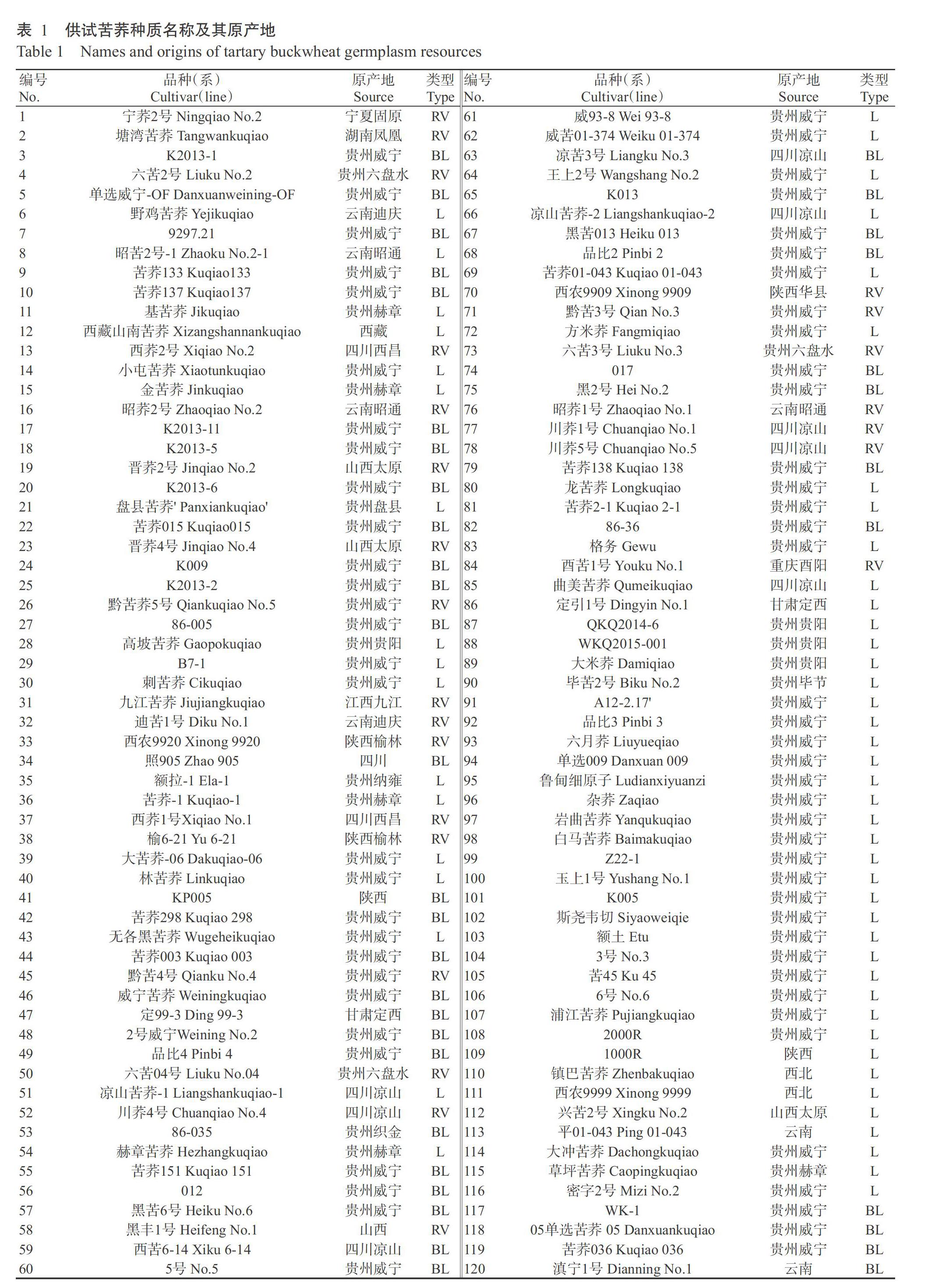

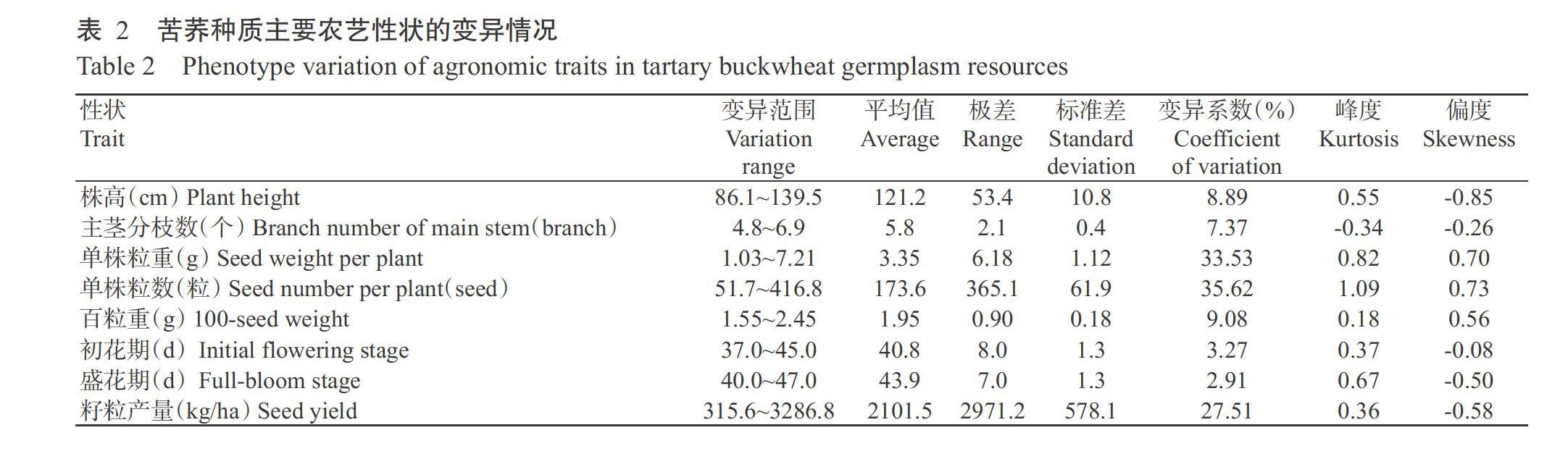
摘要:【目的】调查分析我国213份苦荞种质资源主要农艺性状,筛选高产苦荞种质,以期了解影响苦荞产量的主要因素,为选育高产苦荞品种提供亲本材料。【方法】以来自于我国11个省(区)的213份苦荞种质为材料,对其株高、主茎分枝数、初花期、盛花期、单株粒数、单株粒重、百粒重和籽粒产量8个农艺性状进行变异分析、相关分析、主成分分析和聚类分析,基于分析结果,筛选出高产的苦荞种质。【结果】8个农艺性状的偏度和峰度绝对值均接近1.00,均呈近似正态的连续分布。各农艺性状变异系数为2.91%~35.62%。籽粒产量的变异范围为315.6~3286.8 kg/ha,平均值为2101.5 kg/ha;株高的变异范围为86.1~139.5 cm,平均值为121.2 cm;主茎分枝数的的变异范围为4.8~6.9个,平均值为5.8个;百粒重的变异范围为1.55~2.45 g,平均值为1.95 g;单株粒重的变异范围为1.03~7.21 g,平均值为3.35 g;单株粒数的变异范围为51.7~416.8粒,平均值为173.6粒;初花期的变异范围为37.0~45.0 d,平均值为40.8 d;盛花期的变异范围为40.0~47.0 d,平均值为43.9 d。简单相关分析结果表明,籽粒产量与株高、单株粒重和单株粒数均呈极显著正相关(P<0.01,下同),与百粒重呈极显著负相关;单株粒重与单株粒数呈极显著正相关,与百粒重呈显著负相关(P<0.05,下同)。偏相关分析结果表明,籽粒产量与株高呈极显著正相关,与单株粒重呈显著正相关,与百粒重呈显著负相关;单株粒重与单株粒数和百粒重呈极显著正相关,与初花期呈显著负相关。供试苦荞种质材料8个农艺性状可简化为4个主成分,累积贡献率为84.39%。第一主成分(PC1)和第二主成分(PC2)与籽粒产量密切相关,其中单株粒重和单株粒数是影响苦荞种质产量的主要因素。在歐氏距离为2.50处,可将213个苦荞种质材料划分为六大类群(Ⅰ~Ⅵ),其中,类群Ⅳ的30个苦荞种质材料的单株粒数、单株粒重和籽粒产量的平均值显著高于其他类群,籽粒产量平均值最高。【结论】选育高产苦荞品种时,应着重考察单株粒重和单株粒数这2个指标。Ⅳ类群的30个苦荞种质可作为高产苦荞育种的亲本材料。
关键词: 苦荞;农艺性状;相关性分析;主成分分析;聚类分析;高产种质;筛选
中图分类号: S517.033 文献标志码: A 文章编号:2095-1191(2020)10-2429-11
Main agronomic traits and selection of high seed yield germplasms in 213 tartary buckwheat materials
LYU Dan1, LI Rui-yuan2, ZHENG Ran1, ZHENG Jun-qing1, ZHU Li-wei1,
SHI Tao-xiong1*, CHEN Qing-fu1
(1Research Center of Buckwheat Industry Technology, Guizhou Normal University,Guiyang 550001,China; 2Key Laboratory of Information and Computing Science of Guizhou Province, Guizhou Normal University,Guiyang 550001, China)
Abstract:【Objective】Main agronomic traits of 213 tartary buckwheat germplasms in China to select tartary buckwheat germplasm with high seed yield and to investigate the major factors influencing seed yield,and provide parent material for breeding high yield tartary buckwheat varieties. 【Method】Using 213 tartary buckwheat germplasm from 11 pro-vinces(regions) of China as materials, eight agronomic traits,including plant height,branch number of main stem,initial flowering stage, full-bloom flowering stage, seed number per plant,seed weight per plant,100-seed weight and seed yield were investigated. Variation analysis, correlation analysis,principal components analysis and cluster analysis were carried out on the eight traits, and high yield tartary buckwheat varieties were selected. 【Result】The values of skewness and kurtosis of eight agronomic traits were close to 1.00, and all of them showed a continuous normal distribution. The coefficient variation of the agronomic traits ranged from 2.91% to 35.62%. The variation range of seed yield was 315.6 to 3286.8 kg/ha, with an average of 2101.5 kg/ha, the variation range of plant height was 86.1 to 139.5 cm, with an average of 121.2 cm, and the variation range of branch number of main stem was 4.8 to 6.9, with an average of 5.8, the variation range of 100-seed weight was 1.55 to 2.45 g, with an average of 1.95 g, the variation range of seed weight per plant was 1.03 to 7.21 g, with an average of 3.35 g, the variation range of seed number per plant was 51.7 to 416.8, with an average of 173.6 grains, the variation range of initial flowering stage was 37.0 to 45.0 d, with an average of 40.8 d, and the variation range of full-bloom stage was 40.0 to 47.0 d, with an average of 43.9 d. Simple correlation analysis indicated the seed yield was extremely positively correlated with plant height,seed weight per plant and seed number per plant(P<0.01,the same below),and extremely negatively correlated with 100-seed weight,seed weight per plant was extremely positively correlated with seed number per plant,and significant negatively correlated with 100-seed weight (P<0.05,the same below). Partial correlation analysis showed that the seed yield was extremely positively correlated with plant height,significantly positively correlated with seed weight per plant,and significantly negatively correlated with 100-seed weight. Seed weight per plant was extremely positively correlated with seed number per plant and 100-seed weight,and significant ne-gatively correlated with initial flowering stage. The eight agronomic traits could simplify into four principal components with 84.39% cumulative contribution rate. The first(PC1) and second(PC2) principal components were closely related to seed yield. Seed weight per plant and seed number per plant were important factors affected the seed yield of tartary buckwheat germplasm. All the tested germplasms could be divided into six groups(Ⅰ-Ⅵ) at the Euclidean distance of 2.50. Group IV including 30 tartary buckwheat germplasms had the highest average seed yield and better performance in seed number per plant, seed weight per plant and seed yield than others.【Conclusion】Seed weight per plant and seed number per plant should be important indexes when breeding tartary buckwheat cultivars with high seed yield. The 30 tartary buckwheat germplasms of group IV can be used as recommended materials for high seed yield breeding.
Key words: tartary buckwheat; agronomic traits; correlation analysis; principal component analysis; cluster analysis; high seed yield germplasm; selection
Foundation item: National Natural Science Foundation of China(31960125,31860408,31760430); Guizhou Buckwheat Germplasm Resources Conservation and Innovation Key Laboratory Construction Fund Project(Qianjiaohe KY 〔2017〕002)
0 引言
【研究意义】苦荞[Fagopyrm tataricum(L.) Gaertn]又称鞑靼荞麦(Tartary buckwheat),属双子叶蓼科杂粮作物,富含大量的黄酮类化合物和8种必需氨基酸(张美莉和胡小松,2004;汪燕等,2018),是国际粮农组织公认的粮药兼用粮种。现代医学证明,黄酮类化合物具有防治高血壓、高血脂(王敏等,2006;周良等,2019))、冠心病(Joanna et al.,2012)及预防老年痴呆(陈庆富,2018)等功效,随着人们生活水平和健康意识的不断提高,对苦荞的需求量也在逐年增加。……