促生菌对土壤养分、酶活性及细菌群落功能多样性的影响
2020-01-21韦江璐覃英谢显秋陈教云董登峰邢永秀李杨瑞
韦江璐 覃英 谢显秋 陈教云 董登峰 邢永秀 李杨瑞
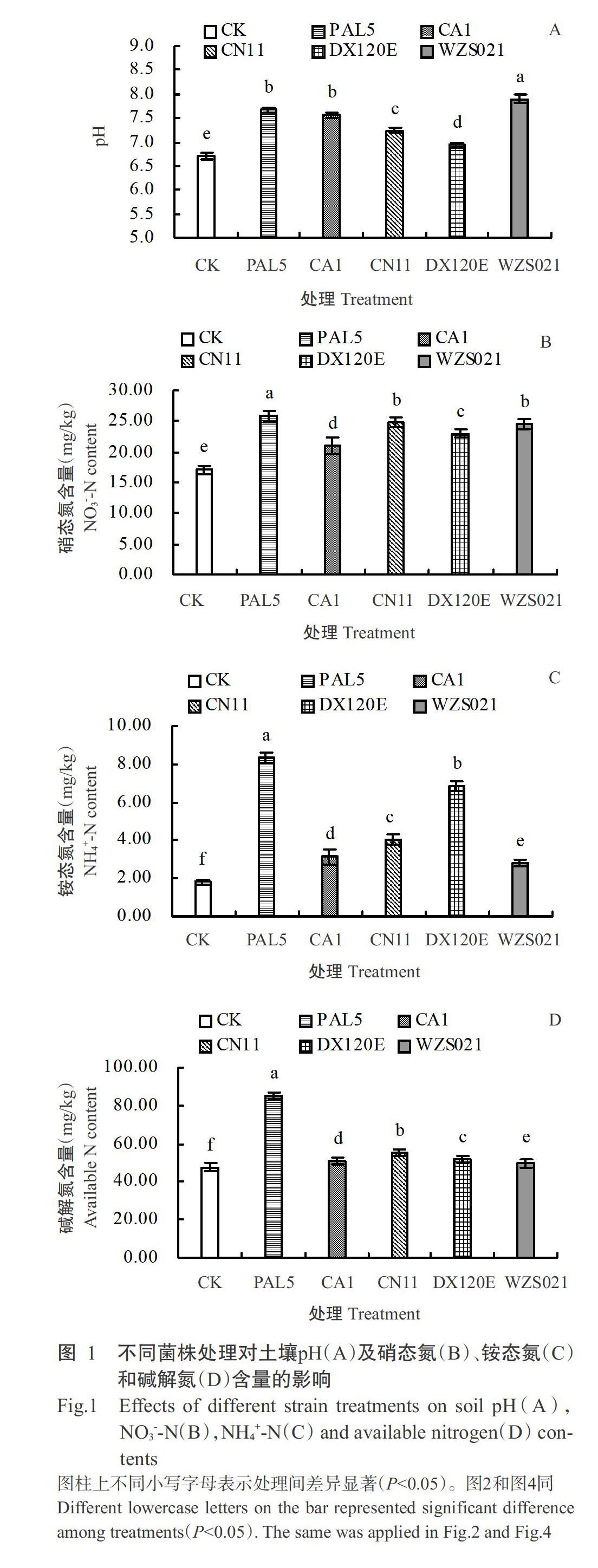
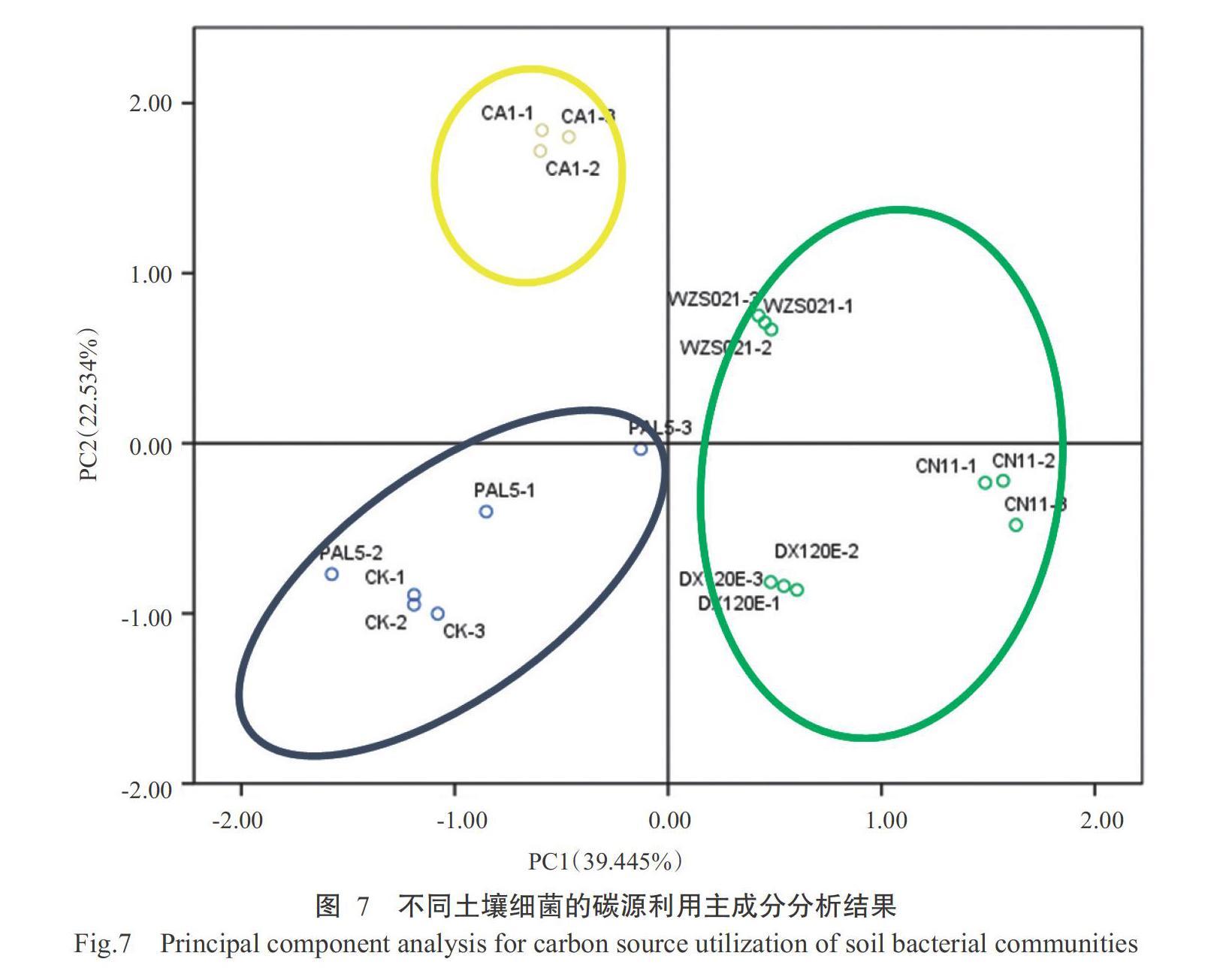
摘要:【目的】探讨植物促生菌对土壤理化特性及细菌群落功能多样性的影响,为高效微生物菌肥的制备及应用提供参考依据。【方法】选用5株对植物生长有促进作用的菌株(PAL5、CA1、CN11、DX120E和WZS021),将菌株分别接种至灭菌土壤(以不接种为对照),通过测定土壤pH、氮磷钾养分含量及土壤碱性磷酸酶、过氧化氢酶和脲酶活性,评价不同促生菌株对土壤肥力的影响;同时运用Biolog测定方法对土壤中的细菌群落功能多样性进行探究。【结果】促生菌处理可显著提高土壤pH及土壤速效和缓效养分含量(P<0.05,下同),同时可促使土壤无机磷向可溶性磷转化,显著降低无机磷含量;促生菌处理的土壤碱性磷酸酶、过氧化氢酶和脲酶活性也显著高于对照,其中,CN11处理的碱性磷酸酶活性是对照的3.64倍,DX120E处理的过氧化氢酶和脲酶活性分别是对照的2.34和4.52倍。Biolog测定结果显示,接种促生菌可提高细菌总代谢活性,其中CN11处理的微生物活性最高。各菌株处理后,土壤细菌群落物种丰富度指数、优势度指数和均匀度指数均显著高于对照;主成分分析结果表明,接种促生菌可調控土壤细菌群落功能多样性及土壤细菌群落结构,其中CN11和DX120E处理的土壤微生物碳源代谢能力较强。【结论】施用促生菌可不同程度地提高土壤养分及土壤酶活性,调控土壤细菌群落结构。CN11和DX120E处理在土壤养分的活化及提高土壤酶活性和细菌群落多样性等方面效果较佳。
关键词: 促生菌;土壤养分;土壤酶活性;细菌群落结构
中图分类号:S154.3 文献标志码: A 文章编号:2095-1191(2020)10-2348-10
Effects of growth-promoting bacteria on soil nutrient,enzyme activity and bacterial community function diversity
WEI Jiang-lu1 , QIN Ying1 , XIE Xian-qiu1, CHEN Jiao-yun1, DONG Deng-feng1 ,
XING Yong-xiu1*, LI Yang-rui1,2*
(1College of Agriculture, Guangxi University, Nanning 530004, China; 2Sugarcane Research Institute,Guangxi Academy of Agricultural Sciences/Sugarcane Research Center,Chinese Academy of Agricultural Sciences/Key
Laboratory of Sugarcane Biotechnology and Genetic Improvement(Guangxi), Ministry of Agriculture and
Rural Affairs/Guangxi Key Laboratory of Sugarcane Genetic Improvement, Nanning 530007, China)
Abstract:【Objective】In order to develop and utilize microbial agent with the greatest advantage,the effect of five plant growth-promoting bacteria(PGPR) on soil physicaland chemical characteristics and bacterial community function diversity was analyzed. 【Method】Selected five strains(PAL5,CA1,CN11,DX120E and WZS021)that were known to promote plant growth, then inoculated the strains to the sterilized soil(without inoculation was as control). The effect of the strains on soil fertility was evaluated by the soil pH,contents of nitrogen, phosphorus and potassium, activities of alkaline phosphatase,catalase and urease. The functional diversity of bacterial communities in the soil was investigated by Biolog analysis. 【Result】The results showed that PGPR could significantly increase the soil pH,available nutrients and the slow-acting nutrients(P<0.05, the same below),respectively. At the same time, it could promote the conversion of soil inorganic phosphorus to soluble phosphorus, and significantly reduce the content of inorganic phosphorus. The activity of alkaline phosphatase,catalase and urease in soil treated by PGPR were significantly higher than that of control. The activity of alkaline phosphatase in CN11 treatment was as 3.64 times as that of the control,and the catalase and urease activities of DX120E treatment were as 2.34 times and 4.52 times as those of the control, respectively. The results of Biolog showed that PGPR could increase the total metabolic activity of bacteria,and CN11 treatment had the highest microbial activity. After each strain treatment,the abundance index,dominance indexand substrate evennessof soil bacterial community were significantly higher than those of the control. Principal component analysis(PCA) showed that inoculating PGPR could regulate the functional diversity of soil bacterial communities and regulate the structure of soil bacterial communities,in which the metabolic capacity of bacterial carbon source treated with CN11 treatment and DX120E treatment was strong. 【Conclusion】PGPR can increase the content of soil nutrients and soil enzyme activities at different extents, and regulate the bacterial community structure. CN11 treatment and DX120E treatment have fine effects in activation of soil nutrients, improvement of soil enzyme activity and microbial community diversity.
Key words: plant growth-promoting bacteria; soil nutrient; soil enzyme activity; soil bacterial community structure
Foundation item: National Natural Science Foundation of China (31560352, 31360293, 31471449); Guangxi Science and Technology Base and Talent Special Project (Guike AD17195100)
0 引言
【研究意义】随着人们对农业可持续发展的重视,减少化肥施用,运用微生物菌劑部分代替化肥已逐渐成为研究热点。促生菌是指生存在植物根圈范围内,对植物生长有促进或对病原菌有拮抗作用的有益细菌。促生菌既能通过分泌生长素、解钾溶磷及生物固氮等直接对植物生长发挥促生作用,也可通过活跃土壤微生物生态系统而间接促进植物生长。近年来,从植物或土壤中分离出促生菌后,其研究重点是探讨菌株对植物生长或抗逆等的影响(Song et al.,2015;张佼等,2019),而关于施用菌株对土壤生态影响的研究较少。作物生长的重要前提是具备良好的土壤环境,在土壤生态系统中,土壤微生物是极重要的组成部分,既是生态系统的分解者,又是物质循环和能量流的载体(高雪峰等,2017)。……