袋料种植淮山药根际土壤细菌多样性的高通量测序分析
2020-01-21劳承英韦本辉周灵芝申章佑李艳英胡泊黄渝岚周佳
劳承英 韦本辉 周灵芝 申章佑 李艳英 胡泊 黄渝岚 周佳

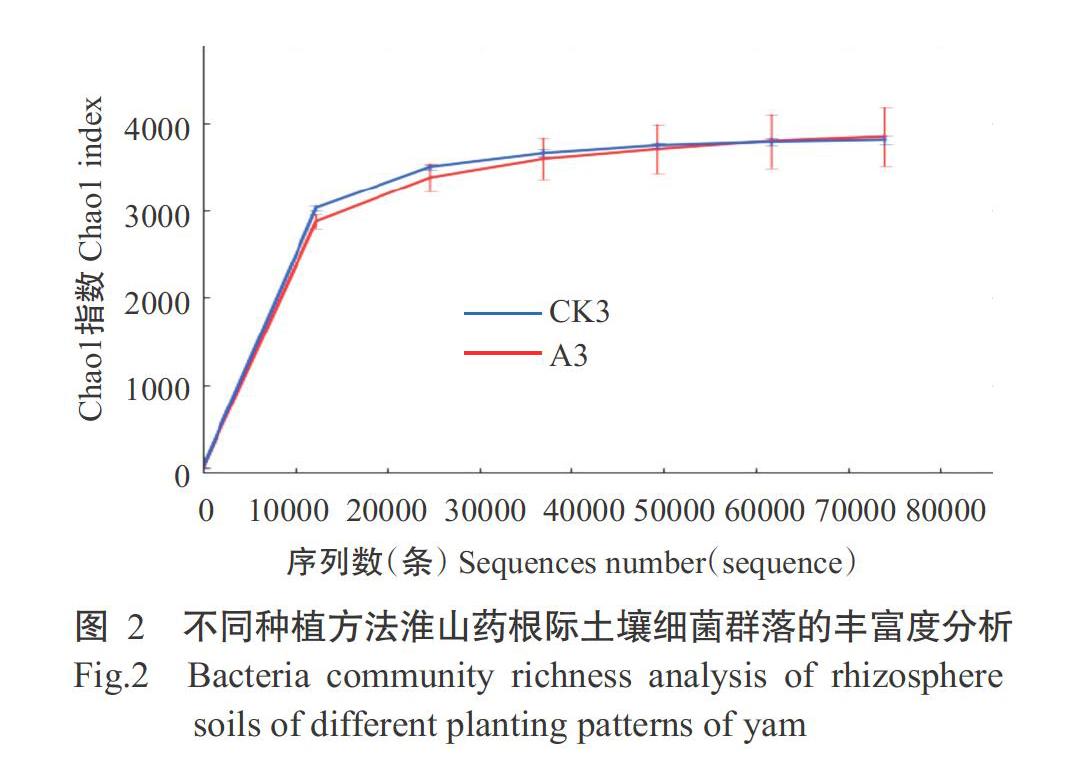

摘要:【目的】比較淮山药袋料种植方法与常规定向结薯种植方法的根际土壤微生物种群多样性,为利用微生物多样性指导淮山药袋料种植提供科学依据。【方法】采集常规淮山药定向结薯种植的根际土壤样品(记为CK3)和袋料种植的根际土壤样品(记为A3),对土壤样品中细菌的16S rDNA序列V4高变区进行PCR扩增,并对扩增产物进行高通量测序,分析土壤样品中细菌群落的多样性及其分布规律。【结果】CK3的pH为6.21,有机质含量为32.2 g/kg;A3的pH为5.98,有机质含量为30.0 g/kg。2种不同种植方法下淮山根际土壤样品中共检测出细菌41门100纲147目292科530属。淮山药根际土壤细菌在门水平上的主要优势类群有变形菌门(Proteobacteria)、酸杆菌门(Acidobacteria)、放线菌门(Actinobacteria)、绿弯菌门(Chloroflexi)和芽单胞菌门(Gemmatimonadetes);在纲水平上的主要优势类群有α-变形菌纲(Alphaproteobacteria)、γ-变形菌纲(Gammaproteobacteria)、β-变形菌纲(Betaproteobacteria)、放线菌纲(unidentified-Actinobacteria)和δ-变形菌纲(Deltaproteobacteria)等。在门和纲分类水平上,2种种植方法淮山药根际土壤样品中细菌的优势菌群相似,相对丰度差异不显著(P>0.05),CK3的细菌多样性高于A3。【结论】淮山药袋料种植方法可行,可在旱坡地和石山地等非耕地应用。
关键词: 淮山药;袋料种植;根际土壤;细菌多样性;高通量测序
中图分类号: S632.1 文献标志码: A 文章编号:2095-1191(2020)10-2367-07
High-throughput sequencing analysis of rhizosphere soil bacterial diversity of yam planting in bag material
LAO Cheng-ying, WEI Ben-hui, ZHOU Ling-zhi, SHEN Zhang-you,
LI Yan-ying, HU Po, HUANG Yu-lan, ZHOU Jia*
(Cash Crops Research Institute, Guangxi Academy of Agricultural Sciences, Nanning 530007, China)
Abstract:【Objective】The microbial population diversity in rhizosphere soil between bag material and conventional orientation in yam planting was compared in order to provide scientific basis on the utilization of soil microbial diversity to plant yam in bag material. 【Method】Rhizosphere soil samples from conventional orientation planting method of yam(marked as CK3) and from bag material planting method of yam(marked as A3) were collected in the field. The 16S rDNA sequence V4 high-variable region of rhizosphere soil bacteria in two kinds of different planting methods were amplified by PCR,and then the products of PCR amplification were sequenced with high throughput to analyze the diversity and distribution of bacterial community in soil. 【Result】The pH value of CK3 sample was 6.21,organic matter content was 32.2 g/kg;the pH value of A3 was 5.98,organic matter content was 30.0 g/kg. A total of 530 genera,292 families,147 orders,100 classes and 41 phyla of bacteria were detected in the two soil samples. The advantage groups in rhizosphere soils of yam were Proteobacteria,Acidobacteria,Actinobacteria,Chloroflexi and Gemmatimonadetes on the phylum level. The advantage groups in rhizosphere soils of yam were Alphaproteobacteria,Gammaproteobacteria,Betaproteobacteria,unidentified-Actinobacteria and Deltaproteobacteria on the class level. The structure and composition of bacterial community in rhizosphere soil samples of different planting methods were similar, the relative abundance of the different planting methods had not significant difference on the phylum and class level(P>0.05). Bacterial diversity of CK3 was higher than that of A3. 【Conclusion】The bag material planting method of yam is feasible, and can be applied in uncultivated areas such as dry slope land and stony hillside.
Key words: yam; bag material planting method; rhizosphere soil; bacteria diversity; high throughput sequencing
Foundation item: National Natural Science Foundation of China(31860347); Guangxi Natural Science Foundation(2018GXNSFAA281012); Science and Technology Development Project of Guangxi Academy of Agricultural Sciences(Guinongke2017JM21)
0 引言
【研究意义】淮山药(Dioscorea opposita Thunb.)隶属于薯蓣科薯蓣属,为一年生或多年生单子叶缠绕性藤本植物,可食用部分为肥厚的块茎,药食同源(Hsu et al.,2003),是美味滋补的佳肴,具有较好的经济价值和市场前景(赵令敏等,2019)。但淮山药茎块多数是在疏松的土壤条件下垂直向下生长,种植和采收均需挖深沟,耗时费力(韦本辉,2013)。为降……