预防性护理在降低ICU脑出血患者术后肺部感染发生率方面效果分析
2019-12-09张娟娟
张娟娟
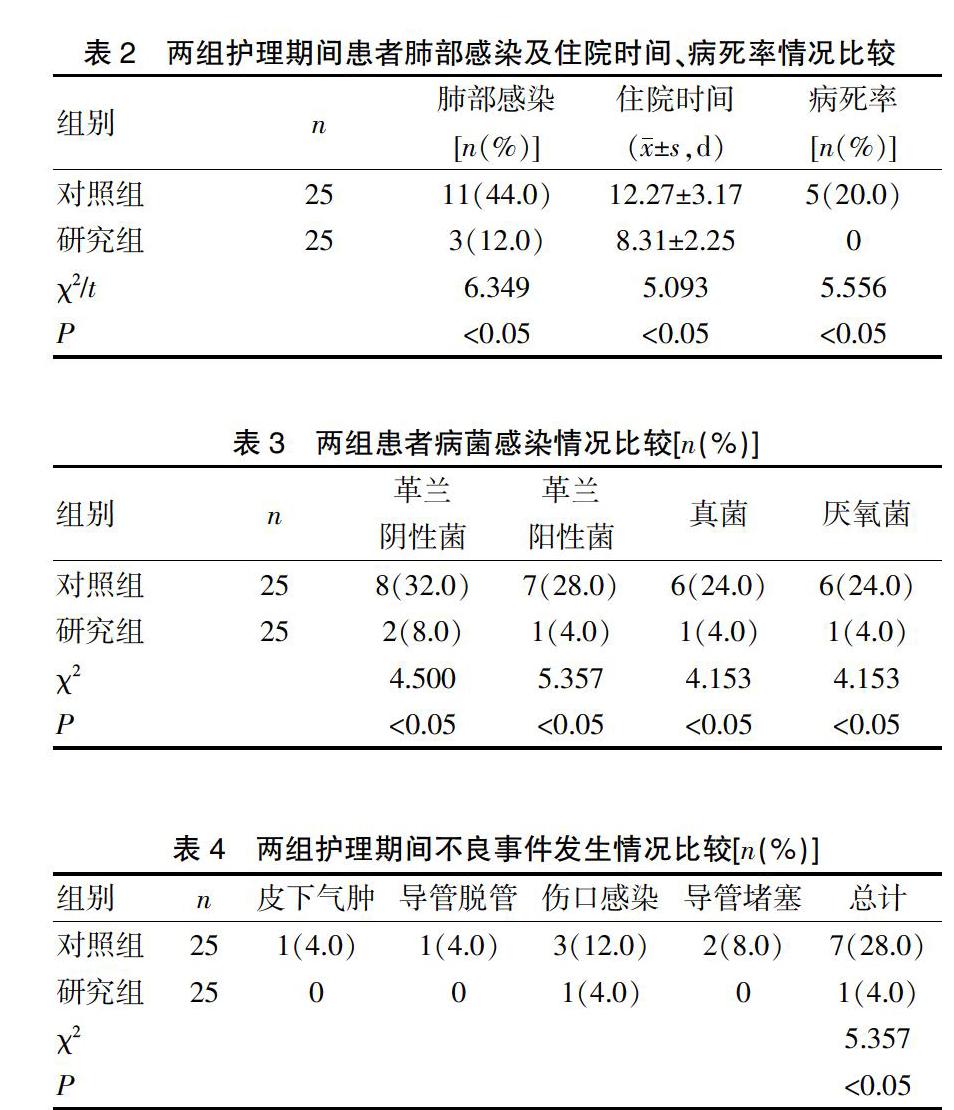

[摘要] 目的 探讨预防性护理在降低ICU脑出血患者术后肺部感染发生率的效果。 方法 于2016年3月~2019年3月我院ICU收治的脑出血患者中抽取50例作为研究对象,按照随机数字法将50例入组患者分为对照组(n=25)与研究组(n=25),两组患者均给予常规护理,研究组加用预防性护理干预,比较两组肺部感染情况、住院时间及不良事件发生情况。 结果 研究组患者肺部感染率、病死率以及住院时间均显著低于对照组,革兰阴性菌、革兰阳性菌、真菌以及厌氧菌感染发生率(8.0%、4.0%、4.0%、4.0%)均显著低于对照组(32.0%、28.0%、24.0%、24.0%),且护理期间不良事件发生率(4.0%)显著低于对照组(28.0%),差异显著(P<0.05)。 结论 给予ICU脑出血患者预防性护理干预能够有效降低肺部感染及不良事件发生率,促进患者早日康复,具有临床推广价值。
[关键词] 预防性护理;ICU;脑出血;肺部感染
[中图分类号] R473.74 [文献标识码] B [文章编号] 1673-9701(2019)28-0146-04
[Abstract] Objective To analyze the effect of preventive nursing care on reducing the incidence rate of postoperative pulmonary infection in the patients with cerebral hemorrhage in ICU. Methods A total of 50 patients with cerebral hemorrhage who were admitted to our hospital from March 2016 to March 2019 were randomly selected as study subjects. According to the random number method, 50 enrolled patients were divided into control group(n=25) and study group(n=25). Both groups of patients were given routine nursing care. The study group was further given preventive nursing intervention. The lung infections, length of stay and incidence of adverse events were compared between the two groups. Results The lung infection rate, mortality and length of stay in the study group were significantly lower than those in the control group. The incidence rate of Gram-negative bacteria, Gram-positive bacteria, fungi and anaerobic infections(8.0%, 4.0%, 4.0%, 4.0%) were significantly lower than those in the control group(32.0%, 28.0%, 24.0%, 24.0%). The incidence rate of adverse events during nursing care(4.0%) was significantly lower than that of 28.0% in the control group. The differences were significant (P<0.05). Conclusion Preventive nursing intervention for the patients with cerebral hemorrhage in ICU can effectively reduce the incidence rate of pulmonary infection and adverse events, and promote their early recovery, which have a clinical promotion value.
[Key words] Preventive nursing care; ICU; Cerebral hemorrhage; Pulmonary infection
腦出血属于ICU较为常见的急性脑血管疾病,多发于中老年人,具有病情凶险、致死率高等特点。脑出血一般发病较急,常出现恶心、呕吐、眩晕,并伴有肢体、语言功能障碍等,且后遗症、并发症较多[1]。ICU是集中治疗危重患者的地方,要求护士及时准确地了解患者病情变化,从而预防并发症的发生。ICU脑出血患者术后肺部感染发生率较高,相关研究发现,给予其积极有效的护理能够有效降低不良事件发生率,提高治疗效果[2]。鉴于此,本研究选取所在医院收治的ICU脑出血患者50例作为研究对象,探讨分析预防性护理在降低ICU脑出血患者术后肺部感染发生率的效果,现报道如下。
1 资料与方法
1.1一般资料
于2016年3月~2019年3月我院ICU收治的脑出血患者入院时间中抽取50例作为本次研究对象。……