基于演化博弈的传染病疫苗接种控制策略研究
2019-07-08田丽云董春玲
田丽云 董春玲
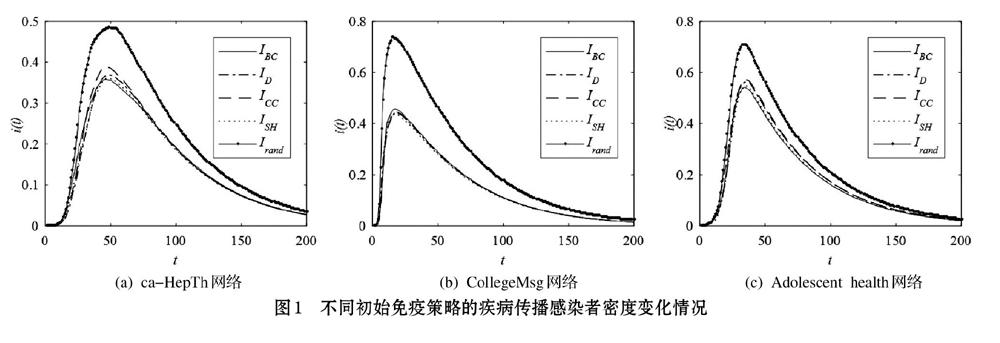
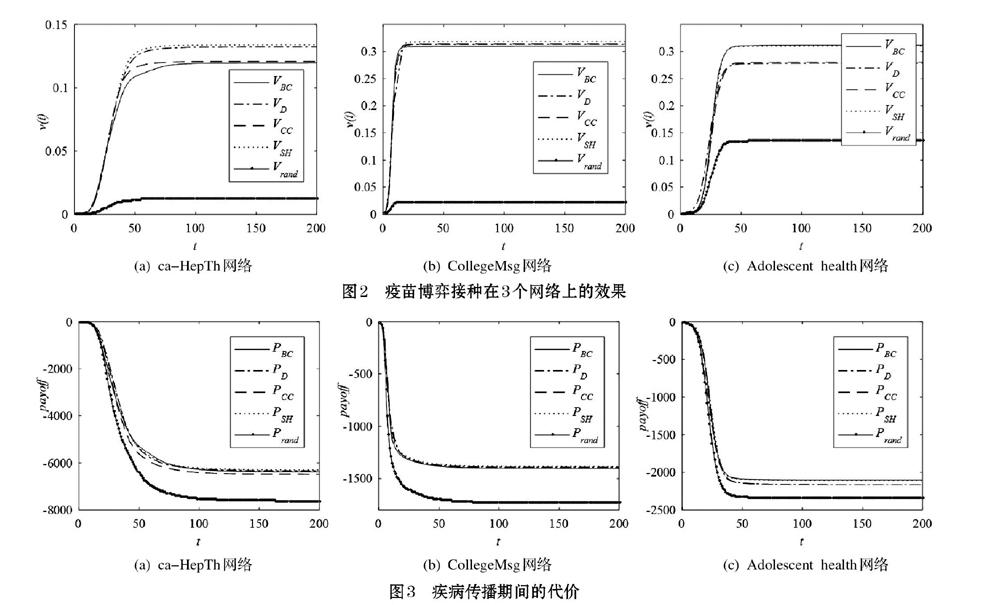
摘 要: 为有效抑制传染病的传播,采用演化博弈理论研究复杂网络中初始疫苗接种免疫节点对传染病传播和个体疫苗接种策略学习的影响。在三个无权无向的网络中,利用5种初始免疫节点选择方法进行了SIR传染病模型传播和博弈策略学习的实验仿真。实验结果表明,在接种疫苗费用相同的情况下,有策略的选择初始免疫节点不仅促进网络中个体疫苗接种策略的学习,而且对传染病的传播速度和扩散规模都有一定抑制作用。
关键词: 复杂网络; 初始疫苗接种节点; 演化博弈; SIR模型
中图分类号:TP393 文献标志码:A 文章编号:1006-8228(2019)04-21-05
Abstract: In order to effectively inhibit the spread of infectious diseases, the influence of initial vaccination nodes on the spreading of diseases and individual vaccination strategy in complex networks is studied by evolutionary game theory. Five initial immune node selection methods are used to simulate SIR epidemic model propagation and game strategy learning in three weightless and undirected networks. Experimental results show that under the same vaccination cost, the strategic choice of initial immune nodes not only promotes the learning of individual vaccination strategies in the network, but also has a certain inhibition on the spread speed and scale of infectious diseases.
Key words: complex networks; initial vaccination node; evolutionary game; SIR model
0 引言
鼠疫、霍乱、埃博拉病毒、非典型肺炎等傳染病在世界各地频发,对成千上万个人的生命财产造成严重危害。对传染病发病机理、传染规律、发展趋势和防控策略的研究备受人们关注。早期的研究在人群均匀混合的假设条件下,利用易感染者-感染者-易感染者(SIS)和易感染者-感染者-恢复者(SIR)经典的仓室模型建模流行病传播规律[1-2]。模型中未考虑接触网络的拓扑结构、个体差异等对传播行为的影响,这与真实情况不一致。近年来兴起的复杂系统和复杂网络理论为疾病传播的研究提供了一种崭新的建模思想与视角[3-5]。Wu Qingchu等人创建了重叠网络上不同传播方式下的传染病模型,研究了疾病传播的阈值以及网络拓扑结构对疾病传播的影响[6]。一些学者利用网络,分析不同网络结构特性对传染病传播速度[7-9]、传播的可预测性[10-11]、传播范围[7],确定影响传播的重要节点[12-13],并还原传染病传播路径,寻找流行病传染源[14-15]等。……