神经内镜微创手术治疗幕上高血压脑出血的临床效果及对神经功能的影响
2019-04-21余吉勇文婷彝熊国祥彭清邹滔滔
余吉勇 文婷彝 熊国祥 彭清 邹滔滔
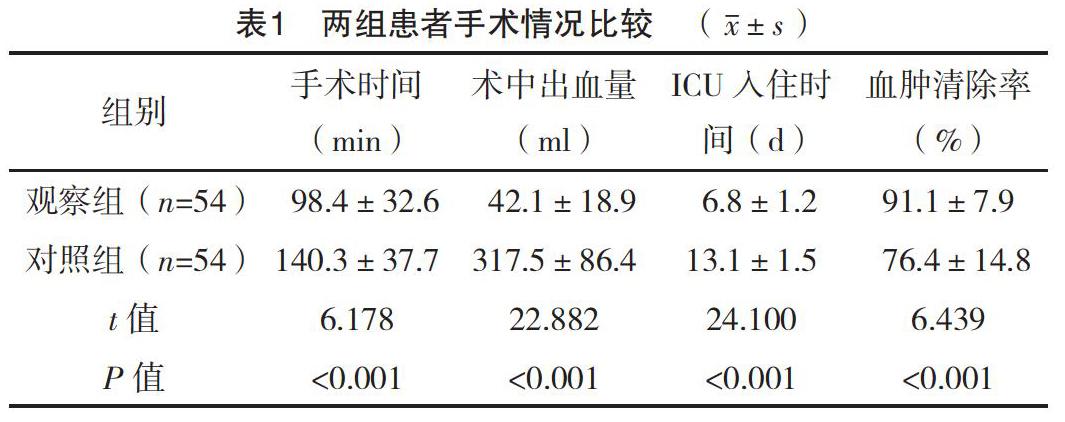

【摘要】 目的:研究神經内镜微创手术治疗幕上高血压脑出血的临床效果及对神经功能的影响。方法:选取2017年6月-2018年6月笔者所在医院神经内科收治的108例幕上高血压脑出血患者作为研究对象,根据手术方式的不同将其分为观察组和对照组,各54例。对照组采用小骨窗开颅显微手术治疗,观察组采用神经内镜微创手术治疗。比较两组患者手术情况、神经功能恢复情况。结果:观察组手术时间、ICU入住时间均明显短于对照组,术中出血量明显少于对照组,且观察组血肿清除率明显高于对照组。差异均有统计学意义(P<0.05)。治疗后6个月,两组CSS评分均较治疗前降低,且观察组降低程度显著优于对照组,差异有统计学意义(P<0.05)。结论:神经内镜微创手术能够快速、彻底地清除颅内血肿,促进神经功能恢复,具有创伤性小、恢复时间短、预后好等优点,具有临床推广和运用价值。
【关键词】 神经内镜 高血压脑出血 临床疗效 神经功能
doi:10.14033/j.cnki.cfmr.2019.28.052 文献标识码 B 文章编号 1674-6805(2019)28-0-03
Clinical Effect of Minimally Invasive Neuroendoscopic Surgery in the Treatment of Supratentorial Hypertensive Intracerebral Hemorrhage and Its Influence on Neurological Function/YU Jiyong, WEN Tingyi, XIONG Guoxiang, PENG Qing, ZOU Taotao. //Chinese and Foreign Medical Research, 2019, 17(28): -127
[Abstract] Objective: To study the clinical effect of minimally invasive neuroendoscopic surgery in the treatment of supratentorial hypertensive intracerebral hemorrhage and its influence on neurological function. Method: A total of 108 patients with supratentorial hypertensive intracerebral hemorrhage admitted in the department of neurology of our hospital from June 2017 to June 2018 were selected as the study subjects. According to the different operation methods, they were divided into the observation group and the control group, 54 cases in each group. The control group was treated with small bone window craniotomy, while the observation group was treated with minimally invasive neuroendoscopic surgery. The operation condition and neurological function recovery of the two groups were compared. Result: The operation time and stay time of ICU in the observation group were significantly shorter than those in the control group, the amount of bleeding during the operation was significantly less than that in control group, and the clearance rate of hematoma in observation group was significantly higher than that in the control group, the differences were statistically significant(P<0.05). Six months after treatment, the GSS scores of the two groups were decreased compared with those before treatment, and the degree of reduction in the observation group was significantly better than that in the control group, the difference was statistically significant (P<0.05). Conclusion: Minimally invasive neuroendoscopic surgery can quickly and thoroughly remove intracranial hematoma and promote the recovery of neurological function, and has the advantages of small trauma, short recovery time and good prognosis. It has the value of clinical popularization and application.
[Key words] Neuroendoscopy Hypertensive intracerebral hemorrhage Clinical efficacy Neurological function
First-authors address: Yidu First Peoples Hospital, Yidu 443300, China
高血压脑出血是高血压最严重的并发症之一,在中老年人群中高发,多见于长期血压增高控制不良的患者[1]。该病发病急骤、病情严重、变化快,具有较高的致残率和致死率,且以幕上出血较为常见[2]。目前临床上治疗幕上高血压脑出血的首选方式是外科手术,然而传统的开颅手术创伤性大、恢复慢、风险大,具有一定局限性,并不适合临床广泛推广运用[3]。随着微创技术日益发展,微创内镜手术在治疗脑出血手术中运用广泛,该手术方式较开颅手术而言具有创伤性小、恢复快、预后较好等优点,为脑出血提供了新的治疗途径[4]。因此,本文回顾性分析了笔者所在医院采取神经内镜微创手术和小骨窗开颅显微手术治疗的幕上高血压脑出血患者的临床资料,对比分析两组患者手术后神经功能恢复情况及临床效果,现报道如下。……