动态经济学数学建模及稳定化控制分析
2018-11-02蔡佐威黄立宏
蔡佐威 黄立宏
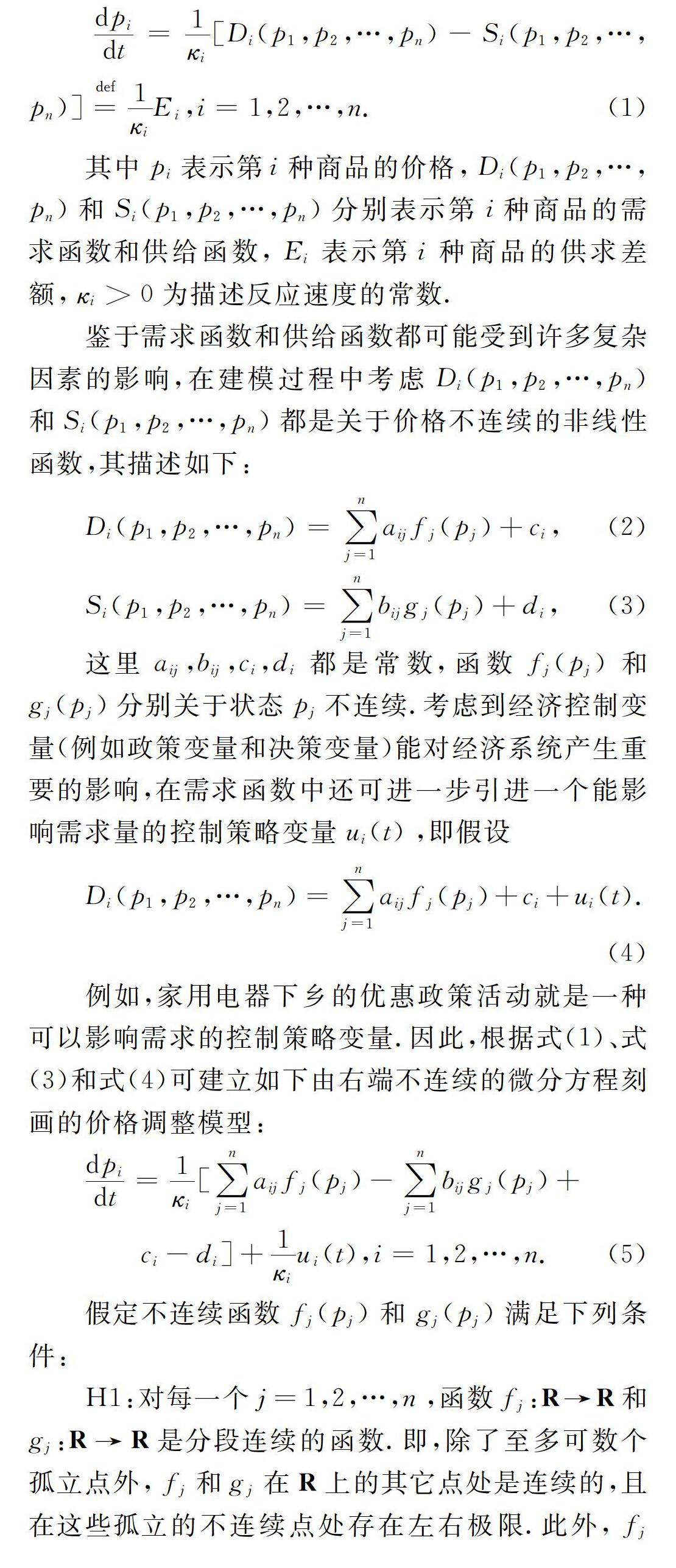
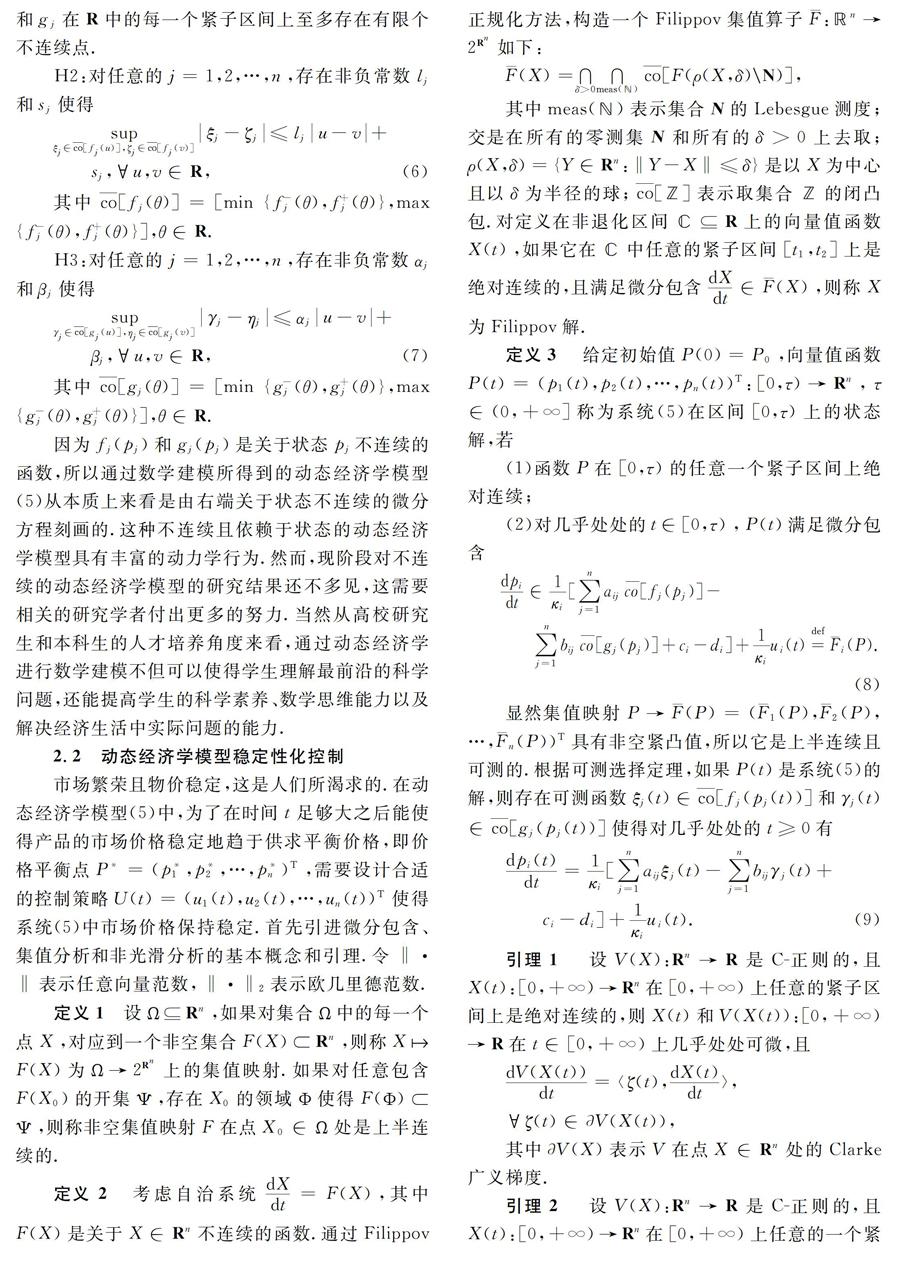
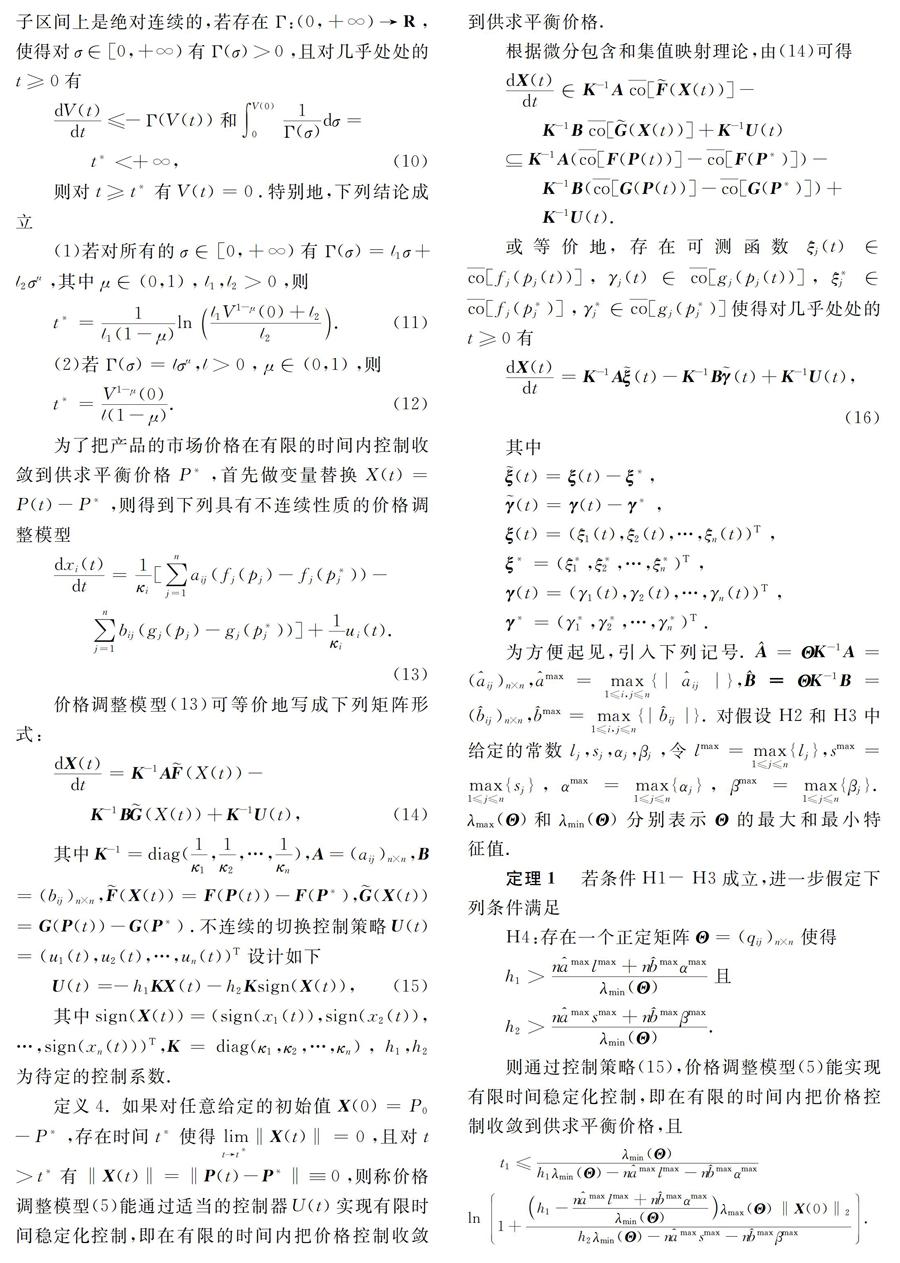
摘 要 通过考虑需求函数和供给函数受到不连续因素的影响以及引进切换型的控制策略,建立由右端不连续微分方程刻画的非线性价格调整模型.利用微分包含理论和Lyapunov稳定性方法分析不连续价格调整模型的有限时间稳定化控制问题,并给出数值模拟实例进行验证说明.最后,结合动态经济学数学建模提出数学建模教学改革的几点建议.
关键词 应用数学;有限时间稳定化;Lyapunov函数法;动态经济学;数学建模
中图分类号 O193; O231; F22 文献标识码 A
Abstract By considering the influence of discontinuous factors on demand function and supply function and introducing the control strategy of switching type, a nonlinear price adjustment model described by discontinuous differential equation is established. By using differential inclusion theory and Lyapunov stability method, the finite time stabilization control problem of the discontinuous price adjustment model is analyzed. Moreover, the numerical simulation examples are given to verify the results. Finally, combining the mathematical modeling of dynamic economics, several suggestions on the teaching reform of mathematical modeling is put forward.
Key words applied mathematics; finite-time stabilization; Lyapunov function method; dynamic economics; mathematical modeling
1 引 言
數学建模无论在科学技术研究还是在国民经济建设中都起着尤为重要的作用.数学建模主要是利用数学语言对社会经济活动中的实际问题和现象进行描述,并通过对寻找变量之间的关系建立出由函数或方程刻画的数学模型.经济学家认为经济变量是动态的,会随着时间的变化而改变,所以对经济系统进行数学建模和动态分析是非常必要的.对经济
系统模型进行动态分析最早可追溯到20世纪30年代末,Samuelson (1939)[1]利用动态分析理论对经济周期模型进行了研究,并且指出如果经济学的研究者没有掌握一定的动态分析理论,将会影响对现代经济学的理解.Romer (1986)[2]对经济动态增长问题进行了研究,并掀起了动态经济学的研究高潮.目前动态经济学已经成为经济学中一个重要的研究方向,并渗透到了宏观经济学和微观经济学的许多领域,动态经济学的课程也在欧美很多高……