不同月龄槟榔江公水牛肉中胆固醇及脂肪酸含量的比较研究
2017-09-07陈艳美李清毛华明金贞何鸿源马丹甘文斌
陈艳美+李清+毛华明+金贞+何鸿源+马丹+甘文斌
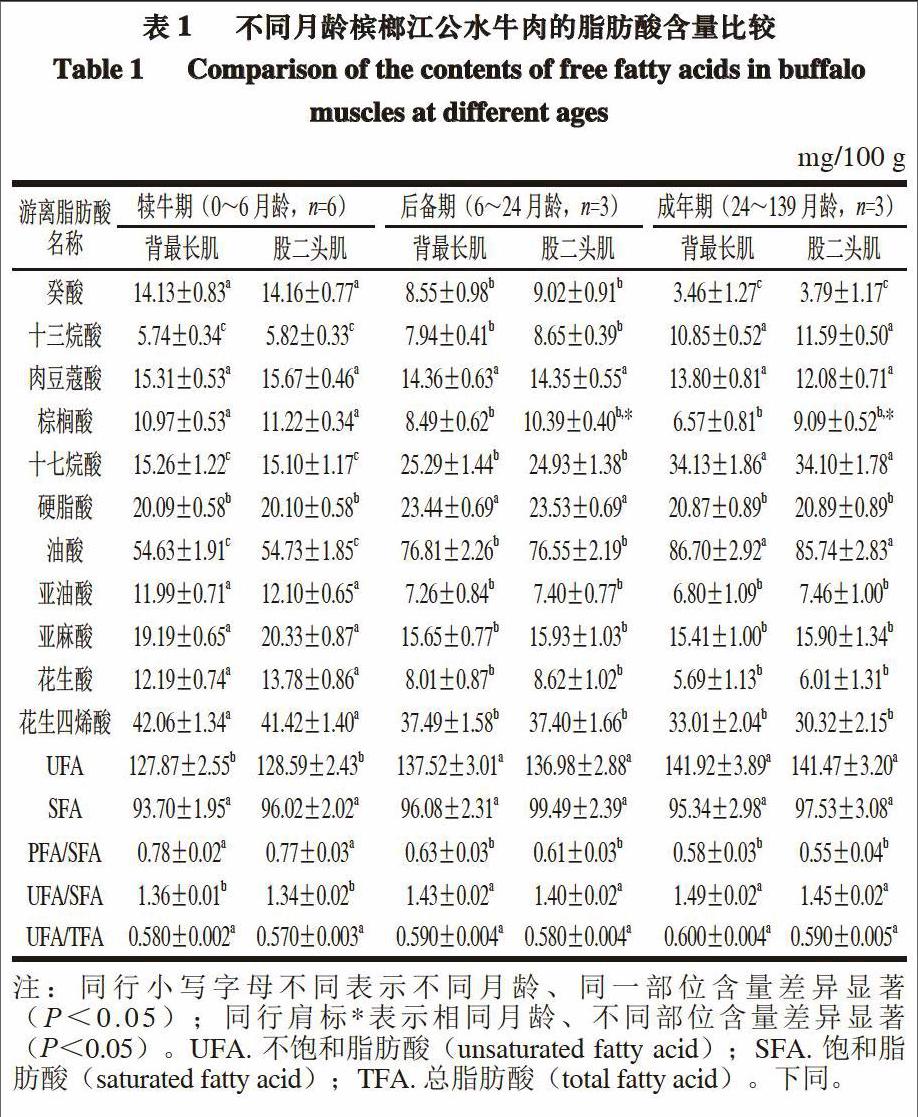
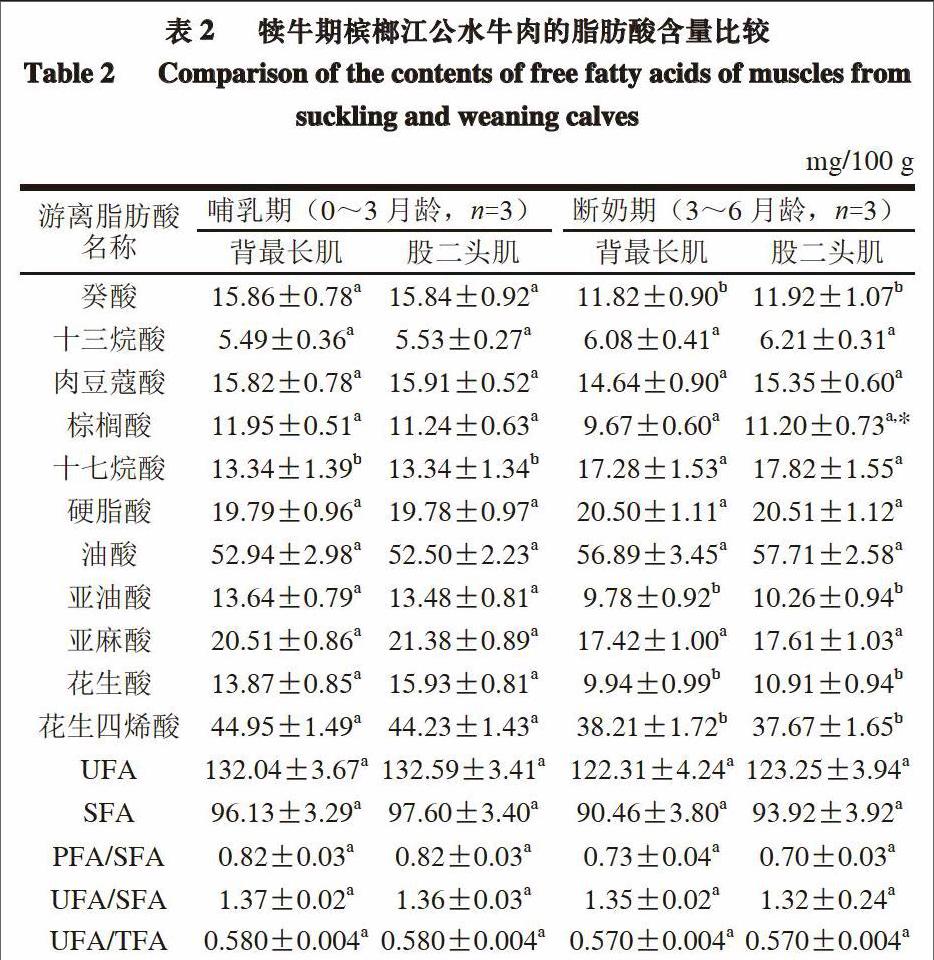

摘 要:采用連续屠宰和色谱分析相结合的方法,对不同月龄槟榔江公水牛背最长肌和股二头肌中的脂肪酸和胆固醇含量进行分析。结果表明:月龄对胆固醇和脂肪酸含量有显著影响,哺乳期胆固醇含量最高,达(58.72±2.98) mg/100 g(股二头肌),成年期含量最低,为(22.65±3.70) mg/100 g(背最长肌),后备期含量为(31.36±3.10) mg/100 g(股二头肌),与成年期差异不显著(P>0.05)。相同月龄段的槟榔江公水牛肉中,棕榈酸含量除了在犊牛期时背最长肌与股二头肌差异不显著(P>0.05)外,后备期和成年期2 个部位间的差异均显著(P<0.05),其余脂肪酸含量、不饱和脂肪酸(unsaturated fatty acid,UFA)/饱和脂肪酸(saturated fatty acid,SFA)、多不饱和脂肪酸(polyunsaturated fatty acid,PFA)/饱和脂肪酸和不饱和脂肪酸(unsaturated fatty acid,UFA)/总脂肪酸(total fatty acid,TFA)值的差异在2 个部位间均不显著(P>0.05);哺乳期和断奶期的相同部位肌肉中,除癸酸、十七烷酸、亚油酸、花生酸和花生四烯酸含量差异显著(P<0.05)外,其余脂肪酸含量及
UFA/SFA、PFA/SFA和UFA/TFA值差异均不显著(P>0.05);犊牛期、后备期和成年期的相同部位肌肉中,癸酸、十三烷酸、十七烷酸和油酸含量差异均显著(P<0.05);后备期2 个部位牛肉的硬脂酸含量与犊牛期和成年期均差异显著(P<0.05),但犊牛期与成年期差异不显著(P>0.05);对于相同部位的棕榈酸、亚油酸、亚麻酸、花生酸、花生四烯酸、UFA含量及PFA/SFA和UFA/SFA值,犊牛期与后备期、成年期均差异显著
(P<0.05),但后备期与成年期差异不显著(P>0.05)。从胆固醇与脂肪酸的含量及组成来看,后备期的槟榔江公水牛肉最佳,且背最长肌略优于股二头肌。
关键词:槟榔江公水牛;月龄;部位;胆固醇;脂肪酸
Comparison of the Contents of Cholesterol and Fatty Acids in Meat from Male Binglangjiang
Buffaloes Slaughtered at Different Ages
CHEN Yanmei1,2, LI Qing1,2,*, MAO Huaming1,2,*, JIN Zhen1,2, HE Hongyuan1,2, MA Dan3, GAN Wenbin3
(1.College of Animal Science and Technology, Yunnan Agricultural University, Kunming 650201, China;
2.Key Laboratory of Animal Nutrition and Feed Science of Yunnan Province, Kunming 650201, China;
3.Veterinary Drug and Feed Control Institute of Yunnan, Kunming 650201, China)
Abstract: The objective of the present work was to analyze the contents of fatty acids and cholesterol in Longissimus dorsi and Biceps femoris from male Binglangjiang buffaloes consecutively slaughtered at different ages by high performance liquid chromatography (HPLC) and gas chromatography (GC). The results showed that the contents of fatty acids and cholesterol were highly affected by age at slaughter. The highest level of cholesterol ((58.72 ± 2.98) mg/100 g) was detected in Biceps femoris from suckling calves, and cholesterol level in Longissimus dorsi from adult buffaloes was the lowest
((22.65 ± 3.70) mg/100 g). Cholesterol level in Biceps femoris from young stock was (31.36 ± 3.10) mg/100 g, which was not significantly different from that in adult buffaloes (P > 0.05). A significant difference between the palmitic acid contents of Longissimus dorsi and Biceps femoris was observed for both young and adult buffaloes of the same age groups (months)
(P < 0.05), while no significant difference was perceived for calves of the same age groups (months) (P > 0.05). The contents of other fatty acids, the ratio of unsaturated to saturated fatty acids (UFA/SFA), the ratio of polyunsaturated to saturated fatty acids (PFA/SFA), and the ratio of unsaturated to total fatty acids (UFA/TFA) were not significantly different between the two muscles (P > 0.05). For the same muscles, the contents of decanoic acid, heptadecanoic acid, linolic acid, arachidic acid and arachidonic acid were significantly different between suckling and weaning calves (P < 0.05), but no significant differences in the contents of other fatty acids, and the ratio of UFA to SFA, PFA to SFA and UFA to TFA were seen. Significant differences in the contents of decanoic acid acid, tridecanoic acid, heptadecanoic acid and oleic acid existed for the same muscles from calves and young and adult buffaloes. Stearic acid contents in the same muscles from young stock were significantly different compared to those in calves and adult buffaloes (P < 0.05), but no significant difference was observed between the latter two (P > 0.05). The contents of palmitic acid, linoleic acid, linolenic acid, arachidic acid and arachidonic acid, and the content of UFA, the ratio of PFA to SFA and the ratio of UFA to SFA in the same muscles from calves were significantly different from those in young and adult buffaloes (P < 0.05), but no significant difference was present between the latter two (P > 0.05). In terms of cholesterol and fatty acids, the meat quality of young buffaloes was the best, and Longissimus dorsi was slightly better than Biceps femoris.endprint
Key words: male Binglangjiang buffalo; age; location; cholesterol; fatty acid
DOI:10.7506/rlyj1001-8123-201707001
中图分类号:TS251.1 文献标志码:A 文章编号:1001-8123(2017)07-0001-06
引文格式:
陈艳美, 李清, 毛华明, 等. 不同月龄槟榔江公水牛肉中胆固醇及脂肪酸含量的比较研究[J]. 肉类研究, 2017, 31(7): 1-6. DOI:10.7506/rlyj1001-8123-201707001. http://www.rlyj.pub
CHEN Yanmei, LI Qing, MAO Huaming, et al. Comparison of the contents of cholesterol and fatty acids in meat from male Binglangjiang buffaloes slaughtered at different ages[J]. Meat Research, 2017, 31(7): 1-6. DOI:10.7506/rlyj1001-8123-201707001. http://www.rlyj.pub
肉中的膽固醇水平和脂肪酸的组成及含量不仅在一定程度上决定着肉的营养品质,而且对人体健康有重要影响。研究发现,动脉粥样硬化、静脉血栓形成、胆石症与高胆固醇血症有密切相关性,虽然膳食摄入胆固醇对血液中胆固醇水平的影响不大,但“取消限量”和“可以敞开吃”是两码事,血胆固醇高仍然是引发心脏病的危险因素之一[1-2]。多不饱和脂……
