机械臂工作空间全局相对可操作度图的构建方法
2016-12-14李宪华疏杨张雷刚郭帅张军
李宪华+疏杨+张雷刚+郭帅+张军
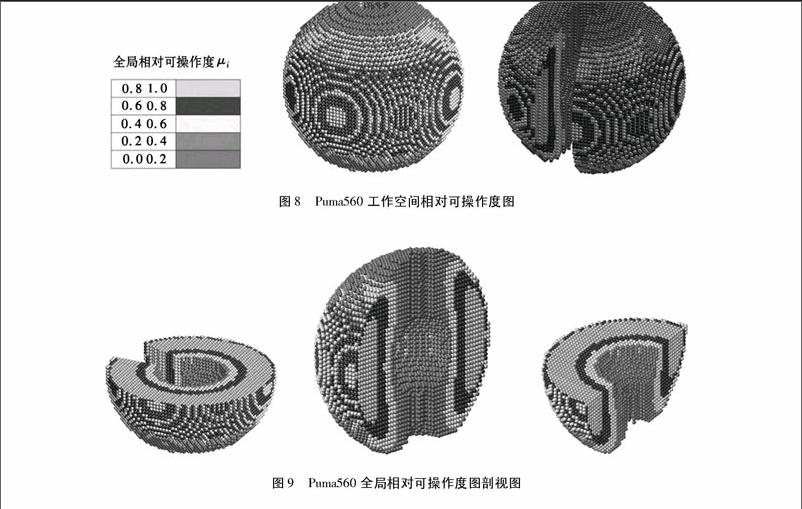

摘要:针对机械臂工作空间的灵活性问题,提出了一种全局相对可操作度图的构建方法。该方法首先将机械臂工作空间进行网格化处理,得到离散位置;然后在离散位置的均布小球上建立直角坐标系,通过绕坐标轴旋转的方式完成机械臂姿态的离散;而后将每个离散位置上的位姿进行逆运动学解算,并计算得到该位置上的最大相对可操作度;最后采用可视化的方法绘制出机械臂工作空间的相对可操作度分布图,进而揭示机械臂在其工作空间内的灵活性分布规律。该方法为机械臂的设计提供了相关理论依据,为机械臂的任务操作规划奠定了基础。
关键词:机械臂;相对可操作度图;逆运动学
中图分类号:TP241文献标志码:A文章编号:1672-1098(2016)01-0056-06
Abstract:Aiming at the flexibility of manipulators in working space, a method of constructing global relative manipulability map was proposed. In this method, the working space of the manipulator was processed by grid, and the discrete positions were obtained; then the rectangular coordinate system was set up on the discrete positions, and the discrete positions of the manipulator were accomplished by rotating the coordinate axis; the position and pose of each discrete position were calculated by inverse kinematics, and the maximum relative operational degree of the position was calculated; finally, the visual method was used to draw the relative operational degree distribution map of the manipulator in the working space to reveal the flexibility distribution of the manipulator in its working space. The method provides a theoretical basis for the design of the manipulator, and lays the foundation for the task operation planning of the manipulator.
Key words:manipulator, relative manipulability map, inverse kinematics
机械臂是模仿人体手臂而设计的一种自动化操作装置,其运动灵活性反映了对任务操作的转换能力,灵活性指标对于机械臂的设计、评价与运动规划有非常重要的作用,机械臂运动灵活性是机器人运动学研究的一个重要内容。
可操作度、条件数和最小奇异值是比较经典的三个灵活性指标[1],其中可操作度应用较为广泛,其物理意义可以解释为机械臂各运动方向上能力的综合度量。Yoshikawa将雅可比矩阵与其转置矩阵乘积的行列式的之值定义为机械臂的可操作性指标,并提出了可操作度椭球的概念对机械臂的灵活性进行描述[2];姚建初等利用方向可操作度对冗余度机械臂进行运动规划,提高了机械臂的运动能力[3];……