流动人口咨询室对外来育龄妇女健康知晓率的影响
2016-09-21杨静杨森
杨静+杨森
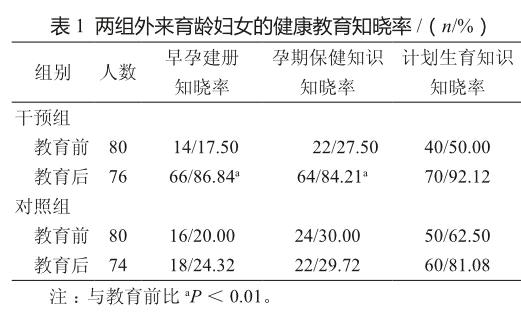
摘 要 目的:探讨外来流动人口咨询室对提高外来流动育龄妇女健康教育知晓率的作用。方法:随机抽取2012年1月-2014年12月广粤农贸市场所外来育龄妇女80人作为干预组,将周边5个居委的育龄妇女80人作为对照组。干预组通过建立流动人口咨询室对研究对象进行健康教育干预,对照组进行常规健康教育。对两组干预前后的健康知晓率进行评估和比较。结果:干预组健康知晓率明显高于对照组,组间差异有统计学意义(P<0.01)。结论:在外来人口聚集地建立流动人口咨询室是提高外来育龄妇女健康水平的有效途径。
关键词 流动人口 育龄妇女 咨询室 健康教育
中图分类号:R173 文献标识码:A 文章编号:1006-1533(2016)16-0033-03
Influence of the floating population consultation room on the health awareness rate of floating women of childbearing age
YANG Jing1, YANG Sen2(1. Liangcheng New Village Community Health Service Center of Hongkou District, Shanghai 200434, China; 2. 10th Peoples Hospital
affiliated to Tongji University, Shanghai 200072, China)
ABSTRACT Objective: To discuss the role of the floating population consultation room to improve the awareness rate of health education for the floating women of childbearing age. Methods: From January 2012 to December 2014, 80 floating women of childbearing age in Guangyue Agricultural Market were selected as an intervention group randomly, and 80 women of childbearing age in the surrounding 5 neighborhood committees were selected as a control group. The intervention group was intervened with health education through establishment of floating population consultation room, and the control group was given the routine health education. The health awareness rates were evaluated and compared before and after intervention in the two groups. Results: The health awareness rate of the intervention group was significantly higher than that of the control group and the differences between the groups were statistically significant(P<0.01). Conclusion: Establishment of the floating population consultation room in the place where the floating population gathers is an effective way to improve the health levels of the floating women of childbearing age.
KEY WORDS floating population; woman of childbearing age; consulting room; health education
当今的中国正发生着翻天覆地的变化,工业迅速崛起,城镇快速发展,随之而来的是人口流动进入了最为活跃的时期[1]。在上海,流动人口大致可以分为两个极端,其中的高端人群是符合人才引进政策的知识型人才,具有较高的学历,掌握紧缺的专业知识,可以在短时间内解决户籍问题,继而享受户籍人口的医疗保障权益,而另一个极端是文化层次较低的弱势人群,占了流动人口的大部分,其中的育龄妇女多数在服务性行业,劳动强度大,收入低[2-3]而由于户籍不在上海也无法解决医保问题,一旦怀孕,大多因为经济原因而拒绝按正规渠道就诊,产前检查和住院分娩费用都成了她们的顾虑[4]。
有数据显示,新生代农民工婚前怀孕比例占42.7%,比老一代农民工高16个百分点[5]。若外来流动人员在沪分娩,按有关规定,居住地街道计划生育办公室会要求其出示户籍地出具的流动人口生育证明。……
