肝胆管结石术后胆道镜检查的临床应用价值
2016-05-14何峰王燕平邓志平邓阳波肖翔健
何峰 王燕平 邓志平 邓阳波 肖翔 健
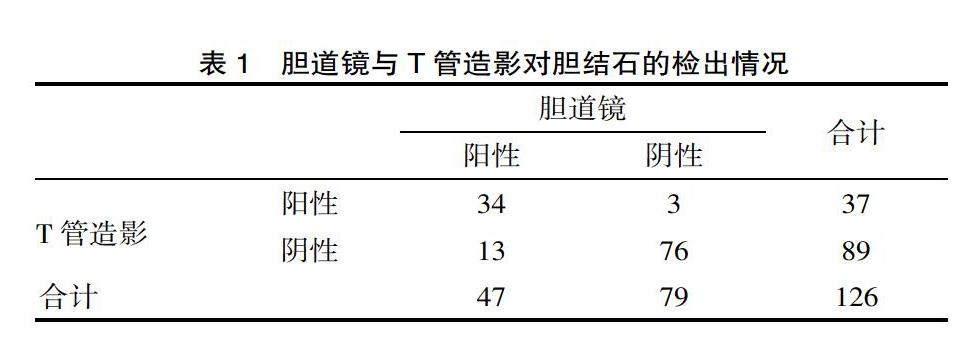
[摘要] 目的 了解肝胆管结石术后行T管胆道造影和胆道镜检查对患者残余结石发生情况,从而探讨胆管结石术后常规行胆道镜检查的临床意义。方法 方便选取并回顾性分析2011年7月—2014年5月湖南省郴州市第三人民医院普外科收治的126例肝胆管结石患者的临床资料。所纳入的患者行胆总管探查T管引流,在T管造影基础上再行胆道镜,了解胆管残余结石的发生情况。 结果 126例患者当中,T管造影检查发现残留结石患者共37例,其中34例经胆道镜证实,3例患者胆道镜检查未见结石。在T管造影未发现结石的89例患者当中,胆道镜检查后有13例患者存在胆石残留,经统计学分析,χ2=5.0625,P<0.05。其中6例患者最大结石直径≥5 mm,7例胆石直径<5 mm。4例患者仅单枚结实,9例患者结石≥2枚。结论 肝胆管结石术后胆道镜检查相对于T管造影而言,可进一步减少胆管残石的发生概率。
[关键词] 肝胆管结石;胆道镜;T管造影
[中图分类号] R737.9 [文献标识码] A [文章编号] 1674-0742(2016)03(c)-0197-02
Clinical Application Value of Choledochoscopic Examination after Cholelithotomy
HE Feng, WANG Yan-ping, DEGN Zhi-ping, DENG Yang-bo, XIAO Xiang, Huang-jian
Department of General Surgery, Chenzhou Third People's Hospital, Chenzhou, Hunan Province, 423000 China
[Abstract] Objective To discuss the clinical significance of routine choledochoscopic examination after cholelithotomy by knowing the occurrence of the residual stones in patients with T-tube cholangiography and choledochoscopy examination after cholelithotomy. Methods The clinical data of 126 cases of patients with intrahepatic bile duct stones admitted and treated in the department of general surgery of our hospital from July 2011 to May 2014 were retrospectively analyzed, and all patients were given common bile duct exploration and T-tube drainage, and were examined by choledochoscope on the basis of the T-tube cholangiography, and the occurrence of the residual bile duct stones was known. ResultsIn The 126 cases of patients, 37 cases with residual stones were discovered by T-tube cholangiography examination, among them, 34 cases were confirmed by choledochoscope, 3 cases were without stones after choledochoscopic examination, in the 89 cases of patients without stones after T-tube cholangiography, 13 cases were with residual stones after choledochoscopic examination(χ2=5.0625, P<0.05), the maximum diameter of the stones ≥ 5 mm was in 6 cases, the diameter of the stones<5 mm was in 7 cases, the single stone was in 4 cases, the stone number ≥ 2 was in 9 cases. Conclusion The choledochoscopic examination after cholelithotomy can further reduce the incidence rate of the residual bile duct stones compared with the T-tube cholangiography.
[Key words] Intrahepatic bile duct stones; Choledochoscope; T-tube cholangiography
经T管行胆道造影(T-CG)是胆总管切开取石并行T管引流后进行的一项常规检查,通过T管造影可了解术后胆道引流以及胆石残留情况[1]。但该方法存在一定的假阴性,因此部分患者术后因存在残留胆石而可能再次接受手术治疗。近年来,越来越多医院具备了胆道镜设备,并广泛应用于肝胆管结实当中。与常规手术探查相比,胆道镜具有多方面的优越性,如可直接观察肝内外胆管情况,了解结石数目和大小,从而有利于选择合适的手术方式,减少创伤[2]。该文通过回顾性分析2011年7月—2014年5月湖南省郴州市第三人民医院普外科收治的126例肝胆管结石患者术后行T 管造影,并常规行胆道镜检查,对比观察两者对减少胆石残余的效果,现报道如下。……
