前列腺增生症合并脑血管病变后遗症患者尿流动力学检查分析
2016-05-14崔耕刚秦明慧徐保才顾兴洲路建磊
崔耕刚 秦明慧 徐保才 顾兴洲 路建磊
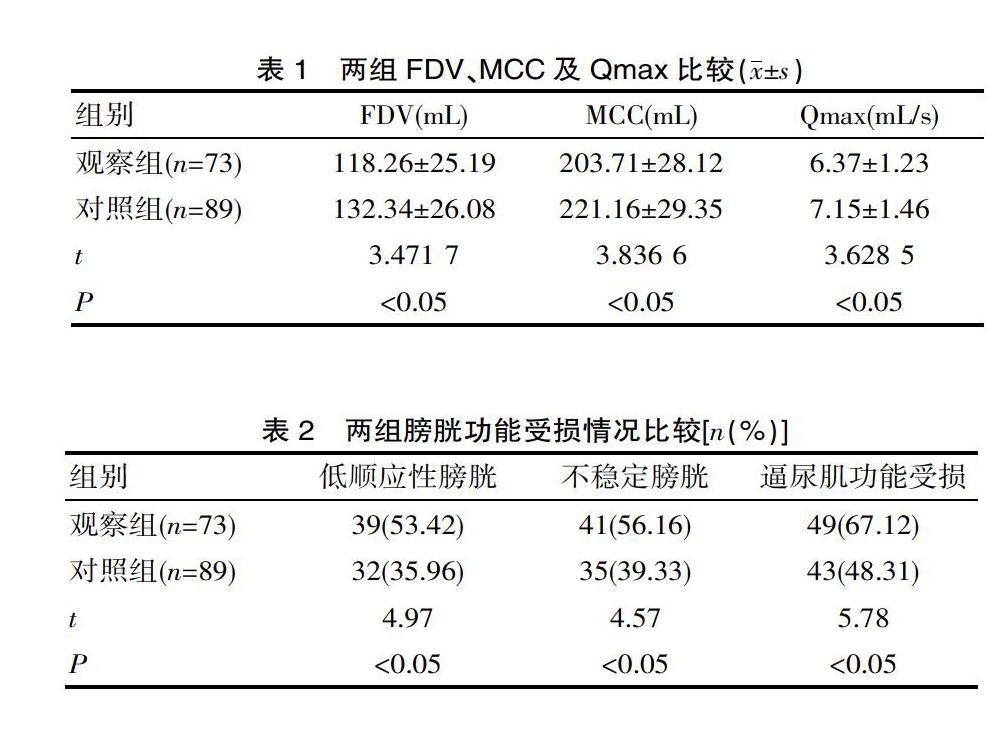
[摘要] 目的 分析前列腺增生症合并脑血管病变后遗症患者尿流动力学检查情况。方法 整群选取2013年5月—2015年4月收治的73例前列腺增生症合并脑血管病变后遗症患者纳入观察组,并选择同期另89例单纯前列腺增生症患者纳入对照组。对比两组尿流动力学检查结果及膀胱功能。 结果 观察组FDV、MCC、Qmax均明显低于对照组(P<0.05);观察组低顺应性膀胱、不稳定膀胱、逼尿肌功能受损发生率分别为53.42%、56.16%、67.12%,均明显高于对照组的35.96%、39.33%、48.31%(P<0.05)。结论 脑血管病变后遗症是导致前列腺增生症患者膀胱功能加重的重要原因。
[关键词] 前列腺增生症;脑血管病变后遗症;尿流动力学
[中图分类号] R5 [文献标识码] A [文章编号] 1674-0742(2016)03(c)-0051-02
Analysis of Urodynamic Study of Patients with Prostatic Hyperplasia Complicated with Cerebral Vascular Disease Sequela
CUI Geng-gang, QIN Ming-hui, XU Bao-cai, GU Xing-zhou, LU Jian-lei
Department of Urinary Surgery, Jining First People's Hospital, Jining, Shandong Province, 272000 China
[Abstract] Objective To analyze the urodynamic study of patients with prostatic hyperplasia complicated with cerebral vascular disease sequela. Methods 73 cases of patients with prostatic hyperplasia complicated with cerebral vascular disease sequela admitted and treated in our hospital from May 2013 to April 2015 were selected as the observation group, 89 cases of patients with simple prostatic hyperplasia treated at the same period were selected as the control group, the urodynamic study results and bladder functions of the two groups were compared. Results The FDV, MCC and Qmax in the observation group were obviously lower than those in the control group (P<0.05), the incidence rates of low compliance bladder, unstable bladder and detrusor dysfunction in the observation group were obviously higher than those in the control group(53.42%, 56.16%, 67.12% vs 35.96%, 39.33%, 48.31%) (P<0.05). Conclusion The cerebral vascular disease sequela is an important cause of bladder function aggravation in patients with prostatic hyperplasia.
[Key words] Prostatic hyperplasia; Cerebral vascular disease sequela; Urodynamic
前列腺增生症及脑血管病变都是男性患者的常见病[1],随着人均年龄的延长,合并脑血管病变后遗症的患者也日益增多。尿流动力学检查是判断前列腺增生症患者排尿梗阻程度及膀胱功能的重要检查手段,临床报道较多[2-3]。该研究通过比较2013年5月—2015年4月收治的73例前列腺增生症合并脑血管病变后遗症及单纯前列腺增生症患者的尿流动力学检查情况,以判断脑血管病变后遗症对前列腺增生症患者膀胱功能的影响,现报道如下。
1 资料与方法
1.1 一般资料
整群选取该院收治的73例前列腺增生症合并脑血管病变后遗症患者纳入观察组,并选择同期另89例单纯前列腺增生症患者纳入对照组。观察组年龄51~73岁,平均(62.83±10.89)岁;前列腺增生病程4~16年,平均(6.89±1.22)年;脑血管病变后遗症病程1~5年,平均(3.18±0.89)年;前列腺体积36~72 mL,平均(45.19±18.39)mL;IPSS评分7~30分,平均(15.87±2.36)分。对照组年龄50~71岁,平均(61.75±10.16)岁;前列腺增生病程4~15年,平均(6.72±1.19)年;前列腺体积35~75 mL,平均(45.95±19.52)mL;IPSS评分7~28分,平均(15.56±2.13)分。所有患者均经B超、肛门指检等方式确诊,且均为良性前列腺增生,排除交流、沟通障碍及精神类病史患者,两组在年龄、病程等方面差异无统计学意义(P>0.05)。
