神经外科颅脑损伤患者应用两种营养支持方法的疗效比较
2015-10-28徐其岭
徐其岭
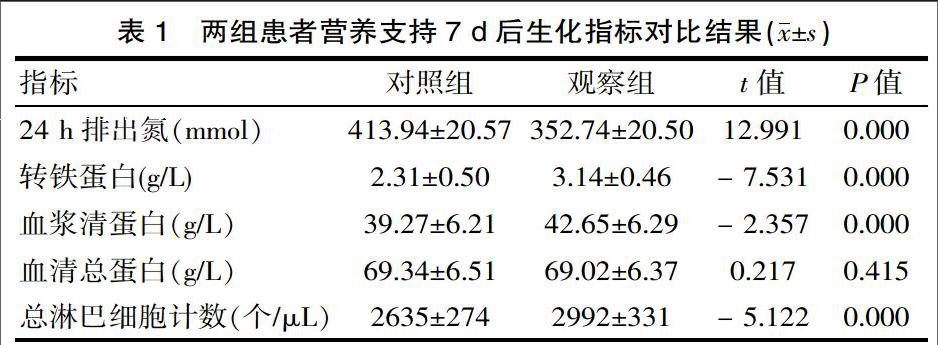
[摘要] 目的 探讨不同营养支持方法对神经外科颅脑损伤患者的临床价值。 方法 随机选取该院2013年5月—2015年1月期间神经外科收治的颅脑损伤患者76例,按照营养支持方法的不同将其分为观察组和对照组,其中对照组患者于伤后24 h实施肠内营养支持,观察组患者于伤后24 h首先开展肠外营养支持,3 d后实施肠内营养支持。对两组患者营养支持7 d后其总淋巴细胞计数、转铁蛋白、24 h排出氮、血浆清蛋白、血清总蛋白水平进行检测记录。 结果 观察组患者在治疗7 d后,其24 h排出氮、血浆清蛋白、总淋巴细胞计数、转铁蛋白水平均明显优于对照组患者,差异有统计学意义(P<0.05),观察组并发症发生率为23.68%,小于对照组的50%(P<0.05)。 结论 对颅脑损伤患者实施肠外营养联合肠内营养的序贯治疗,能够有效促进患者营养指标的改善,有利于减少并发症的发生率,对于改善预后,促进患者恢复具有十分重要的作用,是一种有效的颅脑损伤营养支持方式。
[关键词] 颅脑损伤;营养支持;序贯疗法;应用价值
[中图分类号] R68 [文献标识码] A [文章编号] 1674-0742(2015)09(b)-0035-02
[Abstract] Objective To investigate the clinical value of nutritional support in patients with craniocerebral injury in Department of Neurosurgery. Methods 76 patients with craniocerebral injury admitted to the Department of Neurosurgery in our hospital between May 2013 and January 2015 were randomly divided into observation group and control group according to different nutritional supports. The patients were given enteral nutrition support 24 hours after injury, while those in the observation underwent pareneteral nutrition support 24 hours after injury and enteral nutrition support 3 days after injury. After nutrition support for 7 days in both the two groups, we detected and recorded the total lymphocyte count and levels of ferritin, 24h discharge nitrogen, plasma albumin, and serum total protein. Results After nutrition support for 7 days in both the two groups, 24h discharge nitrogen, plasma albumin level, total lymphocyte count, and levels of ferritin in the observation group than those in the control group, and the differences were statistically significant, P<0.05. The complication rate (23.68% vs 50%) was lower in the observation group than in the control group. Conclusion For patients with craniocerebral injury, parenteral nutrition and enteral nutrition sequential therapy can effectively improve their nutrition indicators, and is propitious for reducing complication rate, improving patient s outcomes and recovery, therefore it is an effective way.
[Key words] Traumatic brain injury; Nutritional support; Sequential therapy; Value
临床研究指出,颅脑损伤后,机体会进入强烈应激状态,以高分解代谢为主要表现,引起负氮平衡和能量消耗增大,从而造成机体功能受损,导致患者死亡或残疾[1]。近年来,大量报道显示,早期营养支持能够对患者的代谢状态进行部分纠正,有助于促进其免疫力和神经功能的恢复,对于降低并发症发生率,改善患者预后具有十分积极的意义[2]。该研究为探讨早期肠内营养和序贯治疗对颅脑损伤患者的临床价值,随机选取该院近2013年5月—2015年1月期间神经内科收治的颅脑损伤患者76例,并对其分别进行两种不同方式的营养支持治疗,现报道如下。
1 资料与方法
1.1 一般资料
随机选取该院神经外科收治的颅脑损伤患者76例,所有患者GCS评分均在8分以下,且住院时间在7 d以上;……