结核性毁损肺外科手术后并发心律失常的危险因素分析
2015-08-06陈伟坚等
陈伟坚等
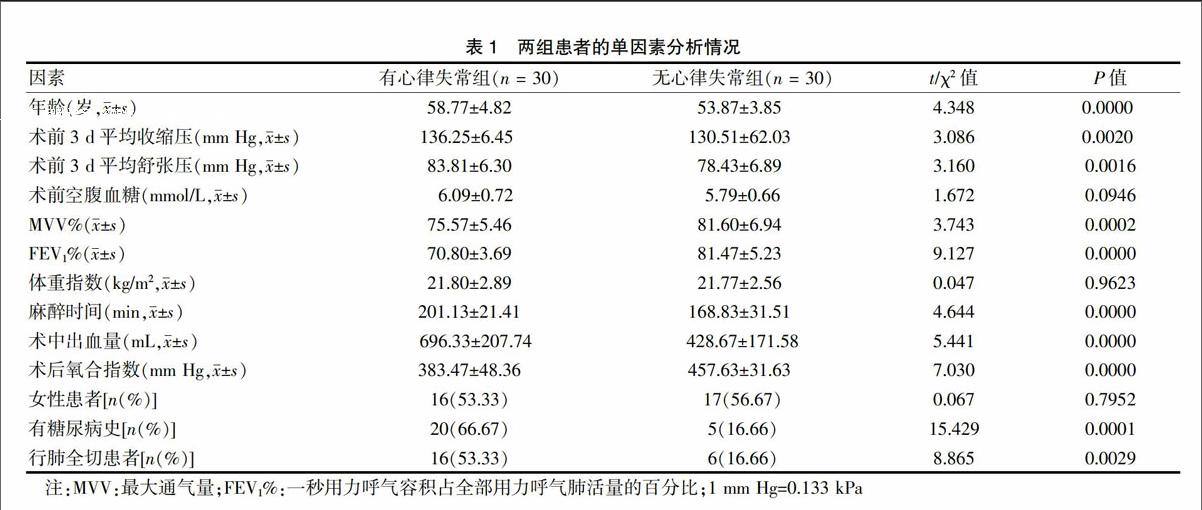
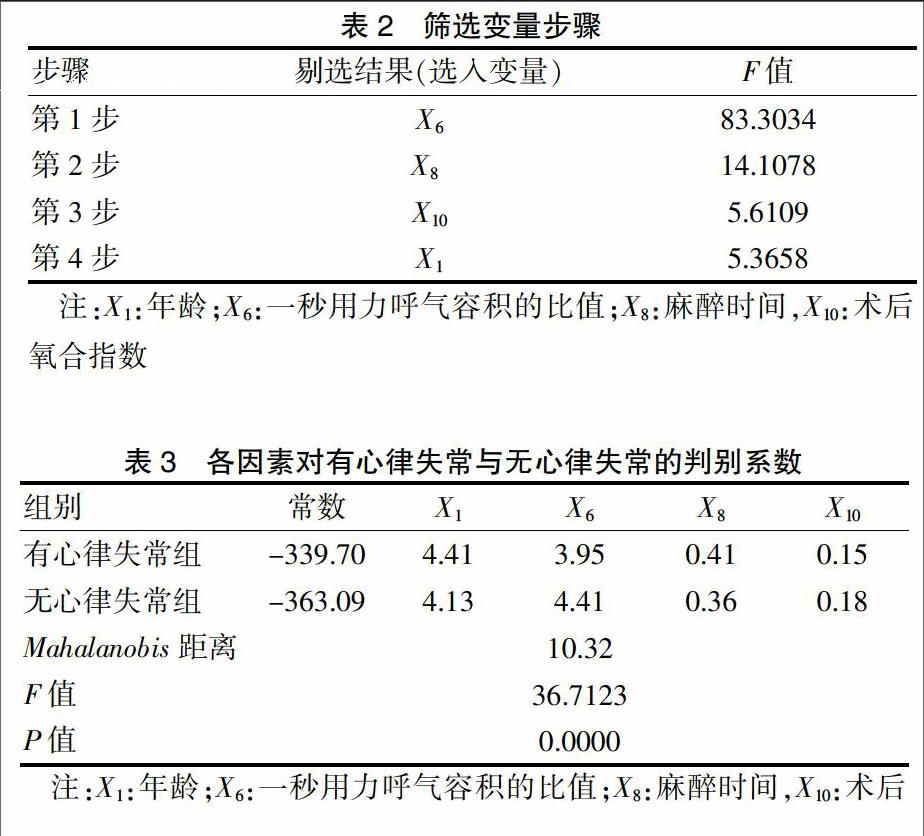
[摘要] 目的 探讨导致结核性毁损肺外科手术治疗术后并发心律失常的危险因素。 方法 选择梧州市第三人民医院及梧州市人民医院2006年1月~2014年8月行结核性毁损肺外科手术治疗患者235例的临床资料作回顾性分析,以术后出现心律失常的30例患者作为有心律失常组,并在未发生心律失常的205例患者中随机抽取30例作各无心律失常组,采用单因素分析及多因素逐步判别法(Bayes法)分析两组患者年龄、性别、术前3 d血压(收缩压和舒张压)平均值、术前有否糖尿病史及术前空腹血糖、最大通气量(MVV)%、一秒用力呼气容积占全部用力呼气肺活量的百分比值(FEV1%)、体重指数、手术方式、麻醉时间、术中出血量、术后氧合指数等指标。 结果 在235例患者中,术后1周内发生房颤、室上性心动过速、频发早搏的患者共30例,占手术患者的12.76%(30/235),单因素分析显示发生心律失常组的年龄、术前3 d血压(收缩压和舒张压)平均值、MMV%、FEV1%、手术方式、麻醉时间、术中出血量、术后氧合指数与无心律失常组比较,差异有高度统计学意义(P < 0.01);逐步判别法分析结果显示年龄、FEV1%、麻醉时间、术后氧合指数是术后并发心律失常的危险因素(Mahalanobis距离为10.21,F = 36.7123,P < 0.01)。 结论 对高龄患者在术前加强肺功能锻炼、缩短麻醉时间和加强围术期呼吸、循环系统的监测和管理,防止术后低氧血症的发生等是预防结核性毁损肺外科手术后并发心律失常的关键措施。
[关键词] 结核性毁损肺手术;心律失常;危险因素
[中图分类号] R541.7 [文献标识码] A [文章编号] 1673-7210(2015)06(b)-0020-04
Analysis on risk factors of cardiac arrhythmia complicated with after tuberculous destroyed lung surgery
CHEN Weijian1 LIU Yuhua2 LI Qinglu3
1.Department of Cardiothoracic Surgery, the Third People's Hospital of Wuzhou City, Guangxi Zhuang Autonomous Region, Wuzhou 543000, China; 2.Department of Medical Insurance, the People's Hospital of Wuzhou City, Guangxi Zhuang Autonomous Region, Wuzhou 543000, China; 3.Department of Cardiothoracic Surgery, the People's Hospital of Wuzhou City, Guangxi Zhuang Autonomous Region, Wuzhou 543000, China
[Abstract] Objective To discuss risk factors of cardiac arrhythmia complicated after destroyed lung of tuberculous surgery. Methods From January 2006 to August 2014, in the Third People's Hospital of Wuzhou City and the People's Hospital of Wuzhou City, the clinical data of 235 patients underwent tuberculous destroyed lung surgery were chosen to be analyzed. 30 postoperative arrhythmia patients were selected as arrhythmia group and, 30 cases from 205 no arrhythmia patients were selected as no arrhythmia group. Single factor analysis and stepwise discriminant method (the Bayes method) were used to analyze age, gender, preoperative three days blood pressure (SBP and DBP), history of preoperative diabetes and preoperative fasting blood glucose, MVV%, FEV1%, body mass index, operation method, anesthesia time, intraoperative blood loss, postoperative oxygenation index. Results Among 235 patients after surgery in one week, there were 30 cases with atrial fibrillate, supraventricular tachycardia, frequent premature beat, accounting for 12.76% (30/235). The result of single factor analysis showed that age, preoperative three days blood pressure (SBP and DBP), MVV%, FEV1%, operation method, anesthesia time, intraoperative blood loss, postoperative oxygenation index of two groups were compared, the differences were statistically significant (P < 0.01). The result of the stepwise discriminant analysis showed that age, FEV1%, anesthesia time, postoperative oxygenation index were the risk factors caused arrhythmia after surgery (Mahalanobis distarce was 10.32, F = 36.7123, P < 0.01). Conclusion The key measures to prevent cardiac arrhythmia complicated after tuberculous destroyed lung surgery are strengthening preoperative pulmonary function exercise in elderly patients, shortening the time of anesthesia and the perioperative respiratory, strengthening monitor and manage circulatory system, preventing the occurrence of postoperative hypoxemia and so on.
[Key words] Tuberculous destroyed lung of surgery; Arrhythmia; Risk factor
随着胸外科技术水平的不断提高,外科手术治疗在肺结核治疗中,发挥着越来越重要的作用,尤其是针对耐多药肺结核病及肺结核病的并发症(如结核性损毁肺),所进行的肺叶或一侧的全肺手术切除治疗。但是,由于开胸手术给机体所带来的创伤和对心、肺等重要的呼吸、循环系统脏器的影响,术后出现心律失常较为常见[1-2],且容易导致不良的临床后果,已逐渐引起胸外科医务人员的高度重视。……