基于房价收入比的中国城市住宅不动产泡沫测度研究
2015-04-20杨晃杨朝军
杨晃+杨朝军
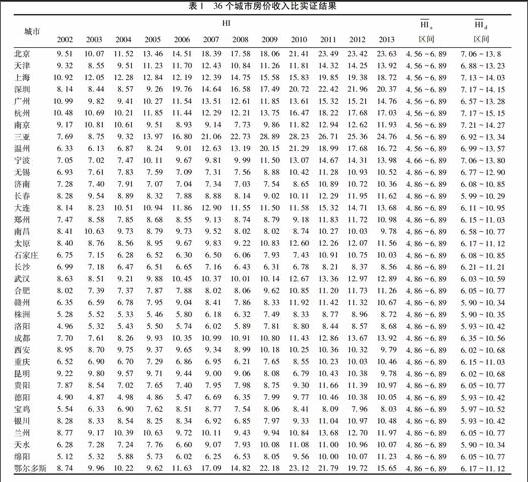
摘要:基于永久性收入理论,引入家庭可支配预期收入增长率,构建了家庭对房产的可支付模型,推导出房价收入比的动态泡沫临界值区间,利用2002~2013年数据对中国36个城市不动产市场价格泡沫进行实证研究。分析得出以下结论:本地居民可支配收入增长率对房价收入比泡沫临界值具有重要影响,并呈正相关,实证分析表明中国城市动态临界值区间是633~1162,城市住宅不动产市场呈结构性泡沫;城市住宅不动产市场价格泡沫存在由东部向中西部、一线城市向二、三线城市间的传导,2012年开始,部分二、三线城市出现去泡沫化现象。
关键词:房价收入比;不动产泡沫;可支配收入增长率
DOI:10.13956/j.ss.1001-8409.2015.04.26
中图分类号:F83059;F2933 文献标识码:A 文章编号:1001-8409(2015)04-0119-05
An Empirical Study on Chinese Residential Real Estate Bubble
Based on the Housing Pricetoincome Ratio
YANG Huang, YANG Chaojun
(Antai College of Economics & Management, Shanghai Jiaotong University, Shanghai 200030
)
Abstract:Based on the theory of permanent income theory, this paper first invents the concept of dynamic housing pricetoincome ratio, then constructs the model of the critical value interval of dynamic housing pricetoincome ratio, and finally does empirical study on the residential real estate price bubbles by using annual data from the 36 cities. The results show household disposable income growth has great influence on real estate bubbles, the critical value interval of dynamic housing pricetoincome ratio is 6.33 to 11.62, a structural real estate bubble exists in China. There exists conductivity on urban price bubbles of residential real estate from east to middle and west china, from firsttier cities to lowertier cities. There exists offbubble phenomenon on chinese residential real estate since the implementation of propertymarket tightening policy from 2012.
Key words:housing pricetoincome ratio; housing bubble; household disposable income growth
2002年后,中国住宅不动产价格快速上涨,全国年平均增长率达到15%,一些城市甚至达到20%,特别是2007年和2009年,上海、北京、深圳等一些城市的房价年增长率更是高达40%。面对房价的快速增长,学术界和业界人士分为两派。一派人士认为,中国住宅不动产市场存在严重泡沫。近些年来,固定资产投资占GDP的比重达到40%以上,而不动产投资约占固定资产投资的25%,再加上不动产业较长的上下游产业链,可以说不动产业的健康与否对中国经济未来走势具有举足轻重的影响。同时,房价已经超出大多数家庭的可支付能力。因此,政府必须对住宅不动产市场加以调控。否则,中国很可能重蹈日本20世纪80年代末资产价格泡沫的覆辙。另一派人士则针锋相对,认为中国住宅不动产市场并不存在泡沫,近十年来房价的上涨是因为居民收入快速增长以及城镇化的推动,再加上过去几十年来被抑制的住房改善需求得以释放的综合结果。……