中国健康体育课程模式对高中生课外体育参与效果影响的研究
2023-06-21郝晓亮杨云云殷荣宾张李强
郝晓亮 杨云云 殷荣宾 张李强

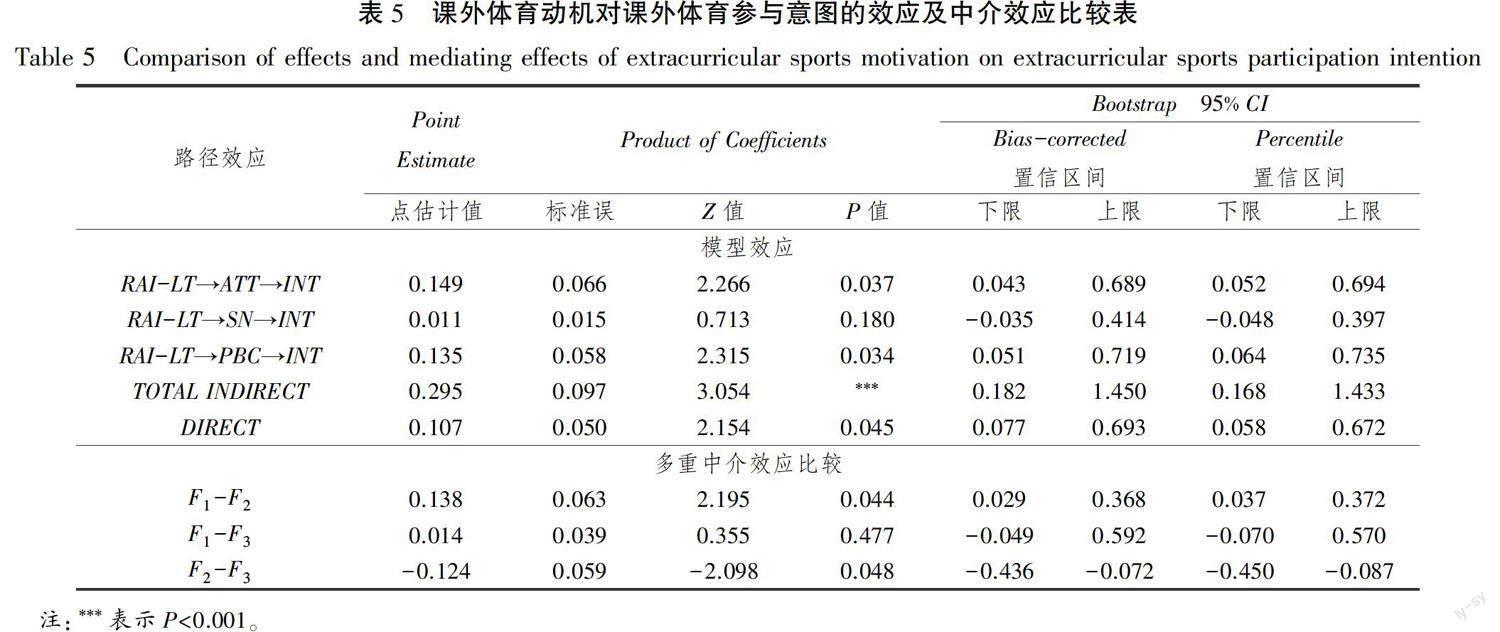

摘 要: 目的:當前我国青少年的身心健康水平饱受社会各界诟病,鉴于此,尝试在高中课堂中实施中国健康体育课程模式,借鉴跨环境动机模型(TCM)考察课程模式对高中生课外体育参与效果的影响。方法:以高一学生为实验对象,教学主题为篮球、健美操,实验组在课堂中采用中国健康体育课程模式,对照组采用惯常教学。实验干预为期12周,所有被试先后4次完成了TCM变量的测试作为实验研究的前测、2测、3测和后测。结果:12周中国健康体育课程模式课堂教学显著提升了学生课堂需求支持感、课堂动机、课外体育动机以及课外体育活动量,对照组没有取得上述效果。实验组学生的课堂需求支持感能够正向预测课堂动机( β =0.343, P <0.001);课堂动机能够正向预测课外体育动机( β =0.435, P <0.001);课外体育动机能够正向预测课外体育参与意图,直接效应显著( β =0.107, P <0.05),总间接效应显著( β =0.295, P < 0.001),主观规范的间接效应不显著( P >0.05);课外体育参与意图能够正向预测课外体育活动量( β =0.361, P <0.001)。结论:中国健康体育课程模式的结构特点为学生的学习提供了支持,有效激发了学生的课堂动机,积极的课堂动机跨环境正向影响了学生的课外体育动机,最终促进了学生的课外体育参与。
关键词: 中国健康体育课程模式;需求支持感;自主动机;跨环境动机模型;课外体育活动量
中图分类号:G807.3 文献标识码:A 文章编号:1006-2076(2023)01-0087-11
Effect of Chinese Healthy Physical Education Curriculum Model on Senior High School Students' Extracurricular Sports Participation: A Test Based on Trans-contextual Model of Motivation
HAO Xiaoliang1,YANG Yunyun2,YIN Rongbin3, ZHANG Liqiang4
1. College of P.E., Taiyuan University of Technology, Taiyuan 030024, Shanxi, China; 2. College of Electrical and Power Engineering, Taiyuan University of Technology, Taiyuan 030024, Shanxi, China; 3. School of P.E., Soochow University, Suzhou 215021, Jiangsu, China; 4. School of P.E., Xizang Minzu University, Xianyang 712082, Shannxi, China
Abstract: Objective: At present, the physical and mental health level of teenagers in China is criticized by all sectors of society; in view of this, the paper tries to implement the Chinese healthy physical education curriculum model in the senior high school PE, and uses the trans-contextual model of motivation to investigate the impact of Chinese healthy physical education curriculum model on the effect of senior high school students' extracurricular sports participation. Methods: Taking fresh students of senior high school as the experimental subject, the teaching themes are basketball and aerobics; the experimental group adopts the Chinese healthy physical education curriculum model in the class, and the control group adopts the habitual teaching. The experimental intervention lasted for 12 weeks, all subjects completed the test of TCM variables four times as the pre-test, 2-test, 3-test and post-test of the experimental study. Results: The teaching of 12 weeks Chinese healthy physical education curriculum model significantly improved students' perceived need support in class, autonomous motivation in PE, autonomous motivation in LT (leisure time) and the amount of extracurricular sports activities, the control group did not achieve the above effect. The perceived need support of experimental group students can predict autonomous motivation in PE positively ( β=0.343,P <0.001); Autonomous motivation in PE can predict autonomous motivation in LT positively ( β=0.435,P <0.001); Autonomous motivation in LT can predict the intention of extracurricular sports participation positively, and the direct effect was significant ( β=0.107,P <0.05), the total indirect effect was significant ( β= 0.295,P <0.001), the indirect effect of subjective norms was not significant ( P >0.05); Extracurricular sports participation intention can predict the amount of extracurricular sports activities positively ( β=0.361,P <0.001). Conclusion: The structural characteristics of the Chinese healthy physical education curriculum model provide support for students' learning, effectively stimulate students' autonomous motivation in PE, and the positive autonomous motivation in PE has a positive impact on students' autonomous motivation in LT across the environment, which ultimately promotes students' extracurricular sports participation.
Key words: Chinese healthy physical education curriculum model; perceived need support; autonomous motivation; trans-contextual model of motivation; amount of extracurricular sports activities
当前我国青少年体力活动不足的窘境依然未能得到扭转。客观来讲,体育课堂和课外体育构成了学生身体锻炼的全部来源,因此,学校的体育课程理应承担部分责任。……