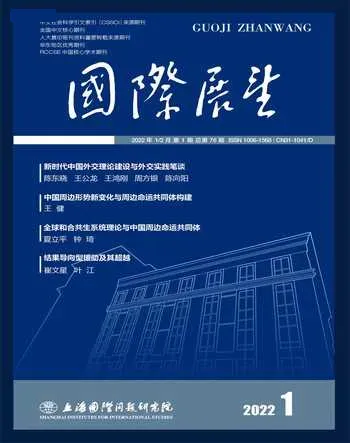
英文摘要
2022-01-13
Abstracts
Chinese Diplomacy in the New Era: Theory and Practice
Chen Dongxiao, Wang Gonglong, Wang Honggang, Zhou Fangyin, and Chen Xiangyang
Abstract: Theory and direction of Chinese diplomacy in the new era should be explored from three perspectives, methodology, theoretical significance, and institutional innovation. The vision of humanity as a community with a shared future contributes to China’s international relations theory and drives innovation in theoretical paradigm, a process that is reflected in the introduction of ;new ideas, values, models, and narratives. The theoretical importance of China’s global partnerships should be better understood to promote a new type of international relations and the progress and ingenuity of the Belt and Road Initiative be popularized to promote institutional innovation for common modernization. International competition in the 21st century will be horizontal, indirect, and asymmetric. As Washington sees Beijing as its peer competition, strategic rivalry between the two superpowers will persist. We must situate strategic competition in a broader spectrum, approach it so as to manage and mitigate it, and at the same time promote a real multilateralism.
Keywords: Xi Doctrine, community with a shared future for mankind, modernization for all, international order, competition and cooperation, multilateralism
New Developments in China’s Peripheries and the Building of a Neighboring Community with a Shared Future
WANG Jian
Abstract: Significant security and economic changes have taken place in China's neighborhood since 2017. In an attempt to increase regional deterrent capabilities, Washington has shored up its Indo-Pacific strategy by fostering closer defense ties with Tokyo and Seoul and courting ASEAN on specific issues on the one hand, and encourage European allies like France, the United Kingdom, Germany, and the European Union to take similar steps, for example, expanding economic and trade links and ramping up security presence. There is a growing tendency toward regionalization as globalization meets major setbacks, a process likely to be accelerated by the development and deployment of robots, 3D printing, renewable energy, and other emerging technologies, presenting new opportunities for China to strengthen ties with neighboring countries. Beijing should further elevate the importance of its peripheries in its foreign policy planning by improving its relationships with regional stakeholders like Japan, South Korea, India, Russia, ASEAN, and the United States, turning itself into a hub of new regional development, actively providing regional public goods, and facilitating the building of a neighboring community with a shared future.
Keywords: Chinese diplomacy, neighborhood, Sino-American relations regionalization, community with a shared future
Symbiotic Systems Theory for Global Peace and Cooperation and China’s Neighboring Community of Shared Future
XIA Liping and ZHONG Qi
Abstract: Symbiotic systems theory for global peace and cooperation is a new framework intermingling symbiosis theory and systems theory. It can be an analytical paradigm and theoretical basis for building a community with a shared future for mankind and China’s neighboring community with a shared future. This theory maintains that everything in the world is a symbiosis in a big system so that the community with a shared future for mankind must be constructed from a global perspective. The relationship between the various components of the international system is dialectical, that is unity of opposites. Interdependence within the global system and China’s peripheral system has both positive side and negative side. Positive interdependence means that both interdependent parties benefit from the relationship, while negative interdependence means that the destruction of interdependence by one party may result in losses for the other or even for both. Building China’s neighboring community with a shared future is the objective of advanced stage of global symbiosis system. Interdependence in the symbiotic systems theory determines the necessity of optimizing China’s peripheral system so as to realize China’s neighboring community with a shared future. Mutual respect, fairness and justice, and win-win cooperation should become the three key factors in China’s effort to build a community with a shared future in its neighborhood.
Keywords: peripheral diplomacy, community with a shared future, symbiotic theory, systems theory, global peace and cooperation, diplomatic philosophy
International Tax Reform: New Process and Implications
DENG Zhichao, LIAN Ping, and ZHOU Yu
Abstract: The BEPS has long plagued international taxation, and the rise of the digital economy has further exacerbated the problem. BEPS was formally put on the reform agenda for international taxation in 2013. Under the impact of Covid-19, the Biden administration has actively promoted international tax reforms in line with its domestic tax increases act. In October 2021, the BEPS international tax reform has "broken down the barriers" and formally obtained the approval of most of the BEPS framework member states. It is planned to be implemented globally in 2023. In the future international tax reforms will continue to have an impact on global tax governance, global tax cycles, digital economy development, capital flows, and global offshore centers. It will also improve China’s tax system, the advantages of China, attract the return of Chinese-funded transnational digital enterprises, and bring opportunities for reform and innovation in the Pilot Free Trade Zone (Port). At the same time, the international tax reform will also tighten the overseas investment environment for Chinese-funded multinational companies, which will have an impact on Hong Kong’s financial stability. China should take the opportunity presented in this round of tax reforms to improve the domestic tax collection and management system, accelerate market-oriented construction and financial opening process, promote the benchmarking of international innovation in the self-experimental zone, and enhance Hong Kong’s endogenous growth momentum and stability.
Keywords: international tax reforms, profit shifting, tax base erosion, digital economy
Toward“Results-based Aid”and Beyond: China’s International Development Cooperation and the Construction of Global Development Discourse in the New Era
CUI Wenxing and YE Jiang
Abstract: Aid is an important tool of a country’s foreign policy. During the Cold War, the main purpose of the US and the Soviet Union’s foreign aid practice was to compete ;for allies. The evaluation of aid effectiveness was mainly process-based, and the aid was used to keep the recipient countries in their own camp. After the end of the Cold War, a crisis of legitimacy of aid budgets emerged in Western countries, and discussions on aid effectiveness gradually shifted from process-oriented to result-oriented. Since the beginning of the 21st century, the United Nations Millennium Development Goals and the 2030 Sustainable Development Goals have provided an important frame of reference for the evaluation of development aid results. Result-based aid provides an important reference for improving the visibility of China’s foreign aid, but its drawbacks and North-South vertical characteristics make it necessary for China to formulate the international development cooperation strategy that goes beyond aid in the new era.The United Nations 2030 Agenda for Sustainable Development not only absorbs the positive elements of results-based aid, but also lays the foundation for transcending it.The in-depth alignment of China’s international development cooperation with the United Nations 2030 Agenda presents an important opportunity for China to break through the strategic containment of the United States and the West and realize the great rejuvenation of the Chinese nation.Global Development Initiative together with the Belt and Road Initiative, Community of a Shared Future for Mankind, Ecological Civilization forms the basis for the construction of China’s global development discourse, surpasses results-based aid and points out the direction for the implementation of the United Nations 2030 Agenda.
Keywords: results-based aid, 2030 Agenda for Sustainable Development, global development, Chinese initiatives
China’s International Development Cooperation under the International Public Goods Perspective
TANG Lixia, ZHAO Wenjie, and LI Xiaoyun
Abstract: With the changes of the international and domestic situations, China’s foreign aid has undergone several changes. In recent years, the emphasis on international development cooperation from the official perspective has become the beginning of the ideological transformation of China’s foreign aid, which has also laid a conceptual foundation for promoting the transformation of foreign aid into international development cooperation and better providing global public goods. At the same time, China’s experience in providing global public goods in the field of development cooperation has become richer. First, international cooperation on poverty reduction based on China’s successful experience has become an important public good. Second, China has provided more public goods to address global food security issues, including through innovative ways of agricultural technology cooperation and so on. Third, triangular cooperation is regarded as an important way to innovate the supply model of public goods. Fourth, China continues to strengthen the supply of public goods in the area of global health. In the field of international development cooperation, China has achieved satisfying results in a series of explorations on innovative modes of supply of public goods. However, there is no denying that China faces challenges in the supply of global public goods, such as limited economic and technological strengths, the sustainability of aid projects to be improved, difficulties in coordinating national governance and non-interference in the internal affairs of recipient countries, and the need to enhance the voice in international development cooperation. In the future, China should pay more attention to making better preparations in terms of institutional building, fund raising, sustainability improvement, and the initiative of recipient countries and the enhancement of international influence.
Keywords: aid, global public goods, international development cooperation, global governance
China-U.S. Engagement in Triangular Development Cooperation: Challenges and Solutions
HU Yong
Abstract: As the biggest providers of South-South cooperation and North-South cooperation respectively, China and U.S. have reinforced policy dialogues on international development and piloted several triangular development cooperation (TDC) programs in human resources, agriculture and public health with partners from the developing world since the early 21st century. However, TDC has been facing dual challenges including incompatibility among participants in international development and political barriers generated by U.S. policy towards China since 2018. Given the international development that was hit heavily by Covid-19, it is of significance for China and U.S. to reset collaboration to bolster triangular development cooperation. Despite of various difficulties, China could play the constructive roles to get TDC back on track through taking measures like proposing development policy dialogues with the U.S., encouraging TDC among non-official participants and improving coordination with partners form the developing world.
Keywords: international development,triangular cooperation, China-U.S. relations.
Foreign Aid of the Arab Gulf States: Strategies, Characteristics, and Implications
LI Yi
Abstract: The Arab Gulf states are an important part of the emerging donor community and are increasingly contributing to the international development assistance. Their aid practices are closely linked to national strategies. The rich oil dividends, the monarchies, the historical geography of the Arab world, the religious attributes of the Islamic culture with the complex and volatile regional security environment, together impact their diplomatic strategy, economic strategy and cultural strategy. In terms of diplomatic strategy, their foreign aid is integrated into the overall national strategy and gradually expanded to the whole world on the basis of maintaining sustained investment in the strategically prioritized regions, mainly in the forms of “solidarity aid” and South-South cooperation. In terms of economic strategy, they aimed at accelerating national economic diversification policies through the deployment and recycling of oil wealth on a global scale. In terms of cultural strategy, they promote the idea of generosity in the traditional culture and Zakat in Islam, in order to achieve the goal of improving national status and gaining regional influence. Their aid policy is monarch- and central government-led that balances bilateral and multilateral aid channels with aid allocations to Arabic neighbouring countries, Islamic countries and sub-Saharan African countries. The Arab Gulf donors focus on the economic and social development of recipient countries and actively align themselves with the new mechanisms for international development cooperation. They have not only alleviated the development difficulties of the poor countries through humanitarian assistance, but also demonstrated their multiple roles in international development cooperation and echoes with China in carrying out the concept of cooperation and shared development.
Keywords: Arab Gulf donors, foreign aid, South-South cooperation