二斑叶螨为害前后抗、感木薯转录组分析及水杨酸、茉莉酸途径差异表达基因验证
2021-12-23窦宏双梁晓陈青伍春玲刘迎范东哲吴岩
窦宏双 梁晓 陈青 伍春玲 刘迎 范东哲 吴岩
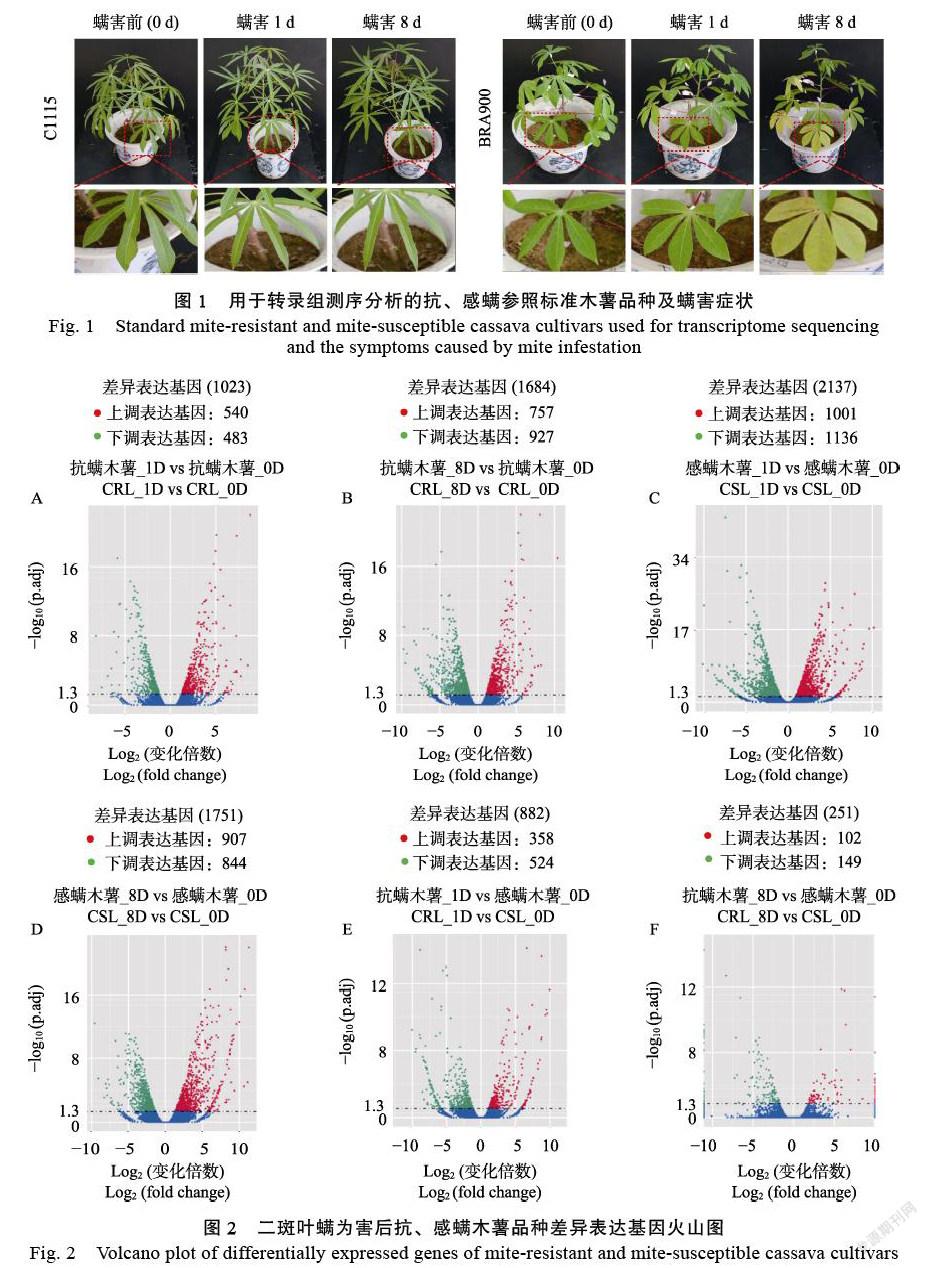
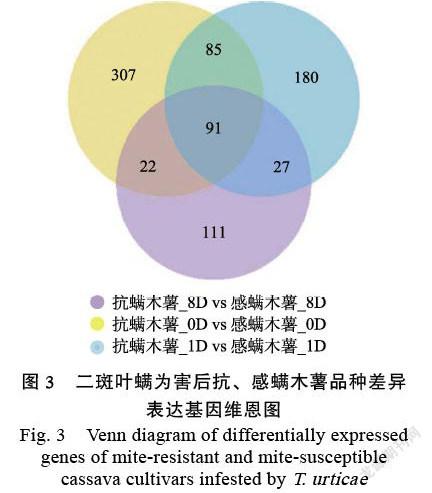
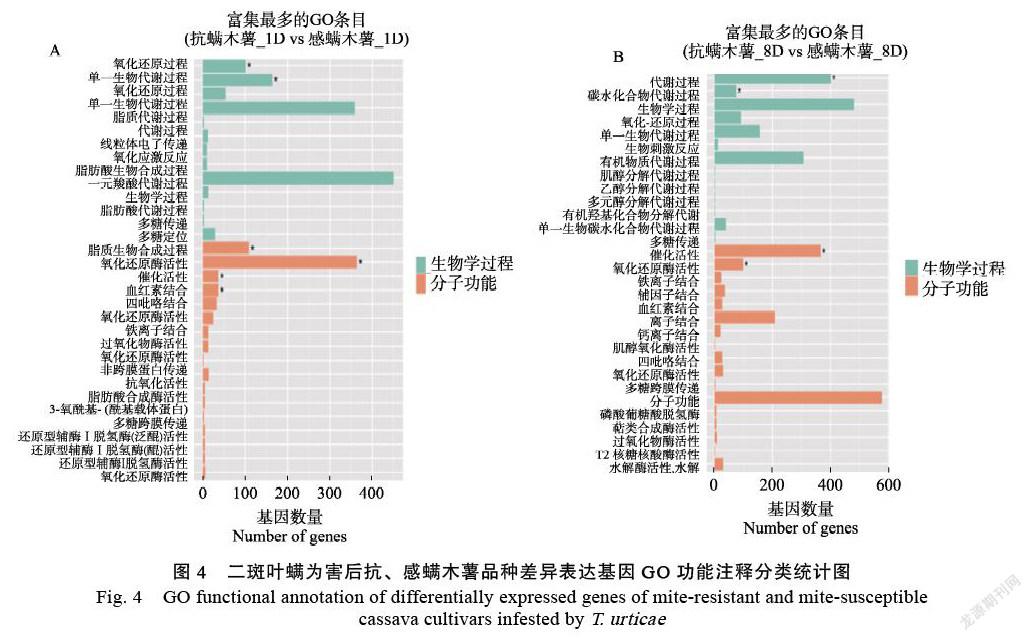
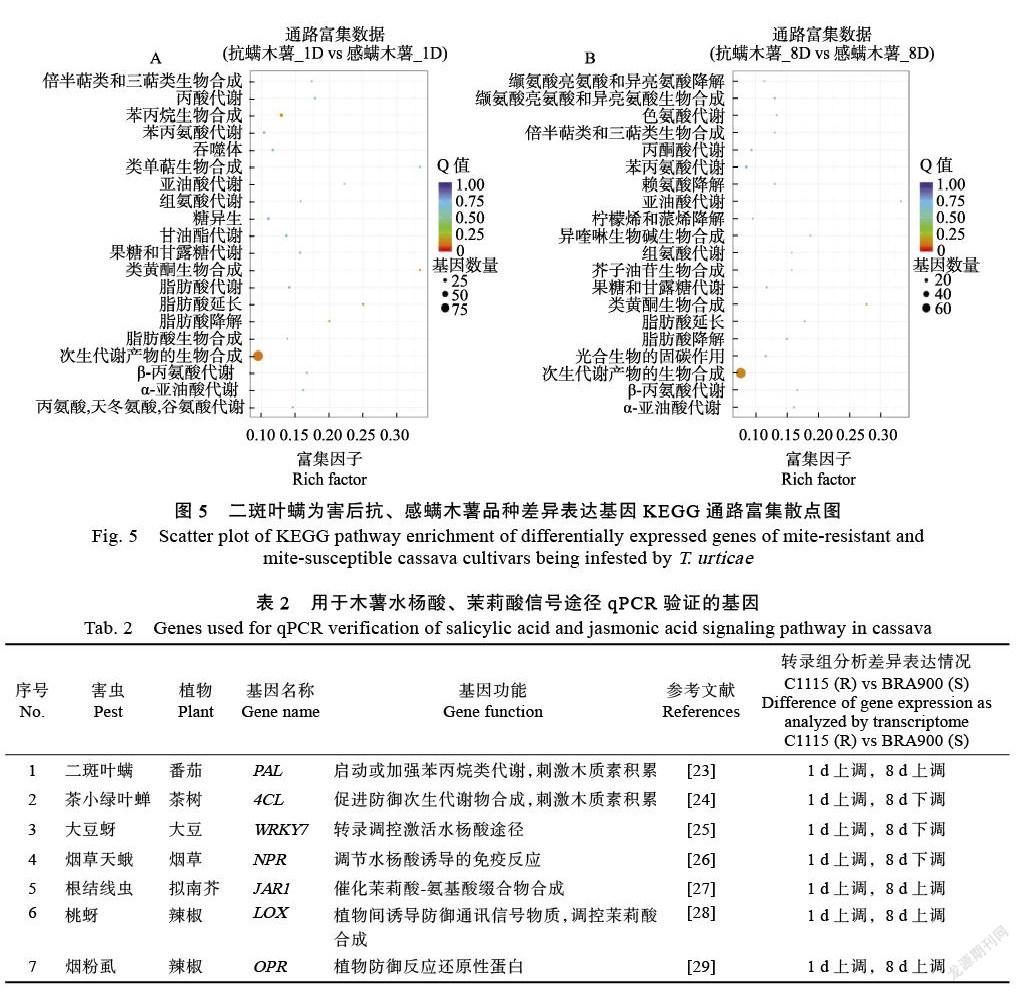
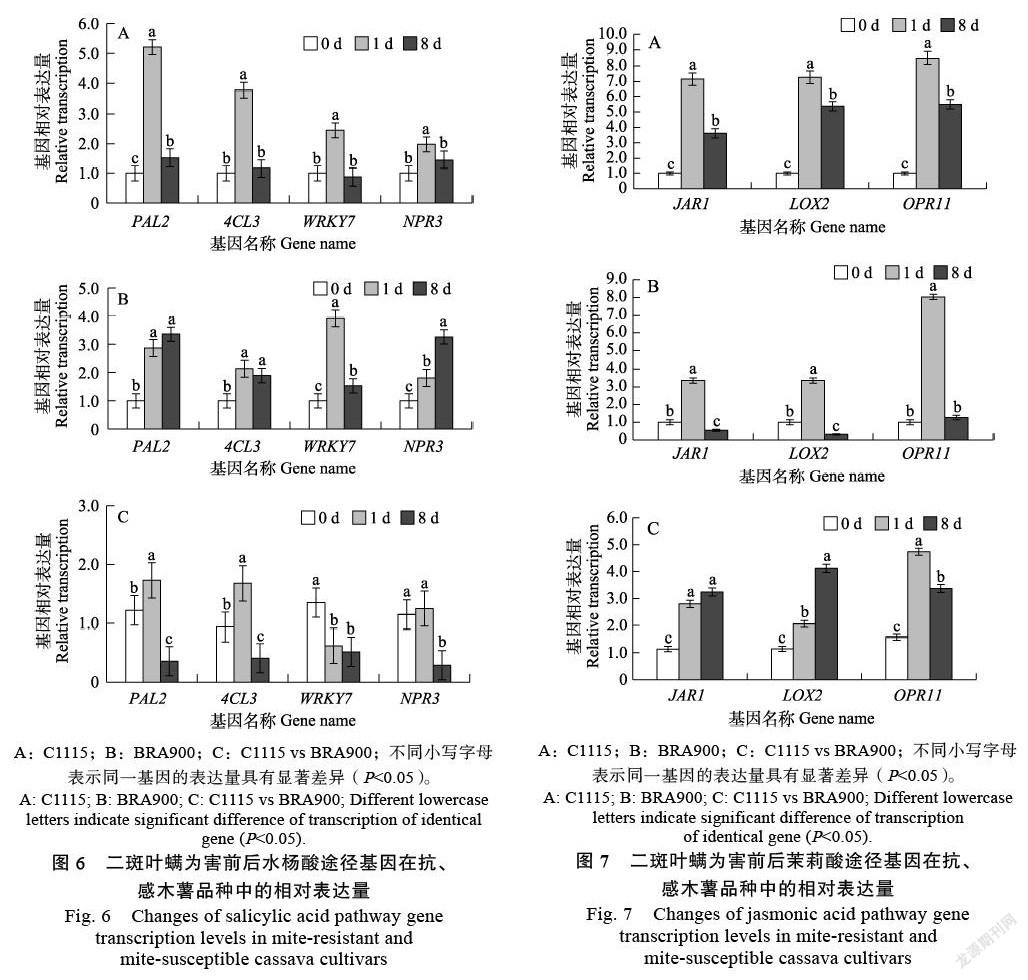
摘 要:本研究通過比较二斑叶螨为害前后抗、感螨木薯品种转录组差异,筛选差异表达基因,并采用qPCR验证水杨酸、茉莉酸信号途径基因的差异表达。转录组分析结果表明,与螨害前相比,螨害1、8 d后,抗螨木薯品种C1115的差异表达基因为589、587个,感螨木薯品种BRA900的差异表达基因为1271、930个,C1115相对于BRA900的差异表达基因分别为383、251个。GO和KEGG富集分析发现这些差异表达基因主要显著集中在次生代谢物质合成、苯丙烷生物合成、类黄酮生物合成和氧化还原反应等过程。qPCR验证结果显示,二斑叶螨为害后,抗螨参照标准木薯品种C1115的水杨酸信号途径基因PAL2、4CL3、WRKY7和NPR3的表达量较为害前呈现先显著提高后降低的趋势,而感螨参照标准木薯品种BRA900中上述4个基因的表达始终维持在显著高于为害前的水平。受螨害后抗螨木薯C1115中茉莉酸信号途径基因JAR1、LOX2和OPR11的表达量也较为害前显著提高,而感螨木薯BRA900中这3个基因的表达量则降低至显著低于螨害前的水平,qPCR验证结果和转录组分析结果相一致。本研究结果表明,抗螨木薯品种C1115受螨害后能够同时激活水杨酸、茉莉酸信号途径以抵御二斑叶螨为害,为深入阐明木薯抗螨分子机理,选育和创制抗螨木薯品种提供了理论参考依据。
关键词:二斑叶螨;抗、感木薯品种;转录组分析;水杨酸信号途径;茉莉酸信号途径
中图分类号:S533 文献标识码:A
Abstract: To the best of our knowledge, there is no report on transcriptome difference while resistant and susceptible cassava cultivars were infested by pests. In this study, by comparing the transcriptome differences of resistant and sus-ceptible cassava cultivars before and after Tetranychus urticae infestation, we screened the differentially expressed genes, and verified the differential expression of salicylic acid and jasmonic acid pathway genes through qPCR. The results of transcriptome analysis showed that there were 589 and 587 differentially expressed genes in mite-resistant cassava cultivar C1115, 1271 and 930 differentially expressed genes in mite-susceptible cassava cultivar BRA900, and 383 and 251 differentially expressed genes between C1115 and BRA900 respectively. In addition, the Go and KEGG enrichment analysis showed that the differentially expressed genes were significantly enriched in the secondary metabolite biosynthesis, phenylpropane biosynthesis, flavonoid biosynthesis and redox related reactions. qPCR verification indicated that after infested by T. urticae for 1 d and 8 d, the transcriptions of salicylic acid signaling pathway genes such as PAL2, 4CL3, WRKY7 and NPR3 in the standard mite-resistant cassava cultivar C1115 were first significantly increased and then decreased, while the expression level of the four genes in the standard mite-resistant cassava cultivar BRA900 was significantly higher than those before infestation. Besides, the transcription of jasmonic acid signal pathway genes like JAR1, LOX2 and OPR11 in C1115 was also significantly higher than those before infestation, while the transcription of the three genes in BRA900 was significantly lower than those before infestation. The results speculated that mite-resistant cassava cultivar C1115 could activate salicylic acid and jasmonic acid signaling pathways to defend T. urticae infestation. This study would lay a theoretical foundation for further elucidating the molecular mechanism of cassava resistance to mite, and for breeding and creating mite-resistant cassava cultivars.
Keywords: Tetranychus urticae; mite-resistant and mite-susceptible cassava cultivars; transcriptome analysis; salicylic acid signaling pathways; jasmonic acid signaling pathways
DOI: 10.3969/j.issn.1000-2561.2021.11.013
木薯(Manihot esculenta Crantz)是全球9亿多人的主粮,同时也是重要的饲料作物、工业原料作物和生物能源[1]。……