认知行为干预对恶性胶质母细胞瘤患者焦虑、抑郁及心理弹性的影响
2021-11-03杨维萍熊中奎陈遐林
杨维萍 熊中奎 陈遐林
[關键词] 认知行为干预;恶性胶质母细胞瘤;焦虑;抑郁;心理弹性
[中图分类号] R739 [文献标识码] B [文章编号] 1673-9701(2021)17-0167-04
Impacts of cognitive behavioral intervention on anxiety, depression and resilience of patients with malignant glioblastoma
YANG Weiping1 XIONG Zhongkui1 CHEN Xialin2
1.Department of Tumor Radiotherapy, Shaoxing Second Hospital, Shaoxing 312000, China; 2.Department of Internal Medicine-Oncology, Shaoxing People′s Hospital, Shaoxing 312000, China
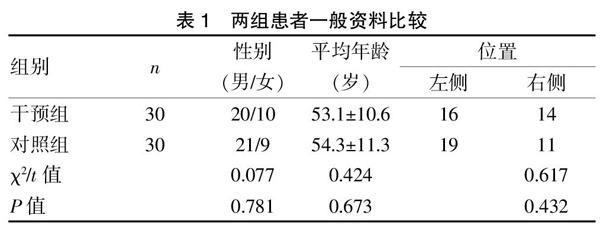
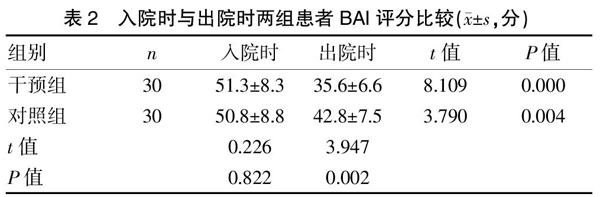
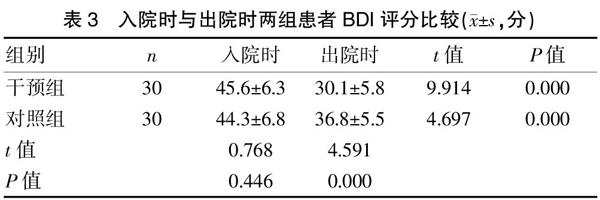
[Abstract] Objective To investigate the impacts of cognitive behavioral intervention on anxiety, depression and resilience of patients with malignant glioblastoma. Methods Sixty patients with malignant glioma diagnosed and treated in our hospital from June 2017 to May 2020 were selected as the research objects, and they were randomly divided into the intervention group (n=30) and the control group (n=30). The control group was given conventional nursing and health education, and the intervention group was given cognitive and behavioral intervention based on the control group. BAI, BDI, CD-RISC and SCSQ were used to evaluate patients′ anxiety, depression, resilience and coping style at admission and discharge respectively. Results (1)The BAI scores (35.6±6.6, 42.8±7.5) points and BDI scores (30.1±5.8, 36.8±5.5) points of the two groups at discharge were significantly decreased than those at admission, with statistically significant differences (P<0.05). Meanwhile, BAI score of the intervention group at discharge was significantly lower than that of the control group, and the difference was statistically significant (P<0.05). (2)The scores of CD-RISC (69.2±6.6, 55.8±6.9) points and SCSQ (49.4±6.8, 40.8±6.2) points in both groups after discharge were significantly increased than those in admission, and the differences were statistically significant (P<0.05). The scores of CD-RISC and SCSQ in the intervention group at discharge were significantly higher than those in the control group, with statistically significant differences (P<0.05). Conclusion Cognitive behavioral intervention can significantly relieve anxiety, depression and other negative emotions of patients with malignant glioblastoma and improve psychological resilience and improve coping style.
[Key words] Cognitive behavioral intervention; Malignant glioblastoma; Anxiety; Depression; Psychological resilience
脑胶质细胞瘤(glioblastoma)是由于大脑和脊髓胶质细胞癌变所发生的,最常见的为颅脑肿瘤。脑胶质细胞瘤根据细胞分化分为低级别胶质瘤与高级别胶质瘤,后者低分化,为恶性肿瘤,患者预后差。恶性胶质母细胞瘤(malignant glioblastoma)患者多需要手术或者放化疗治疗,疾病本身以及相关的治疗均会对患者的心理、情绪等造成影响,而不良的心理、情绪影响又会影响疾病的恢复。心理弹性是主体对外界变化的环境的心理及行为上的反应状态,是一种动态形式,在变化中达到对环境的动态调控与适应[1,2]。认知行为干预是基于知-信-行理论之上的一种干预方法,知是基础,信是动力,行是目标,是广泛使用的能够改善心理健康的干预疗法。研究显示,认知行为干预可以显著改善广泛性焦虑症患者的焦虑、抑郁、服药依从性、睡眠质量、生活质量等[3]。本文将认知行为干预应用于恶性角质细胞瘤患者,分析其对患者焦虑、抑郁以及心理弹性的影响,以期为临床提供参考。
1资料与方法
1.1一般资料
选择2017年6月至2020年5月在医院诊断治疗的恶性胶质瘤患者60例为研究对象。纳入标准[4,5]:恶性胶质母细胞瘤,WHO Ⅳ级[6];病理确诊为恶性胶质母细胞瘤;首次确诊;术后放化疗患者,术后情况良好;KPS>60分;认知功能正常;住院时间超过1周;对本次研究知情同意。排除标准[4,5]:认知功能障碍,既往有精神病病史、神经病病史,既往有其他脑肿瘤病史,既往有其他系统肿瘤病史;合并其他脏器功能障碍者;有治疗方案禁忌证者;中途转院患者。6……