间歇运动干预对儿童执行功能的影响及其延迟效益研究
2021-10-18蔡春先张运亮朱艳彤冯淑瑞刘杰
蔡春先 张运亮 朱艳彤 冯淑瑞 刘杰
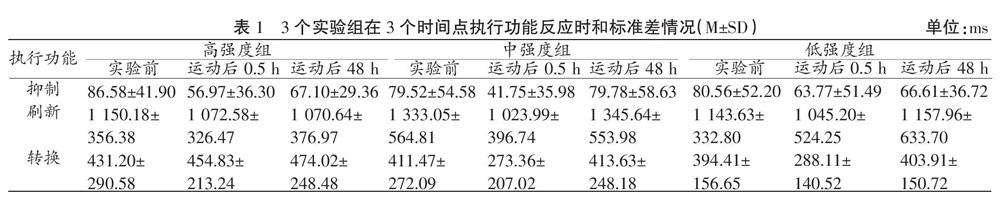
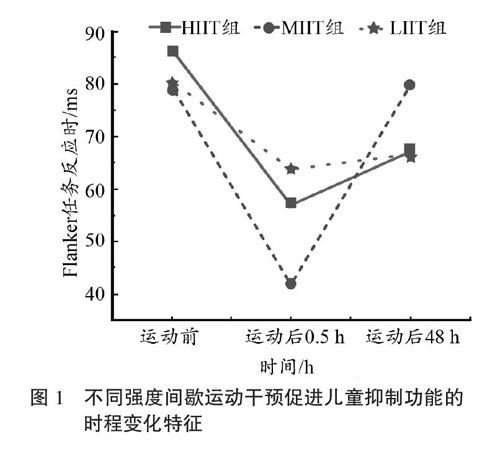
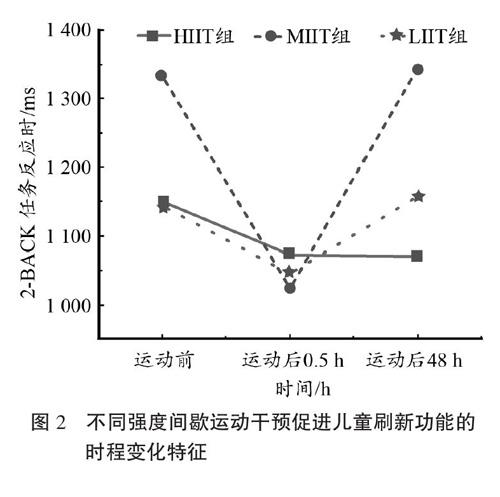
摘 要:探究不同強度间歇运动干预对儿童执行功能的影响及其延迟效益。方法:以5年级小学生为实验对象,依据跳绳的节奏将其随机分成低强度组(LIIT组)、中强度组(MIIT组)和高强度组(HIIT组),各组按照运动方案进行跳绳干预。运动前、运动后0.5 h、运动后48 h均使用儿童执行功能测量工具,运用Flanker任务、2-back任务、More-odd shifting任务全面评价小学生的抑制、刷新、转换3个子功能。结果:1)抑制功能。HIIT组和MIIT组在不同时间点上完成Flanker任务的反应时存在显著性差异(p<0.05),LIIT组则未见显著性差异(p>0.05)。2)刷新功能。HIIT组和LIIT组在不同时间点上完成2-back任务的反应时未见显著性差异(p>0.05),MIIT组存在非常显著性差异(p<0.001)。3)转换功能。HIIT组在不同时间点上完成More-odd shifting任务的反应时未见显著性差异(p>0.05),而MIIT组和LIIT组存在非常显著性差异(p<0.001)。4)在运动后0.5 h,中强度组、低强度组与高强度组完成More-odd shifting任务的反应时存在显著性差异(p<0.05);在运动后48 h,不同强度实验组完成More-odd shifting任务的反应时未见显著性差异(p>0.05)。结论:不同强度间歇运动对儿童执行功能的促进作用不同,中强度间歇运动对儿童执行功能的促进作用更显著。间歇运动干预对儿童执行功能的促进有一定的延迟效益,效益延迟时间与运动强度有关。
关键词:间歇性运动;儿童;执行功能;延迟效益;跳绳
中图分类号:G 804.55 学科代码:040302 文献标识码:A
Abstract:To explore the effects of intermittent exercise interventions with different intensities on childrens executive function and their delayed benefits. Methods: The fifth-grade students in a primary school were randomly divided into low-intensity intermittent group (LIIT group), medium-intensity intermittent group (MIIT group) and high-intensity intermittent group (HIIT group) according to the rhythm of rope jumping. Each group performed rope skipping intervention according to the exercise program. With childrens executive function measurement tools, the sub-functions (inhibition, updating and shifting) of primary school students were evaluated via Flanker task, 2-back task, and More-odd shifting task before exercise, 0.5 hours and 48 hours after exercise, respectively. Results: 1) Inhibition function: Both HIIT and MIIT groups exhibited significant differences (p<0.05) in the responses of performing Flanker task at different measure time, while no significant difference (p>0.05) showed in LIIT group. 2) Updating function: Both HIIT and LIIT groups exhibited no significant differences (p >0.05) showed in the responses of performing 2-back task at different measure time, while a significant difference (p<0.001) showed in MIIT group. 3) Shifting function: HIIT group showed no significant difference (p>0.05) in the response of performing More-odd shifting task at different measure time, while a significant difference (p<0.001) showed in MIIT and LIIT groups. 4) There was significant difference (p<0.05) showed in the response time of performing More-odd shifting tasks between medium intensity group, low intensity group and high intensity group at 0.5 h after exercise; there was no significant difference (p<0.05) in the response time of performing More-odd shifting tasks in different experimental groups with different intensity 48 hours after exercise. Conclusions: Intermittent exercise of different intensities promotes childrens executive function at varying level. Medium-intensity intermittent exercise is most significant compared with the others. Intermittent exercise interventions have a delayed effect on the promotion of childrens executive function. Benefit delay time is related to exercise intensity.
Keywords: intermittent exercise; children; execution function; delayed benefit; rope jumping
作为儿童认知、情绪和社会功能的核心,执行功能在儿童身心健康发展过程中具有重要作用,良好的执行功能是儿童形成正确认知的基础和进行恰当行为的保证,一旦执行功能的发展出现障碍就会诱发诸如注意力缺陷、学习障碍等多种问题。以往的研究发现,适宜的运动能够对儿童执行功能的发展产生积极效益[1]。在此基础上,学者们开始探究运动要素(运动强度、运动时间、运动项目、运动方式等)与儿童执行功能发展之间的关系,以期设计出有效促进儿童执行功能发展的最佳运动方案。