超声联合神经刺激仪引导下肌间沟臂丛神经阻滞在高血压患者上肢手术中的临床观察
2021-09-13朱海彬伍素贞邓秋红吴耀滨
朱海彬 伍素贞 邓秋红 吴耀滨
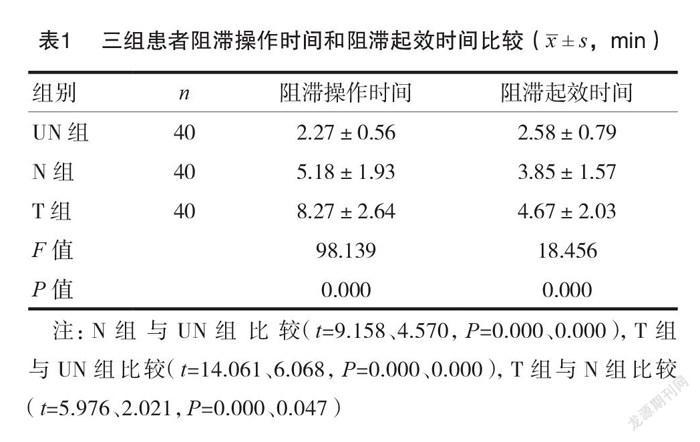


[摘要]目的探讨超声联合神经刺激仪引导下肌间沟臂丛神经阻滞在高血压患者上肢手术中的临床效果。方法选取2018年10月至2020年10月肇庆市高要区人民医院收治的120例经肌间沟臂丛神经阻滞下择期行上肢手术的高血压患者,按照随机综合序贯法将其分为 UN 组(超声引导+神经刺激仪定位组)、N 组(神经刺激仪定位)、T 组(传统方法)各40例,比较三组的阻滞操作时间、阻滞起效时间、血流动力学变化、麻醉效果和并发症发生率。结果三组的阻滞操作时间、阻滞起效时间比较,差异有统计学意义( P <0.05),其中 UN 组的阻滞操作时间(2.27±0.56)min 和阻滞起效时间(2.58±0.79)min 短于 N 组的(5.18±1.93)min、(3.85±1.57)min 与 T 组的(8.27±2.64)min 和(4.67±2.03)min,差异有统计学意义( P <0.05);三组进入手术室(T0)的平均动脉压(MAP)、心率(HR)比较,差异无统计学意义( P >0.05);手术开始时(T1)、手术开始后10 min(T2)、手术开始后30 min(T3)、手术开始后60 min(T4)、手术后(T5)三组患者的 HR、 MAP 比较,差异有统计学意义( P <0.05);UN 组 T1、T2、T3、T4、T5的 HR 高于 N 組和 T 组,T1、T2、 T3、T4、T5的 MAP 高于 N 组, T1、T2的 MAP 高于 T 组, T3、T4的 MAP 低于 T 组,差异有统计学意义( P <0.05);UN 组、N 组阻滞成功率(100.00%、92.50%)高于 T 组(70.00%)( P <0.05),UN 组、N 组阻滞成功率比较,差异无统计学意义( P >0.05);三组的并发症发生率比较,差异有统计学意义( P <0.05),其中 UN 组并发症发生率(0.00%)低于 N 组(22.50%)和 T 组(47.50%),差异有统计学意义( P <0.05)。结论在高血压患者上肢手术中 UN 组应用的麻醉方法可有效维持血流动力学稳定,缩短阻滞操作时间和起效时间,降低并发症发生风险。
[关键词]超声;神经刺激仪;臂丛神经阻滞;高血压;安全性;上肢手术
[中图分类号] R14 [文献标识码] A [文章编号]2095-0616(2021)22-0089-05
Clinical observation of intermuscular sulcus brachial plexus block guided by ultrasound combined with nerve stimulator in upper limb surgery of hypertensive patients
ZHU Haibin WU Suzhen DENG Qiuhong WU Yaobin
Department of Anesthesiology, People's Hospital of Gaoyao District in Zhaoqing City, Guangdong, Zhaoqing526000,China
[Abstract] Objective To explore the clinical effect of intermuscular sulcus brachial plexus block guided by ultrasound combined with nerve stimulator in upper limb surgery of hypertensive patients. Methods A total of 120 hypertensive patients undergoing upper limb surgery under intermuscular sulcus brachial plexus block in People's Hospital of Gaoyao District in Zhaoqing City from October 2018 to October 2020 were selected, and were randomly divided into UN group (ultrasound-guided + nerve stimulator positioning group), N group (nerve stimulator positioning group) and T group (traditional method), with 40 cases in each group. The operation time of block, onset time of block, hemodynamic changes, anesthetic effect and complication rate of the three groups were compared. Results There were significant differences in the operation time of block and onset time of block among the three groups (P <0.05). The operation time and onset time of block in UN group were (2.27±0.56) min and (2.58±0.79) min, respectively, shorter than those in N group [(5.18±1.93)min and (3.85±1.57)min], and T group [(8.27±2.64)min and (4.67±2.03) min], with statistically significant differences (P <0.05). The mean arterial pressure (MAP) and heart rate (HR) of the three groups entering the operating room (T0) showed no significant difference (P >0.05). HR and MAP showed statistically significant differences among three groups at the beginning of operation (T1), 10 min after operation (T2), 30 min after operation (T3), 60 min after operation (T4) and after operation (T5), with statistically significant differences (P <0.05).In UN group, HR at T1, T2, T3, T4 and T5 was higher than that of N and T group, while MAP at T1, T2, T3, T4 and T5 was higher than that of T group, and MAP at T3 and T4 was lower than that of T group, with statistically significant differences (P <0.05). The blocking success rate of UN group (100.00%) and N group (92.50%) was higher than that of T group (70.00%)(P <0.05), but there was no significant difference between UN group and N group (P >0.05). There was significant difference in the incidence of complications among the three groups (P <0.05). The incidence of complications in UN group (0.00%) was lower than that in N group (22.50%) and T group (47.50%), with statistically significant difference (P <0.05). Conclusion The anesthesia method applied in upper limb surgery of patients with hypertension in UN group can effectively maintain the hemodynamic stability, shorten the block operation time and onset time, and reduce the risk of complications.
[Key words] Ultrasound; Nerve stimulator; Brachial plexus block; Hypertension; Safety; Upper limb surgery
臂丛神经阻滞是临床上外科手术常用的麻醉方法,传统的臂丛神经阻滞属于盲探式操作,容易受医师操作经验、患者配合度等因素影响,具有较高并发症发生风险[1]。临床中高血压患者术中容易出现呼吸困难、出血等并发症,手术麻醉风险较高,而精准的臂丛神经阻滞能够减少麻醉对患者呼吸、循环系统的影响,维持患者血流动力学平稳。近年来,周围神经刺激仪引导神经阻滞在临床领域得到了逐步推广和应用,该技术能够在盲探法基础上实施定位进针,借助神经刺激器诱发神经支配的肌肉收缩,提高定位准确度,具有操作简单、定位准确、并发症少的优势[2]。……