单双粒播种对珍珠豆花生产量和农艺性状的影响
2021-09-12徐日荣陈昊陈湘瑜张玉梅胡润芳蓝新隆唐兆秀林国强
徐日荣 陈昊 陈湘瑜 张玉梅 胡润芳 蓝新隆 唐兆秀 林国强


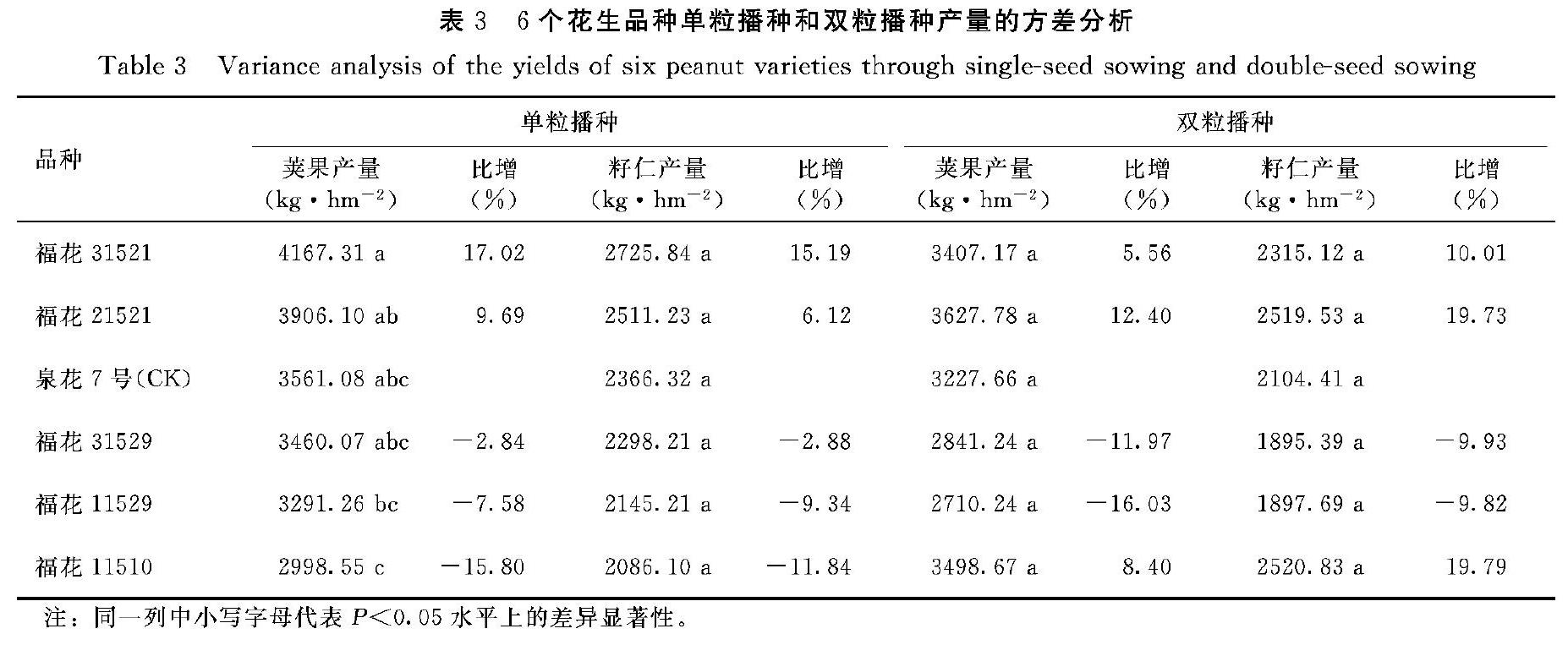
摘 要:為了明确福建气候条件花生单粒和双粒播种对产量和性状的影响,为单粒播种的品种选择及栽培技术提供理论依据。以南方生态区选育的6个珍珠豆型花生品种开展单粒和双粒播种对比试验,研究单、双粒播种对其产量和性状的影响,并采用灰色关联度分析了与经济性状关联的其他20个性状变化规律。结果表明:单粒播种较双粒播种能极显著提高株型指数、分枝数、结果枝数、荚果总数、单株荚果产量和单株籽仁产量(P<0.01),饱果率极显著降低(P<0.01),主茎高显著降低(P<0.05),秕果总数的增加是造成单粒播种荚果增加的主要因素,单粒播种能明显促进侧枝生长,导致百果重变小,双仁果率下降,出仁率降低;单双粒播种间荚果产量和籽仁产量均未达到显著差异,福花31521在单粒播种下能获得更高产量,而福花11510却在单粒播种下减产明显,表明品种存在适宜单粒和双粒播种不同的倾向性;灰色关联度分析表明,相比双粒播种,单粒播种的单仁饱果、双仁率、秕果总数和百仁重等4个性状对荚果产量和籽仁产量的关联系数上升较大,饱果总数、单株籽仁重和百果重等3个性状对荚果产量的关联系数下降明显,饱果总数和荚果总数等2个性状对籽仁产量的关联系数降低较大。因此,在单粒播种品种筛选及高产栽培生产过程中应注意这些性状的表现。
关键词:珍珠豆型花生;单粒播种;灰色关联度分析
中图分类号:S 565.2 文献标志码:A 文章编号:0253-2301(2021)06-0022-07
DOI: 10.13651/j.cnki.fjnykj.2021.06.004
Abstract: The effects of single-seed sowing and double-seed sowing on the yield and characters of peanut under the climatic conditions in Fujian were studied to provide theoretical basis for the variety selection and the cultivation techniques of single-seed sowing. The six varieties of pearl type of peanut were selected from the southern ecological zone to carry out the comparative experiment of single-seed sowing and double-seed sowing, thus to study the effects of the single-seed sowing and double-seed sowing on their yield and characters. And the change rules of other 20 characters related to the economic characters were analyzed by using the grey relational grade analysis. The results showed that the single-seed sowing could significantly increase the plant type index, the number of branches, the number of fruiting branches, total number of pods, pod yield per plant and seed kernel yield per plant (P<0.01), the full pod rate was significantly decreased (P<0.01), and the height of main stem was significantly decreased (P<0.05). The increase of the number of unfulfilled fruit was the main factor that caused the increase of pod per plant. The single-seed sowing could obviously promote the growth of lateral branches, resulting in the decrease of 100 fruit weight, the decrease of double kernel fruit rate, and the decrease of kernel yield. The 6 cultivars had different propensity to be suitable for the single-seed sowing and double-seed sowing. Not all the cultivars suitable for the double-seed sowing were suitable for the single-seed sowing. The pod yield of Fuhua 31521 and Fuhua 21521 were 17.02% and 9.69% higher than that of Quanhua No.7, respectively, and the seed kernel yield of Fuhua 31521 and Fuhua 21521 were 15.19% and 6.12% higher than that of the control Quanhua No.7, respectively. The grey relational grade analysis showed that compared with the double-seed sowing, the correlation coefficients of the four traits of single-seed sowing such as full fruit of single kernel, double kernel rate, total number of unfulfilled pod, and 100 kernel weight on the pod yield and seed kernel yield increased more significantly. The correlation coefficients of the three traits such as total number of full fruit, seed kernel weight per plant and 100 fruit weight on the seed kernel yield decreased significantly, while the correlation coefficients of the two traits such as total number of full fruit and total number of pods on the seed kernel yield decreased significantly. The peanut varieties suitable for the double-seed sowing were not all suitable for the single-seed sowing, and the single seed sowing could significantly change the agronomic traits of the varieties. The pod yield and seed kernel yield of Fuhua 31521 and Fuhua 21521 were both higher than those of the control Quanhua No.7, which could be used for wider regional tests and the related cultivation technology research.
Key words: Pearl type of peanut; Single-seed sowing; Grey relational grade analysis
花生是我国重要的油料作物和经济作物[1-2]。据FAO统计数据显示,我国2017年花生种植面积462.8万hm2,仅次于印度,位居世界第2,总产量1715.0万t,居世界第1,分别占世界的16.6%和36.4%。随着我国经济的发展和研究经费的投入,我国花生育种单位共同努力下,花生新品种推陈出新,品种个体优势越发明显,但种植户仍延续传统老品种的种植习惯,以1穴2粒甚至多粒花生播种,造成同穴群体恶性竞争,优势个体发育受限制。另外,传统播种用种量大,增加花生的生产成本,大粒花生品种一般需要种子300~375 kg·hm-2,中小粒型品种一般需要220~270 kg·hm-2,全国用于做种的花生约为150 万t·年-1,相当于全国花生总产量的10%左右,种子投入量占农资投入量的40%~50%[3-4]。因此,如果能在保持花生产量的条件下,改变传统习惯,采用花生单粒播种,可减少用种量,实现降低成本、提高经济效益的目的。……