活血化瘀法对膝骨性关节炎模型兔基质金属蛋白酶的影响
2021-08-23余毅张婷熊逸啸向振欧广洋潘波刘剑徐仪昕刘雅娟李梅琪余望贻
余毅 张婷 熊逸啸 向振 欧广洋 潘波 刘剑 徐仪昕 刘雅娟 李梅琪 余望贻
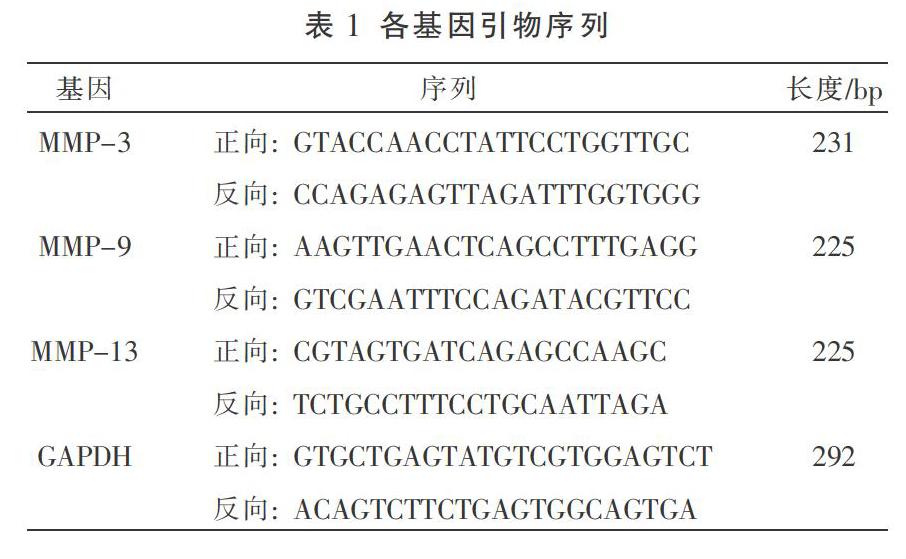
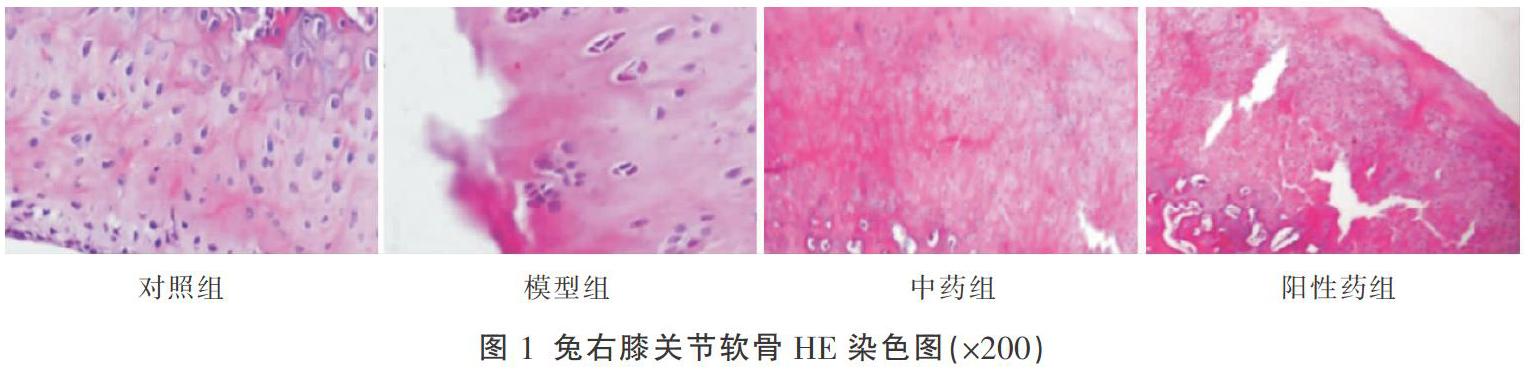
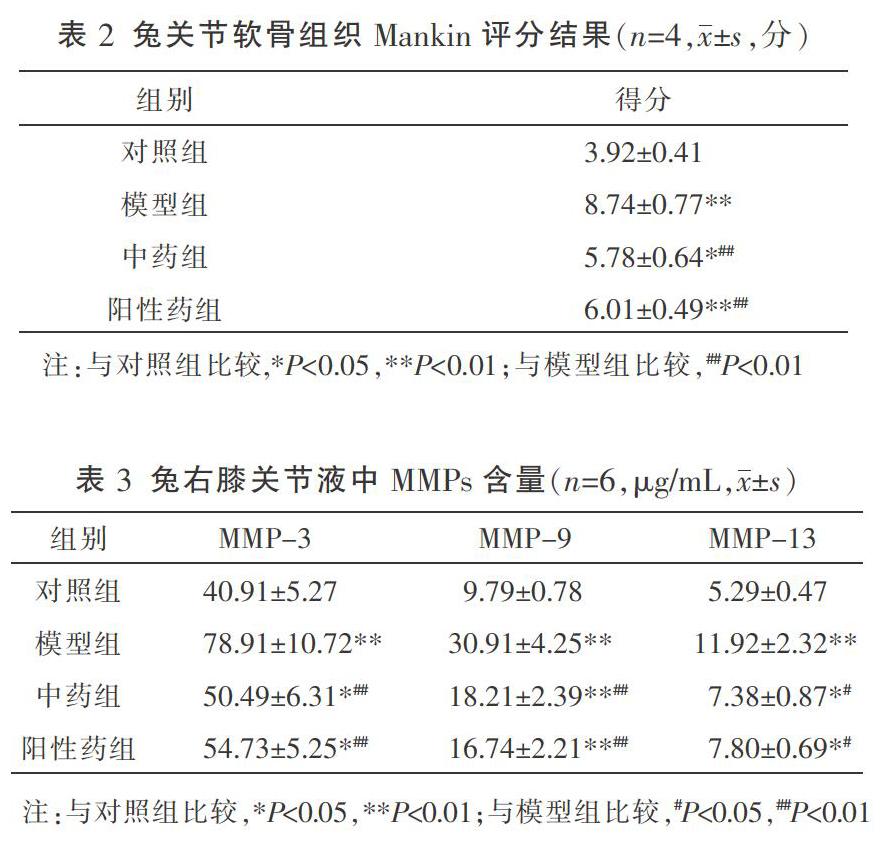
〔摘要〕 目的 研究活血化瘀法對膝骨性关节炎模型兔基质金属蛋白酶(matrix metalloproteinase, MMPs)的影响。方法 将32只新西兰兔分为对照组、模型组、中药组、阳性药组,每组8只。采用改良Hulth造模法建立兔膝骨性关节炎模型,给予药物治疗28 d。中药组给予活血化瘀合剂(1.4 g/kg),阳性药组给予硫酸氨基葡萄糖溶液(0.07 mg/kg),对照组及模型组给予等体积蒸馏水。给药结束后,取兔右后膝关节软骨行HE染色,用于组织病理分析;收集关节液,采用ELISA法检测MMP-3、MMP-9、MMP-13的含量;采用Western blot和RT-qPCR法分别检测兔关节软骨MMP-3、MMP-9、MMP-13蛋白及mRNA水平。结果 与对照组比较,模型组兔关节软骨存在浅表层纤维化,软骨细胞成簇、排列无规则、部分坏死,滑膜增厚,基质染色丢失等病理现象,关节液MMP-3、MMP-9、MMP-13含量较对照组显著升高(P<0.01),其蛋白及mRNA表达在关节软骨中也显著上升(P<0.01);与模型组比较,中药组兔关节软骨病理损伤得以缓解,关节液MMP-3、MMP-9、MMP-13含量明显下降(P<0.01或P<0.05),关节软骨MMP-3、MMP-9蛋白及mRNA表达均下调(P<0.01),MMP-13 mRNA表达下调(P<0.05);与中药组比较,阳性药组MMP-13 mRNA表达水平显著降低(P<0.05)。结论 活血化瘀法能缓解膝骨性关节炎模型兔关节软骨的损伤,其机制可能与抑制MMPs的表达,尤其是MMP-3和MMP-9表达有关。
〔关键词〕 膝骨性关节炎;活血化瘀;基质金属蛋白酶;关节软骨;关节液
〔中图分类号〕R255.6 〔文献标志码〕A 〔文章编号〕doi:10.3969/j.issn.1674-070X.2021.07.005
〔Abstract〕 Objective To study the effects of Huoxue Huayu method on matrix metalloproteinase (MMPs) in rabbit model of knee osteoarthritis. Methods 32 New Zealand rabbits were divided into control group, model group, Chinese medicine group and positive drug group, with 8 rats in each group. A rabbit model of knee osteoarthritis was established by modified Hulth modeling method, followed by drug treatment for 28 days. The Chinese medicine group was given Huoxue Huayu Mixture (1.4 g/kg), the positive drug group was given glucosamine sulfate solution (0.07 mg/kg), and the control group and the model group were given equal volume of distilled water. At the end of the administration, rabbit right posterior knee articular cartilage was taken for histopathological analysis through HE staining, and the content of MMP-3, MMP-9 and MMP-13 of synovial fluid was detected by ELISA; Western blot and RT-qPCR were used to detect MMP-3, MMP-9, MMP-13 protein and mRNA levels in rabbit articular cartilage. Results There were superficial fibrosis in the articular cartilage of rabbits in the model group compared with the control group, the chondrocytes were clustered, arranged irregularly, partially necrotic, thickened synovial, and lost in matrix staining, the content of MMP-3, MMP-9 and MMP-13 in synovial fluid was higher than control group (P<0.01), and the protein and mRNA expression in the articular cartilage also increased significantly (P<0.01); compared with the model group, the pathological damage of rabbit articular cartilage of Chinese medicine group was relieved, and the content of MMP-3, MMP-9 and MMP-13 in joint fluid decreased significantly (P<0.01 or P<0.05), articular cartilage MMP-3, MMP-9 protein and mRNA expression were down-regulated (P<0.01), and MMP-13 mRNA expression was down-regulated (P<0.05); compared with the Chinese medicine group, MMP-13 mRNA expression in positive drug group was down-regulated (P<0.05). Conclusion Huoxue Huayu method can alleviate the damage of articular cartilage in rabbits with knee osteoarthritis model, and its mechanism may be related to the inhibition of MMPs expression, especially the expression of MMP-3 and MMP-9.
〔Keywords〕 knee osteoarthritis; Huoxue Huayu; matrix metalloproteinase; articular cartilage; joint fluid
膝骨性关节炎是由于膝关节局部损伤、炎症或慢性劳损引起的软骨变性及活动障碍的慢性退行性骨关节病,在老年人中患病率高达50%[1]。软骨组织损伤是膝骨性关节炎的重要病理特征,基质金属蛋白酶(matrix metalloproteinase, MMPs)在软骨基质降解过程中发挥了关键作用[2-3]。因而,抑制MMPs表达能保护软骨组织,恢复膝骨关节的正常活动。膝骨性关节炎属中医学“痹证”范畴,气滞血瘀是其主要病机,治宜活血化瘀,基于此理法而成的消炎散是湖南中医药大学第一附属医院院内制剂,已使用40余年,全方由近20味中藥组成,具活血凉血、散瘀止痛之功,临床疗效显著[4]。……