时间领导对员工建言行为的影响研究
2021-08-16韩健一
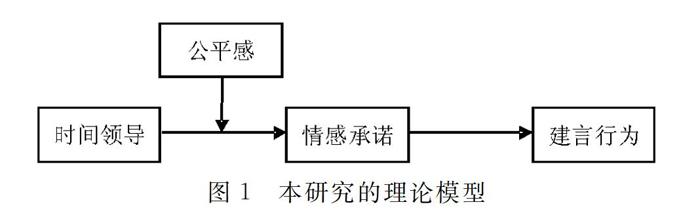

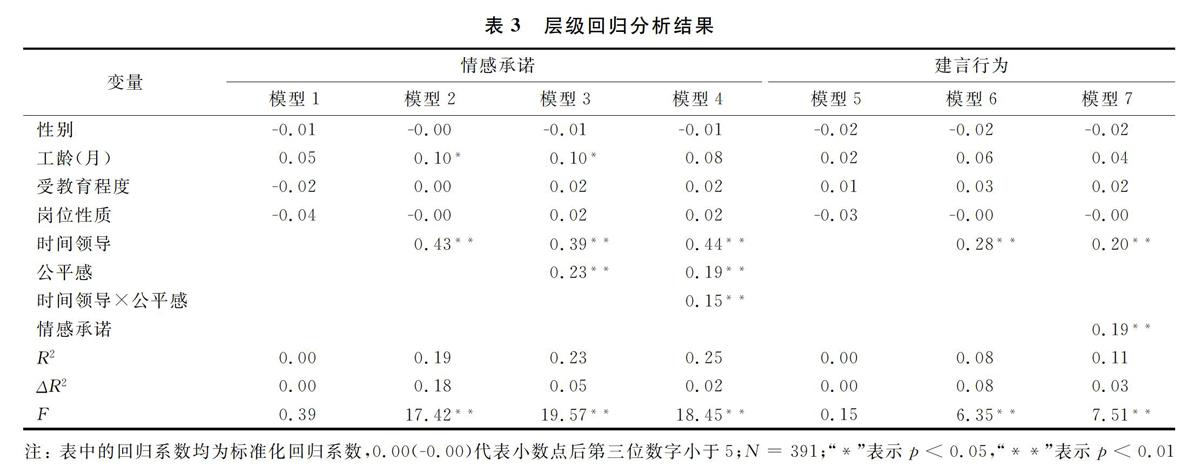
摘 要: 基于工作要求-资源模型和社会认知理论,采用问卷调查法分阶段收集了391份员工数据,探讨了时间领导对员工建言行为的影响机制,并分析了情感承诺的中介作用和公平感的调节作用。结果表明: (1) 时间领导对员工建言行为有正向影响;(2) 情感承诺在时间领导与员工建言行为之间起到部分中介作用;(3) 公平感对时间领导与情感承诺之间的关系起正向调节作用;(4) 公平感会调节情感承诺在时间领导与员工建言行为之间的中介作用,当员工有较强的公平感时,时间领导通过情感承诺影响员工建言行为的中介作用更强。研究结果丰富了时间领导的相关理论,对于促进员工建言有着重要的理论意义和实践意义。
关键词: 时间领导;建言行为;情感承诺;公平感
中图分类号: C 939
文献标志码: A
The Effect of Temporal Leadership on Employee Voice Behavior
HAN Jianyi
(Antai College of Economics & Management,Shanghai Jiao Tong University,Shanghai 200030, China)
Abstract: Based on job demands-resources model and social cognitive theory, this study examines how temporal leadership influences employee voice behavior, with the mediating effect of affective commitment and the moderating role of fairness perceptions. Data were collected from a time-lagged questionnaire design of 391 employees in China. The empirical results indicated that: (1) Temporal leadership had positive effect on employee voice behavior. (2) Affective commitment mediated the relationship between temporal leadership and voice behavior. (3) Fairness perceptions positively moderated the relationship between temporal leadership and affective commitment. (4) The indirect effect of temporal leadership on voice behavior via affective commitment was stronger when employees perceived effort-reward fairness. This study enriched temporal leadership literatures and provided both theoretical and practical implications for voice management.
Key words: temporal leadership; voice behavior; affective commitment; fairness perceptions
本研究聚焦一线员工的工作情境,探究时间领导对员工建言行为的影响。为了分析这一过程的作用机制,本研究基于工作要求-资源模型引入情感承诺这一变量,讨论其在时间领导影响员工建言行为的过程中发挥的中介作用。此外,考虑到员工十分关心他们在工作中被对待的方式,本研究引入公平感作为调节变量,探究时间领导如何影响公平感知不同的员工的建言行为,弥补现有研究对时间领导影响作用边界条件讨论的不足。通过提出一个被调节的中介模型,本研究期望在阐明时间领导对员工建言行为影响作用的同时,也能为组织中的领导有效促进员工建言提供指导与帮助。……