华南龙眼叶片营养诊断指标的建立
2021-08-06朱永聪王伟周昌敏白翠华姚丽贤
朱永聪 王伟 周昌敏 白翠华 姚丽贤

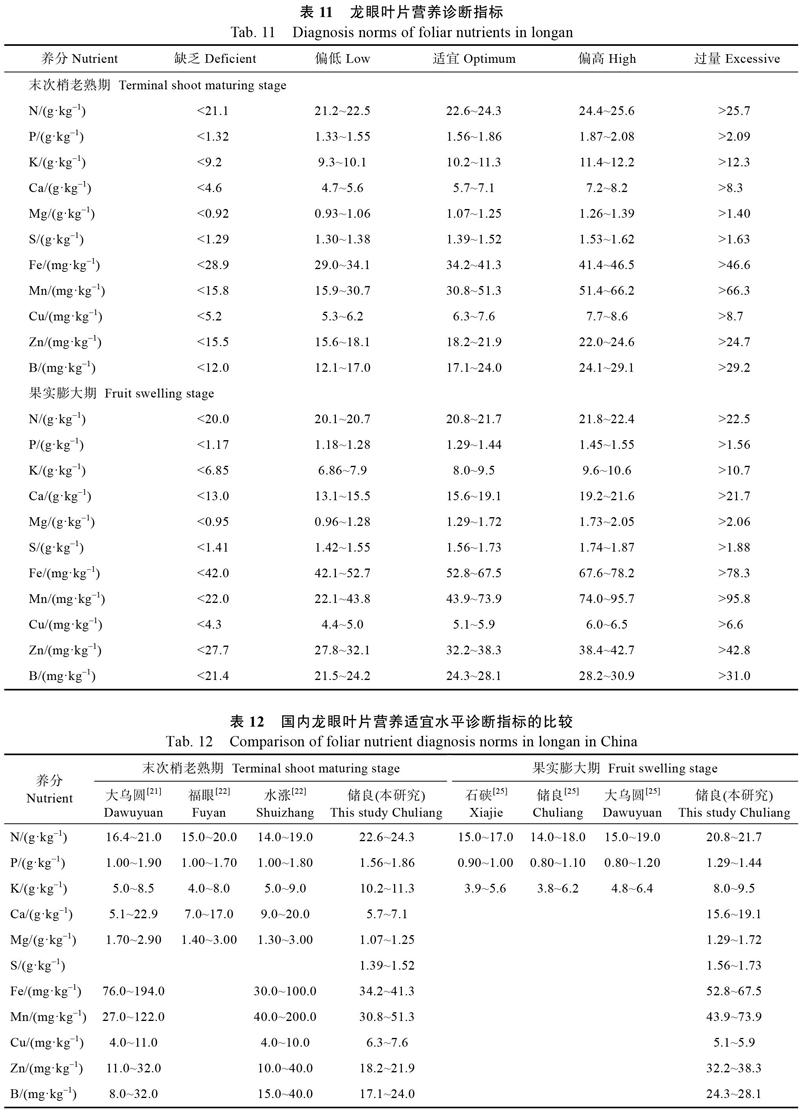
摘 要:比较4种叶片营养诊断方法在龙眼上应用的优缺点,确定适用于龙眼的营养诊断方法并建立诊断指标,为华南龙眼叶片营养诊断和养分管理提供科学依据。2017—2019年在华南主产区分别采集2次末次梢老熟期和果实膨大期龙眼叶片样本,测定大、中、微量元素含量,记录果实产量,建立产量与叶片养分含量关系函数;利用4种叶片营养诊断方法[临界值法(CVA)、充足范围法(SRA)、诊断施肥综合法(M-DRIS)、组分营养诊断法(CND)],分别对2年4个时期叶片营养状况进行诊断。结果表明,龙眼年际产量变异大,不同年份同一生育期及同年不同生育期叶片多数养分含量差异显著,但2年高产群体叶片养分含量较为接近。根据产量与叶片养分含量关系模型,CVA仅获得少数养分的诊断指标,M-DRIS和CND只能定性列出养分需求顺序,而且诊断准确性与诊断时期、养分丰缺程度有关且年际差异很大,SRA可获得所有养分诊断指标,而且2年指标接近。故SRA可用于龙眼叶片营养诊断,并用该法建立末次梢老熟期和果实膨大期龙眼叶片养分诊断指标体系。用该法获得龙眼末次梢老熟期叶片养分适宜水平为N 22.6~24.3 g/kg、P 1.56~ 1.86 g/kg、K 10.2~11.3 g/kg、Ca 5.7~7.1 g/kg、Mg 1.07~1.25 g/kg、S 1.39~1.52 g/kg、Fe 34.2~ 41.3 mg/kg、Mn 30.8~ 51.3 mg/kg、Cu 6.3~7.6 mg/kg、Zn 18.2~21.9 mg/kg、B 17.1~24.0 mg/kg;果實膨大期叶片养分适宜范围为N 20.8~21.7 g/kg、P 1.29~1.44 g/kg、K 8.0~9.5 g/kg、Ca 15.6~19.1 g/kg、Mg 1.29~17.20 g/kg、S 1.56~1.73 g/kg、Fe 52.8~67.5 mg/kg、Mn 43.9~73.9 mg/kg、Cu 5.1~5.9 mg/kg、Zn 32.2~38.3 mg/kg、B 24.3~28.1 mg/kg。
关键词:龙眼;叶片营养诊断;诊断指标;充足范围法
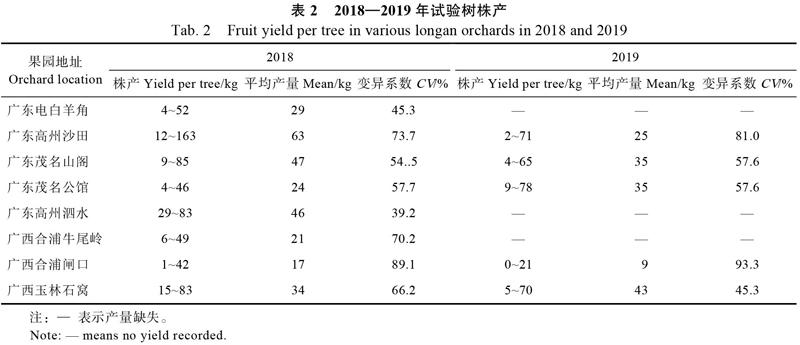
Abstract: Foliar nutrient diagnosis has been developed and utilized in crops for decades. Four methods including the critical value approach (CVA), sufficiency range approach (SRA), modified diagnosis and recommendation integrated system (M-DRIS), and compositional nutrient diagnosis (CND) are commonly adopted to evaluate the leaf nutrient status in crops. The availability and reliability of the four foliar nutrient diagnosis approaches were compared in longan in southern China, with the aim to (1) select the suitable diagnosis method for longan; (2) establish the foliar diagnosis norm; and (3) provide scientific base for nutrient management in longan in southern China. Eight typical longan orchards, located in the main production regions of South China, were chosen in this study during 2017 to 2019. 82 leaf samples at both terminal shoot maturing stage (TSMS) of 2017 and fruit swelling stage (FSS) of 2018, and 49 leaf samples at FSS of 2018 and at TSMS of 2019 were collected, respectively. Foliar nutrient (N, P, K, Ca, Mg, S, Fe, Mn, Cu, Zn and B) concentration in all samples was detected. The fruit yield was recorded for each sampled tree at harvest in 2018 and 2019. The fruit yield in each orchard was calculated by multiplying the yield per tree and the plantation density in the orchard. The high yield population for nutrient diagnosis in both years was determined by cluster analysis in fruit yield. Then, the relationship between fruit yield and leaf nutrient concentration was calculated. Further, the above four approaches were used to assess the foliar nutrient status of longan at four stages within two years, respectively. Irregular fruit bearing was commonly observed in most sampled orchards. The maximum concentrations of foliar nutrients were 2-fold to more than 10-fold higher than the minimum levels in the sampled trees at the same growth stage. Significant difference was observed in foliar nutrient contents at FSS and TSMS between 2018 and 2019, respectively. However, the high yield population in both years was characterized by relatively constant foliar nutrient concentrations. Based on the relationship between fruit yield and foliar nutrient concentration, diagnosis indices of a few foliar nutrients were obtained by CVA. The necessity of foliar nutrients was qualitatively evaluated by M-DRIS and CND. Moreover, the diagnosis accuracy for nutrients was related to the diagnosis stage and the severity of nutrient deficiency or abundance, with significant yearly variation. In contrast, diagnosis indices for all nutrients could be calculated by SRA, and maintained relatively stable at FSS or TSMS of both years, regardless of the annual variation of fruit yields. SRA is accepted to compute the foliar nutrient diagnosis norms for longan due to its universal diagnosis indexes with small annual variation and practicability in practice. According to SRA, the optimum foliar nutrient contents for longan in southern China are recommended as N 22.6-24.3 g/kg, P 1.56-1.86 g/kg, K 10.2-11.3 g/kg, Ca 5.7-7.1 g/kg, Mg 1.07-1.25 g/kg, S 1.39-1.52 g/kg, Fe 34.2-41.3 mg/kg, Mn 30.8-51.3 mg/kg, Cu 6.3-7.6 mg/kg, Zn 18.2-21.9 mg/kg, B 17.1-24.0 mg/kg at TSMS, and N 20.8-21.7 g/kg, P 1.29-1.44 g/kg, K 8.0-9.5 g/kg, Ca 15.6-19.1 g/kg, Mg 1.29-17.20 g/kg, S 1.56-1.73 g/kg, Fe 52.8-67.5 mg/kg, Mn 43.9-73.9 mg/kg, Cu 5.1-5.9 mg/kg, Zn 32.2-38.3 mg/kg, B 24.3-28.1 mg/kg at FSS.
Keywords: longan; foliar nutrient diagnosis; diagnosis index; sufficiency range approach
龙眼是国际上重要的热带亚热带水果。我国龙眼总产量和种植面积均居世界首位[1],但单产低,大小年挂果现象较为严重。从栽培面积上看,龙眼作为我国热带区域第四大水果,仅低于荔枝、柑橘橙和香蕉,但单位面积产量仅为6530.1 kg/hm2,大大低于同为木本果树的柑橘橙的14 702 kg/hm2,仅高于同为无患子科的荔枝(4824 kg/hm2)[2]。……