恢复生长与电导法结合分析橡胶树抗寒性研究
2021-08-06李玲桂明春管艳毛常丽田海张凤良吴裕段安安梁国平
李玲 桂明春 管艳 毛常丽 田海 张凤良 吴裕 段安安 梁国平
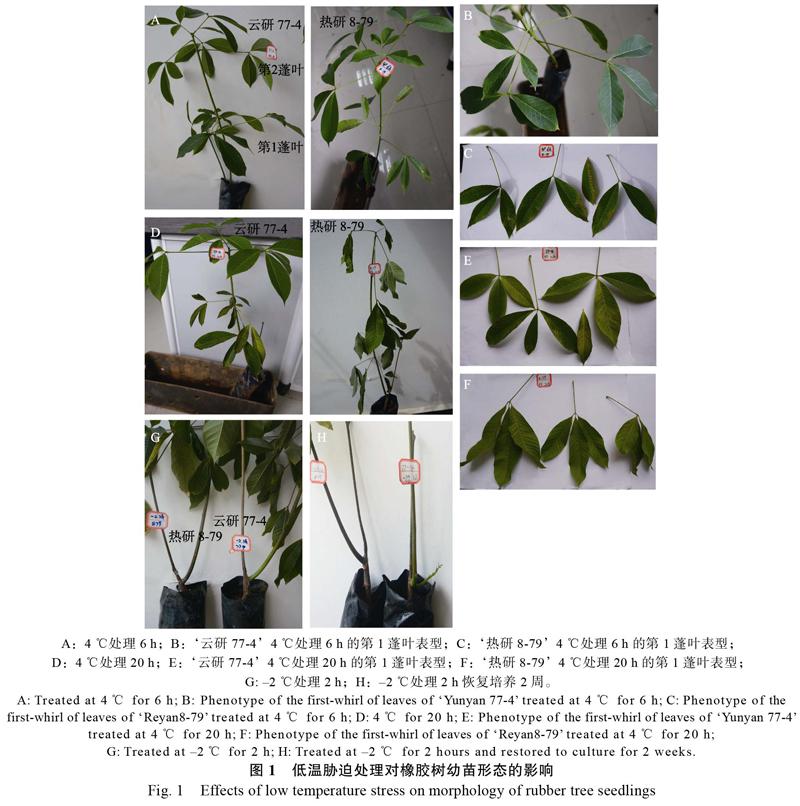
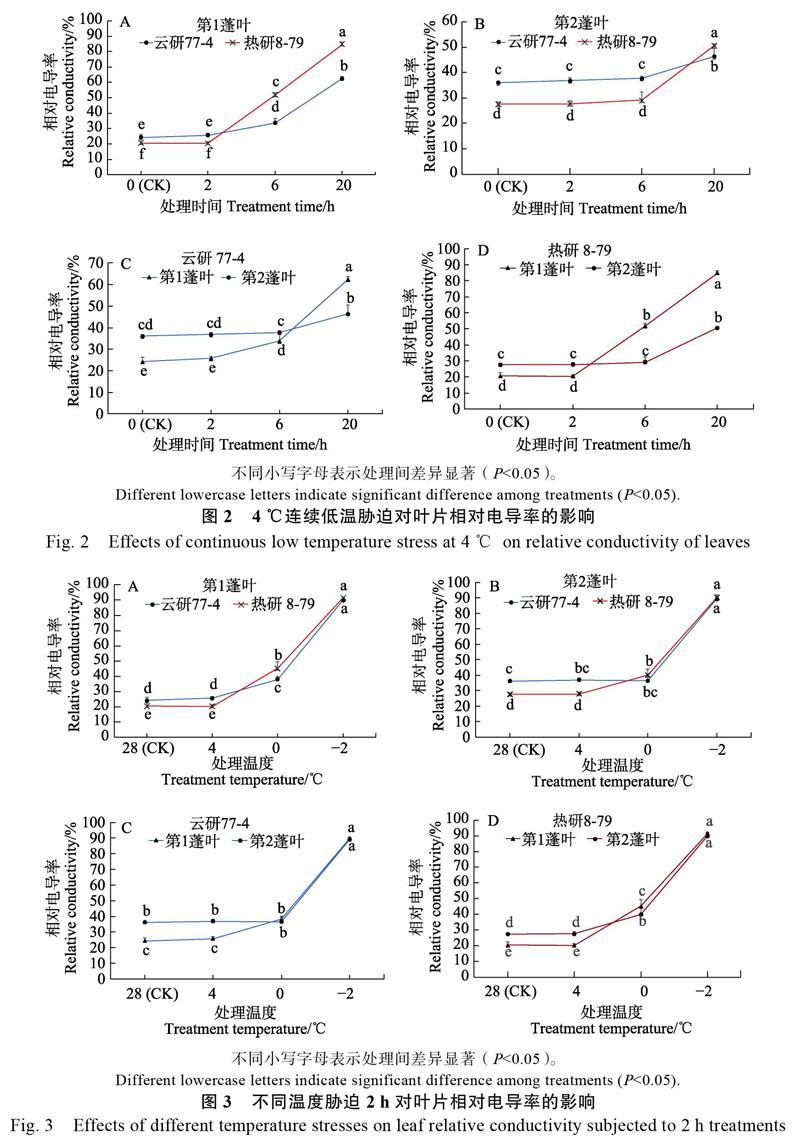

摘 要:研究低温胁迫下,橡胶树(Hevea brasiliensis Muell. Arg.)不同组织的抗寒性情况以及品种间的差异,为进一步研究橡胶树的冷敏感性或耐受机制奠定基础。以橡胶树‘云研77-4和‘热研8-79无性系幼苗为材料,进行不同低温类型的室内低温胁迫处理,对橡胶树不同叶片和茎杆组织进行电导率测定,并结合恢复生长法进行不同组织器官及无性系间抗寒性分析。结果表明:恢复生长实验结果与电导法鉴定橡胶树幼苗不同组织及品种间抗寒性强弱的结果一致,随着低温胁迫时间的延长和胁迫温度的下降,橡胶树2个无性系叶片和茎杆的相对电导率呈上升趋势,‘热研8-79的增幅大于‘云研77-4,恢复生长后‘热研8-79植株受害程度重于‘云研77-4,‘云研77-4的抗寒性强于‘热研8-79;橡胶树幼苗不同组织器官对低温胁迫响应的敏感度不同,表现为叶片受害早于茎杆,两蓬叶稳定期的幼苗第2蓬叶耐寒性强于第1蓬叶。研究结果为橡胶树品种抗寒性鉴定及进一步研究抗寒机制提供了材料选择和低温处理参考方法。
关键词:橡胶树;低温胁迫;抗寒性;幼苗形态;品种差异
Abstract: To study the cold resistance of different tissues of rubber tree (Hevea brasiliensis Muell. Arg.) under low temperature stress and the differences among varieties, the ‘Yunyan 77-4 and ‘Reyan 8-79 grafted saplings were subjected to different types of indoor low-temperature to determine the relative conductivity of different leaves and stem tissues of rubber trees. The cold resistance of different tissues, and clones in combination with the recovery were evaluated. The results showed that the results of the recovery growth experiments were consistent with the results of identifying the cold resistance between different tissues and varieties of rubber tree seedlings by the conductivity method. With the extension of low temperature stress treatment time and decrease of the treatment temperature, the relative conductivity of the leaves and stems of the two clones of the rubber tree showed an upward trend. The increase of ‘Reyan 8-79 relative conductivity was higher than that of ‘Yunyan 77-4, and ‘Yunyan 77-4 was more resistant to cold than ‘Reyan 8-79. After the restoration, the ‘Reyan 8-79 plant was more severely damaged than the ‘Yunyan 77-4. Different rubber tree tissues had different sensitivity to low temperature stress, with the leaves damaged earlier than stems, and the second-whirl of leaves more invulnerable than the first-whirl of leaves. The results would provide reference methods for material selection and low temperature treatment for cold resistance identification and cold resistance mechanism of rubber tree varieties.
Keywords: Hevea brasiliensis; low temperature stress; cold resistance; seedling morphology; variety differences
橡胶树(Hevea brasiliensis Muell. Arg.)是典型的热带雨林乔木树种,生长和产胶的适宜温度为20~30 ℃,橡胶树能够正常生长和发育的临界温度为18 ℃,当下降至5 ℃时橡胶树开始出现不同程度的寒害症状,温度低于0 ℃时树梢和树干枯死,发生严重寒害甚至导致部分不耐寒品系死亡[1]。低温胁迫是限制橡胶树生长发育、产量和地理分布的主要环境胁迫因素[2-3]。……