人行桥振动控制研究及TMD性能提升
2021-07-22祁鑫温金龙
祁鑫 温金龙
摘 要:随着社会进步,轻质、大跨度人行桥越来越多,其低频、低阻尼的动力特性更容易遭受人致荷载的影响,引发舒适度等振动问题。为了更好地精准评估结构舒适度,系统研究人-结构在耦合系统中的相互作用,认为以M-SD模型来模拟真实行人具备一定可信度。作为人行桥振动控制常见被动减振装置TMD,从阻尼元件性能提升和质量元件效应放大等方面不断进行改良并取得了一定的成绩。
关键词:动力特性;舒适度评估;TMD性能提升
中图分类号:U441.3文献标识码:A文章编号:1003-5168(2021)08-0079-03
Research on Vibration Control of Footbridge and
Application and Improvement of TMD
QI Xin WEN Jinlong
(School of Civil Engineering and Transportation North China University of Water Resources and Electric Power,Zhengzhou Henan 450045)
Abstract: With the progress of society, the lightweight and long-span pedestrian bridges become normal. Due to the dynamic characteristics (low frequency and low damping), these bridges are more vulnerable to human-induced loads, resulting in vibration problems such as vibration serviceability. For reach an accurately evaluation of the vibration serviceability, the vertical interaction of human-structure has been systematically studied. It is believed that the M-SD model is reliable to simulate real pedestrians and has obtain widely applied. As a common passive vibration device for vibration control, TMD has been continuously improved in improvement of damping components and the amplification of mass component effect.
Keywords: dynamic characteristics;vibration serviceability evaluation;improvement of TMD
1 人行橋发展趋势
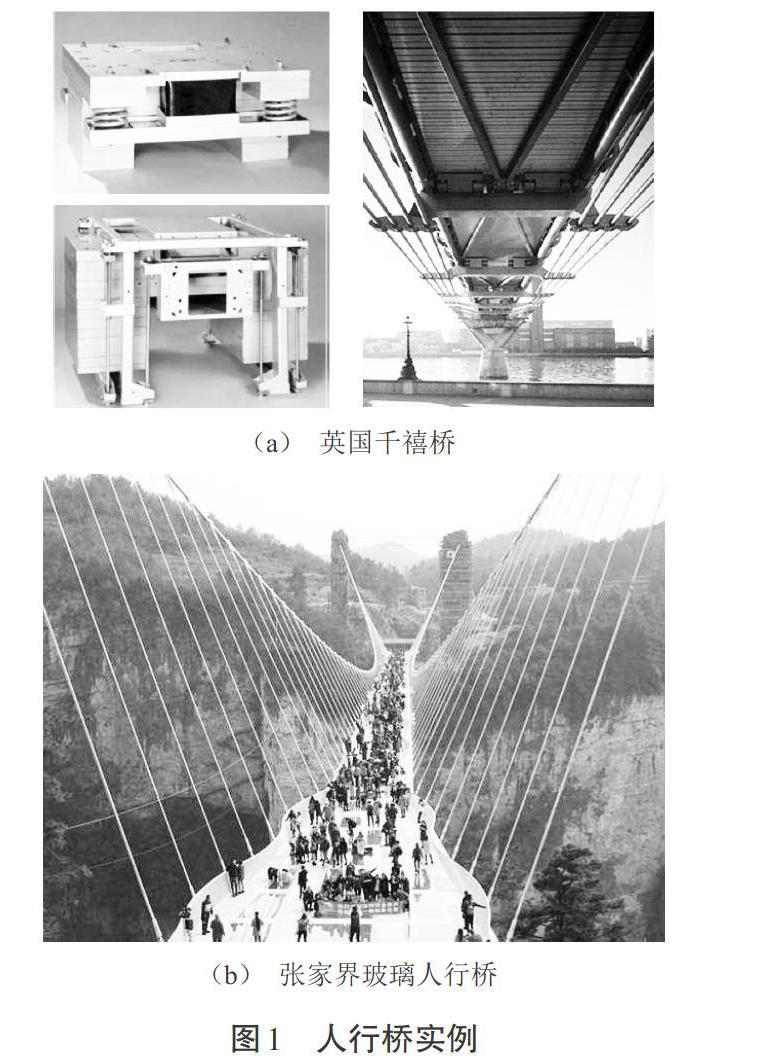
近年来,社会经济迅速发展,新型轻质高强建筑材料的质量和建造水平逐渐提高,现代化立体交通概念不断推广,建筑美学品位提升,使得大跨、纤细以及轻柔等特点正逐渐成为工程结构发展方向[1]。由于城市发展和车道拓宽及人行安全的需要,越来越多的大跨度人行桥出现在人群视野中。刚度较低使得大跨度人行桥在地震作用、风致荷载以及人行荷载等动力荷载作用下易产生振动,引起疲劳性动力损伤问题。这不仅会缩短建筑结构的使用寿命,而且可能导致结构的破坏性损伤,同时振动直接作用于人体时会令人产生不适感,出现舒适度问题。
轻质、大跨等特点使得部分人行桥的一阶竖向频率为1.9~2.5 Hz[2]。已知人行走时活动频率为1.5~2.5 Hz,人行桥服役期桥面上行人运动状态各异,当人流较大且其人行荷载频率等于或接近建筑结构的固有频率时,桥梁将会发生共振现象,导致桥面板产生较大幅度的振动。……